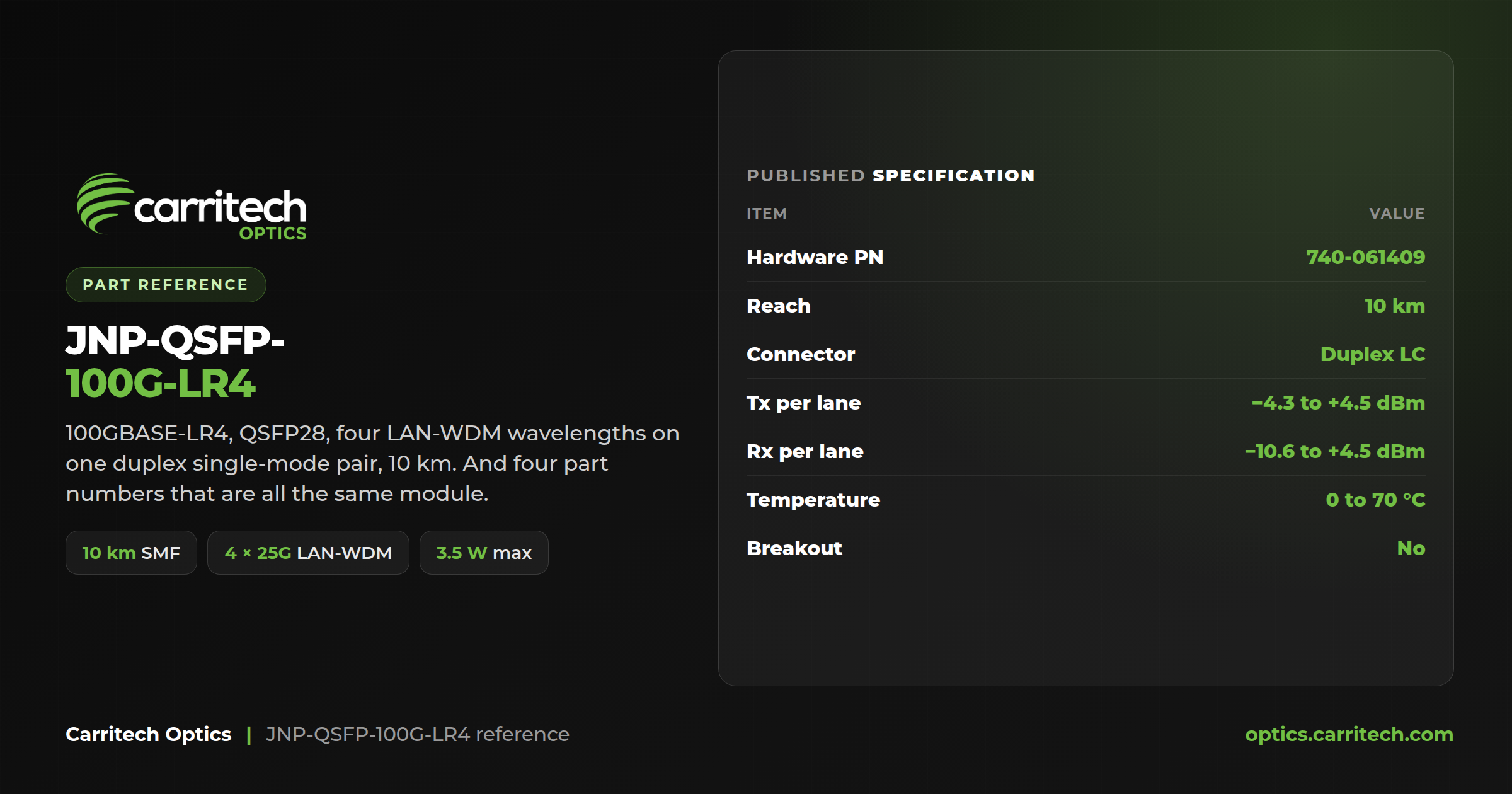
JNP-QSFP-100G-LR4 is a 100GBASE-LR4 QSFP28 transceiver: four wavelengths, one duplex single-mode pair, 10 kilometres. That part is straightforward.
What is not straightforward is that Juniper has published four names that resolve to the same physical module, and three more that look almost identical and are genuinely different parts. People order across those boundaries constantly, and two of the crossings leave you with a module that seats perfectly and never links.
This is the specification, every part number in the family, which ones are interchangeable, and the two places the documentation contradicts itself.
JNP-QSFP-100G-LR4 specification
Everything below is from the Hardware Compatibility Tool entry for the part y its published hardware specifications.
| Item | Valor |
| Standard | 100GBASE-LR4 |
| Factor de forma | QSFP28 |
| Hardware part number | 740-061409 |
| Llegue a | 10 km |
| Fibre | Single-mode, 9/125 µm |
| Conector | Duplex LC, PC/UPC |
| Lanes | 4 × 25G, LAN-WDM |
| Longitudes de onda | 1294.53–1296.59 · 1299.02–1301.09 · 1303.54–1305.63 · 1308.09–1310.19 nm |
| Transmit power, per lane | −4.3 to +4.5 dBm |
| Receive power, per lane | −10.6 to +4.5 dBm |
| Operating temperature | 0 to 70 °C |
| Consumo de energía | 3.5 W maximum |
| DOM | Supported |
| Breakout capable | No |
The standard behind it is IEEE 802.3ba-2010, which added 40G and 100G Ethernet and introduced Clauses 80 through 88; 100GBASE-LR4 is the Clause 88 PMD. Nominal LAN-WDM centre wavelengths are 1295.56, 1300.05, 1304.58 and 1309.14 nm — the ranges in the table are the tolerance windows around them.
Two details worth pulling out of that table, because they cause support calls.
Receive power tops out at +4.5 dBm. A receiver has a maximum as well as a minimum, and on a short single-mode patch between two LR4 modules you can be close to it. A 10 km part used across a data hall is an attenuator conversation, not a fault.
The part is not breakout capable. LR4 carries its four lanes as four wavelengths on one fibre pair, so there is nothing physically to fan out. That matters more than it sounds — see the contradictions below.
JNP-QSFP-100G-LR4 and the part numbers that are the same optic
This is the reason the article exists. Four names lead to hardware part number 740-061409:
| Part number | Published description | Hardware PN |
| JNP-QSFP-100G-LR4 | QSFP28 100GBase-LR4 Optics for up to 10km transmission over serial SMF | 740-061409 |
| QSFP-100G-LR4-C | QSFP-28, 100G-LR4 Transceiver | 740-061409 |
| QSFP-100G-LR4-T2 | 100G-LR4 Ethernet only QSFP28 Module T2 | 740-061409 |
| QSFP-100GBASE-LR4 | 100GBASE-LR4 QSFP28 pluggable module, support only Ethernet rate | not published |
Both JNP-QSFP-100G-LR4 and QSFP-100GBASE-LR4 list QSFP-100G-LR4-C as their “Common Optic Equivalent” — a plain statement that the naming eras converge on one module. The -C suffix denotes the common optics portfolio, a consolidation of parts that had accumulated separate SKUs across product lines.
So if a bill of materials calls for QSFP-100GBASE-LR4 and the quote comes back as JNP-QSFP-100G-LR4, that is not a substitution needing sign-off. It is the same optic under a newer name.
The part numbers that are not the same optic
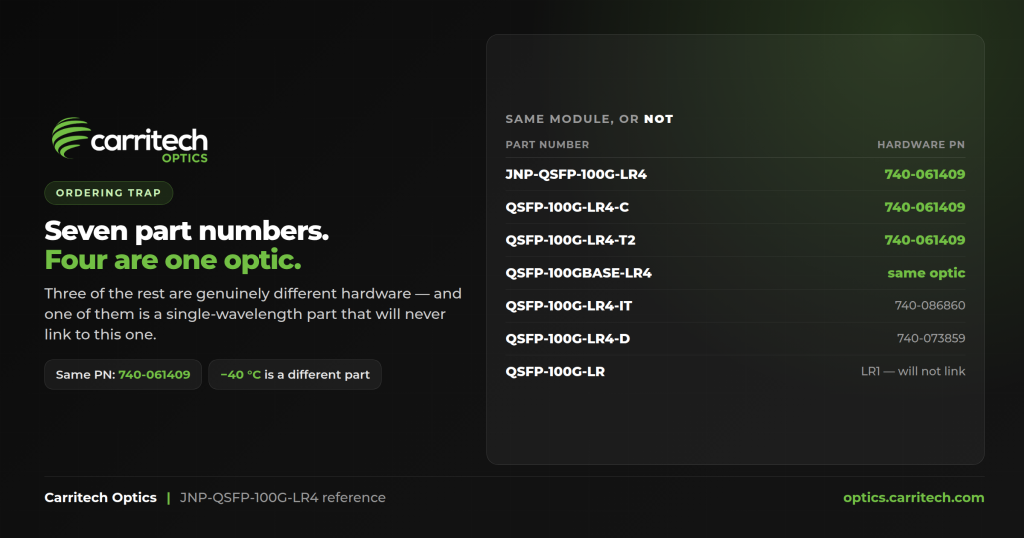
The JNP-QSFP-100G-LR4 part number family — which names are the same module and which are genuinely different parts
Three more names sit one or two characters away and are different hardware:
| Part number | What is different | Hardware PN |
| QSFP-100G-LR4-IT | Industrial temperature, −40 to +85 °C, 4.5 W | 740-086860 |
| QSFP-100G-LR4-D | Adds OTN rate support, not Ethernet only. End of life | 740-073859 |
| QSFP-100G-LR4-ET | Extended temperature, −5 to +85 °C. End of life | not published |
The -IT part is the one that matters commercially. It has a different hardware part number, a wider temperature range and a higher power draw, and it exists because somebody specified an optic for a cabinet that is not climate controlled. Dropping a 0–70 °C part into that role is not a like-for-like swap, however similar the description reads.
And one more, which is the crossing that actually breaks links:
QSFP-100G-LR4 is not QSFP-100G-LR. The latter is 100GBASE-LR1, hardware part number 740-096178 — a single-wavelength 100G optic. Same 10 km, same duplex LC, same single-mode fibre, documented as running media-side RS(544,514) FEC with host-side CAUI-4 and no FEC. An LR1 will not link to an LR4. Four wavelengths cannot talk to one, and no amount of re-seating changes that. Two part numbers, two characters apart, and the failure looks exactly like a dead module.
Two places the documentation contradicts itself
Recording these because automated tooling — ours included — will otherwise inherit them.
Operating temperature. JNP-QSFP-100G-LR4 is published at 0 to 70 °C. QSFP-100GBASE-LR4 is published at 0 to 75 °C. Both name QSFP-100G-LR4-C as the same common optic, so they cannot both be right about the same module. If a deployment is genuinely near the top of that range, design to 70 °C.
Breakout. The compatibility tool marks JNP-QSFP-100G-LR4 “Breakout Capable: No”, which is correct — it is a WDM part on a duplex pair. But the 100G optics and cables guide states in prose that 100G transceivers in the QSFP28 form factor support breakout to 4×25G, 2×50G or 1×100G. Read as a blanket claim about the form factor, that is a trap: it is true of parallel QSFP28 optics such as SR4 and PSM4, and false of every WDM part sitting in the same cage. The form factor does not determine breakout. The lane structure does.
One gap worth naming rather than papering over: EX-QSFP-100G-LR4 appears as a valid tool URL, but there is no published description, hardware part number or specification behind it. Every substantive description we could find sits on reseller sites, so we are not going to assert what it is.
When a JNP-QSFP-100G-LR4 link will not come up
Five checks, in the order that resolves fastest. Most 100G LR4 faults are one of the first three, and none of them requires swapping the module.
1. Confirm both ends are LR4. Not LR1, not FR4, not CWDM4. Four LAN-WDM wavelengths at 1295–1310 nm only link to four LAN-WDM wavelengths. The optic reports what it is over DOM, so read it from the interface rather than from the label on the cage — a mis-coded or mis-recorded module is exactly the case where the printed label and the EEPROM disagree.
2. Read the receive power at both ends. LR4 wants between −10.6 and +4.5 dBm per lane. Below the floor is a loss problem — dirty end faces, a bad splice, too many patch panels. Above the ceiling is a short-link problem, and it is the one people do not look for because the light is obviously arriving.
3. Clean the end faces, then read it again. Contamination is the single most common cause of loss on single-mode, and a 10 km-class link has less margin to absorb it than a short multimode hop. IEC 61300-3-35 sets the visual inspection criteria most test kits grade against; the Asociación de Fibra Óptica has the practical procedure.
4. Check the fibre is single-mode, end to end. An LR4 will not work down multimode, and in a mixed plant the patch lead in the cabinet is where the mode mismatch usually hides.
5. Only then look at FEC and platform configuration. LR4 is a legacy CAUI-4 interface without FEC, which is different from the newer single-lambda 100G parts that run RS(544,514) on the media side. If the platform has been configured for a FEC mode the optic does not expect, the link stays down and logs nothing useful about the transceiver.
The JNP-QSFP-100G-LR4 compatible equivalent
Carritech’s equivalent is CT-QSFP28-LR4 — 100GBASE-LR4, QSFP28, four LAN-WDM wavelengths, duplex LC, 10 km on single-mode. Same standard, same lane structure, same connector, same reach.
You can check JNP-QSFP-100G-LR4 in the compatibility checker and see the match with its specification alongside. The same product carries the equivalents from the other vendors whose part numbers turn up on mixed estates, which is usually the more useful answer when you are reconciling a bill of materials rather than buying one module.
On support, the published position is that JTAC does not provide support for third-party optical modules and cables that are not qualified or supplied by Juniper Networks, and that damage to host equipment arising from their use is the user’s responsibility. That is a statement about the module, and a reasonable one — they did not sell you the module. In practice the question that decides an escalation is whether you can run a swap test quickly, which is an argument for keeping a small number of vendor modules in the spares kit whatever the rest of the estate runs.
Before you order
- Confirm which of the four equivalent names your records use, and do not treat a change between them as a substitution requiring approval.
- Check the temperature requirement. Anywhere that is not climate controlled needs the -IT specification, ordered as such.
- Confirm LR4 and not LR1. Four wavelengths or one — they do not link to each other.
- Do not plan a breakout on this part. If the port needs to become 4×25G, the optic has to be a parallel type.
- Check the far end matches, because LR4 links only to LR4.
If you are working from a quote or a bill of materials rather than one part number, send us the list — part numbers and quantities are all we need, and we will price it line by line.
Related reading: choosing 400G optics, where the same lane-structure logic plays out one speed tier up, and the Juniper QFX5120 compatible optics guide if you are specifying for that platform. Standards background is in IEEE 802.3ba and the TIA Fiber Optics Tech Consortium tables; the Asociación de Fibra Óptica has the practical material on loss budgets and end-face inspection, both of which matter more on a 10 km single-mode link than on a patch.