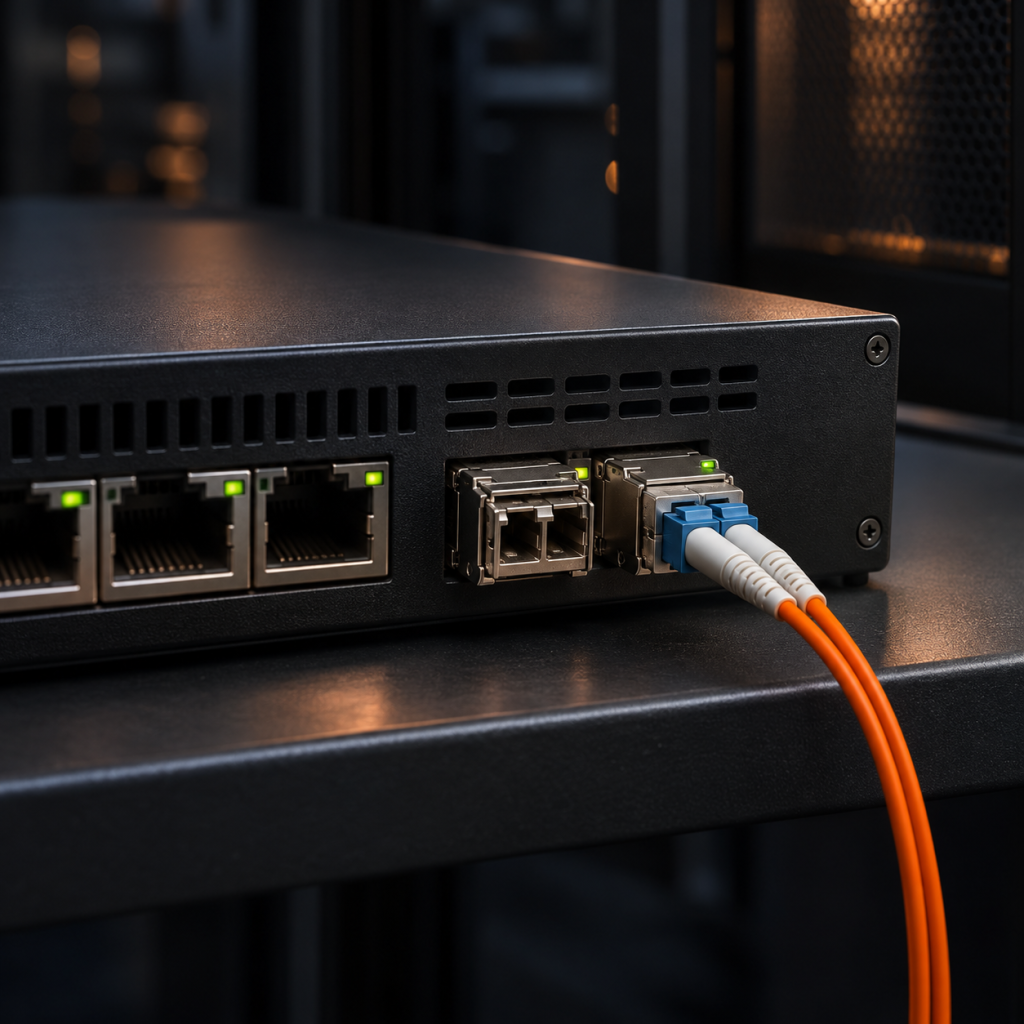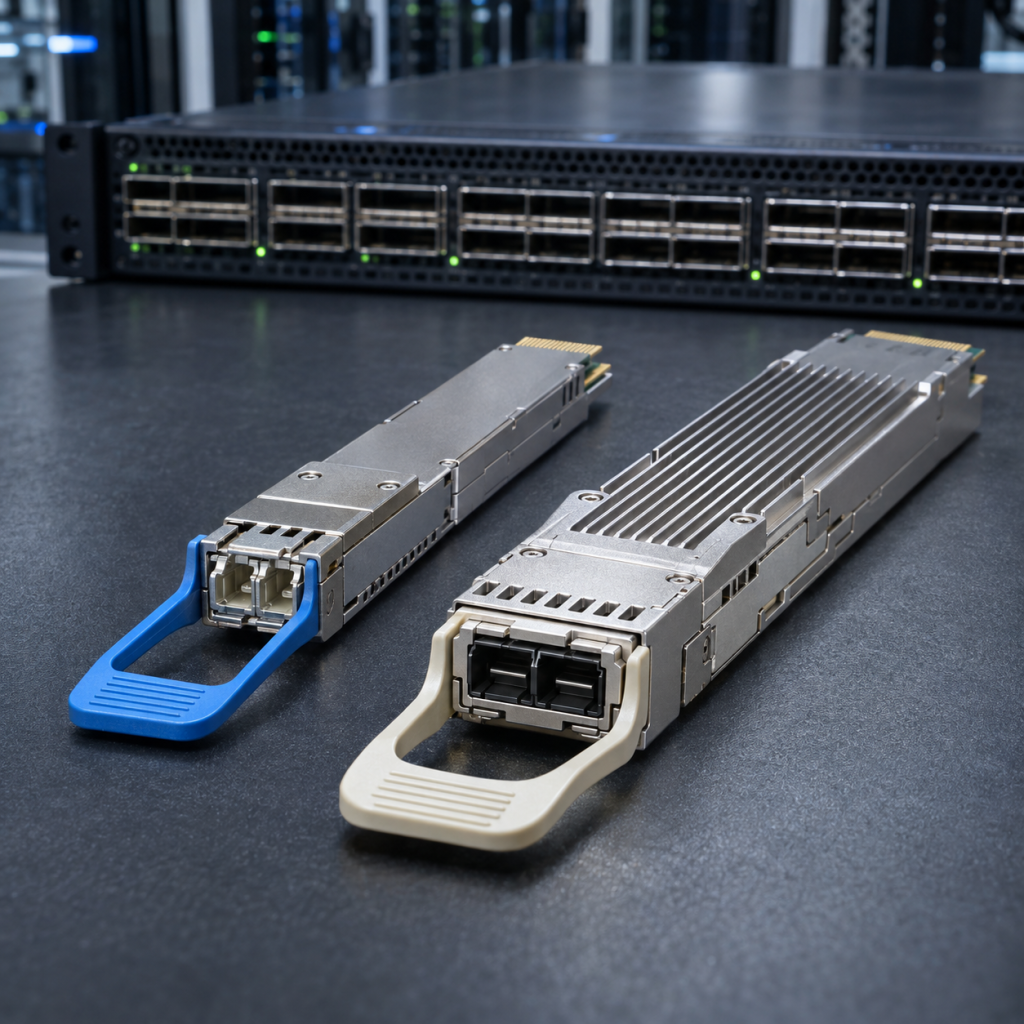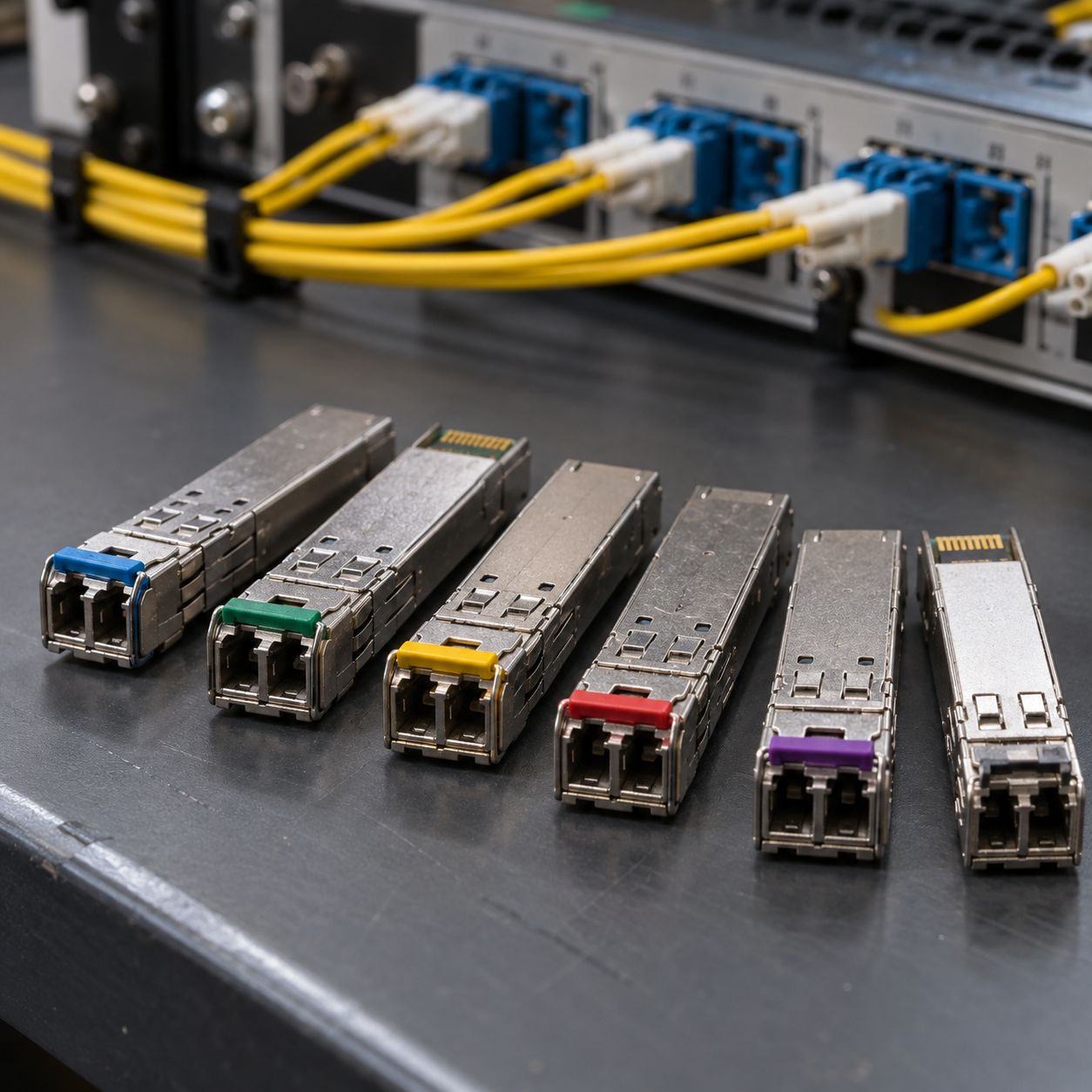
A gigabit is not a lot of bandwidth in 2026. It is, however, exactly what an enormous amount of real infrastructure runs on: substation telemetry, rail signalling, traffic systems, CCTV backhaul, municipal networks, business access tails, and the thousands of SDH and access shelves that still underpin European telecoms. In those networks the constraint is almost never the speed of the link. It is the number of fibres in the duct.
That is the whole argument for coloured optics, and at 1.25G it is a particularly good one. Trenching new fibre costs hundreds of pounds a metre. A CWDM or DWDM SFP costs a tiny fraction of that and multiplies the capacity of glass that is already in the ground — eight times over with CWDM, forty times with DWDM, using the cheap asset to stretch the expensive one. And because these modules plug into ordinary switch and router ports, they do it without buying a transmission platform at all.
This guide covers the two ITU grids and why the choice between them is almost irreversible, the water-peak and amplifier traps that catch people on older fibre, how the receiver rather than the laser decides your reach, what the standards say about putting a third-party optic into somebody else’s line system, and which of the 74 modules Carritech holds across the 1.25G CWDM and DWDM ranges fits what.
Two grids, and the choice is harder to undo than it looks
Everything in this range is governed by one of two ITU-T Recommendations. They are not competing versions of the same thing; they describe different engineering compromises.
- CWDM follows ITU-T G.694.2, "Spectral grids for WDM applications: CWDM wavelength grid", whose in-force edition dates from December 2003. The grid runs from 1271 nm to 1611 nm in 20 nm steps — eighteen channels in total. Twenty nanometres is an enormous gap by optical standards, and that is the point: the laser can drift with temperature across the whole industrial range without ever wandering into its neighbour, so it needs no cooling, no wavelength locking and no thermoelectric controller. Cheap, cool, simple, and limited to eighteen channels.
- DWDM follows ITU-T G.694.1, "Spectral grids for WDM applications: DWDM frequency grid", current edition October 2020. It is specified in frequency rather than wavelength and anchored on 193.1 THz, with channel spacings defined down to fractions of a nanometre. Packing channels that tightly means the laser has to be held on frequency, which means a cooled device with active control — more expensive, more power, and dozens of channels on one fibre pair instead of eighteen.
The decision between them is usually framed as cost against capacity, and that is roughly right: below about sixteen channels with no amplification, CWDM is cheaper and simpler, and above that it has to be DWDM. Our guide to CWDM vs DWDM works through the arithmetic. But there is a second consequence that is easy to miss at design time and expensive later, and it is the subject of the next section.
Four things worth knowing before you commit
1. Choosing CWDM quietly closes the door on amplification
An erbium-doped fibre amplifier works across the C-band, roughly 1530 to 1565 nm. That is a narrow window, and of the eighteen CWDM channels only two fall inside it — the ones at 1531 and 1551 nm. The other sixteen cannot be amplified by standard equipment at all.
So if you build an eight-channel CWDM system today and the route later needs more reach than a passive link can give, there is no amplifier to add. The upgrade path is to re-engineer the whole thing on the DWDM grid, which means new optics on every channel at both ends. A DWDM plan, by contrast, sits entirely inside the amplifier window from the start. If there is any prospect of the span growing, that single fact should decide the grid — not the module price.
2. On older fibre, the lower CWDM channels behave differently from the design
Standard single-mode fibre is specified in ITU-T G.652. The older grades, G.652.A and G.652.B, have a pronounced attenuation peak around 1383 nm caused by residual hydroxyl absorption from manufacture — the "water peak". The low-water-peak grades, G.652.C and G.652.D, flatten it out, which is why they are what gets installed now.
The CWDM grid runs straight through that region. Channels at 1371, 1391 and 1411 nm sit on or beside the peak, and on older fibre they can lose far more light than the module’s budget assumed. You will notice that the Carritech range starts at 1470 nm and the OEM codings we stock do the same. That is not an accident of inventory; it is the part of the grid that works on fibre of unknown vintage. If a supplier offers you the lower channels for a link over 1990s cable, ask what the fibre grade is before you accept the reach figure.
3. The receiver decides the reach, and a sensitive receiver overloads
Across this range the transmitter barely changes. What changes is the detector, and Carritech’s own specifications show it clearly: CT-SFP-CWXX-40 e CT-SFP-CWXX-80 pair a DFB laser with a PIN photodiode, while CT-SFP-CWXX-120 keeps the same DFB and swaps in an avalanche photodiode. On the DWDM side, CT-SFP-DWXX-80 e CT-SFP-DWXX-120 both use an APD.
An APD is more sensitive, which is how the extra forty kilometres is bought. It also has a narrower usable input range, so a 120 km module on a 20 km link can be saturated by its own far end. The symptom is errors that look exactly like a dirty connector and do not improve when you clean it; the cure is an attenuator or the right part. Work the optical link budget for the real route — and on a multiplexed span remember to include the insertion loss of the mux and demux at both ends, which is routinely forgotten and routinely the difference between a working link and a marginal one.
4. Forty channels means forty part numbers, for life
A fixed DWDM module is locked to one wavelength permanently. A forty-channel plan is therefore forty line items to buy, forty to label, and forty to keep spares of — and the spare you need at three in the morning is the one channel you are short of.
Tunable optics solve this by covering the whole plan from a single part number, and at 1.25G that option does not exist in this range; the tunable parts in our catalogue start at 10G, covered in tunable DWDM SFP+ e why tunable optics reduce complexity in DWDM networks. So at gigabit the realistic mitigations are different: hold spares for the channels that carry service rather than all forty, keep the channel plan documented somewhere other than one engineer’s memory, and buy from a source that can supply a single channel at short notice rather than a minimum order quantity.
Neither of these is an IEEE interface
This matters more than it sounds. IEEE 802.3 defines the 1000BASE-X family — LX, SX and the rest — and it defines nothing at all for gigabit over a CWDM or DWDM channel. There is no 1000BASE-CWDM and no 1000BASE-DWDM port type. You will see both names used, including in OEM product literature and in some of the product data on this site, but they are industry shorthand rather than standard designations.
Two practical consequences. First, interoperability between two vendors’ coloured optics is a question of specification overlap, not standards compliance: compare launch power, receiver sensitivity and dispersion tolerance rather than assuming that two modules on the same channel will reach the same distance. Second, the reach figures are the manufacturer’s, derived from a reference channel. Carritech’s Cisco-compatible CWDM-SFP-1470 record is unusually honest about this — it maps to the 80 km optical profile, notes that Cisco specifies a 29 dB optical link budget, and says plainly that deployed reach depends on the fibre and the passive CWDM loss. That is the right way to read every number in this range.
What the modules do follow is the SFP electrical and management specification — the SFF documents held in the SNIA SFF specifications library — which is why they drop into any SFP cage and report digital diagnostics normally. And where the traffic is SDH rather than Ethernet, as it often is at this speed, the framing is specified in ITU-T G.707 and the module simply has to be rated for it.
Putting your optic into somebody else’s line system
The most common awkward question in this range is some version of: our carrier, or our transmission vendor, owns the DWDM line system, and we want to put our own optics on the ends of it. Will it work, and will anyone support it?
There is a standard for exactly this. ITU-T G.698.2, "Amplified multichannel dense wavelength division multiplexing applications with single channel optical interfaces", current edition November 2018, specifies the single-channel interface at each end of a line system whose internals are treated as a black box. You do not need to know what amplifiers, filters or spans are inside; you need the interface parameters at the hand-off point. That is what turns the question from a gamble into a design exercise with numbers in it, and it is the document to cite when you ask the line-system owner what their interface specification is.
For access networks there is a second and newer one. ITU-T G.698.4, "Multichannel bi-directional DWDM applications with port agnostic single-channel optical interfaces", in force since May 2025, addresses the case where the optic has to work without being told in advance which channel it is on — the port-agnostic model that makes a single spare part viable in an access plant. It is aimed squarely at the networks this range serves, and it is worth knowing it exists before anyone tells you that third-party optics in a DWDM access network are inherently unsupportable.
When a coloured optic is the wrong answer
Multiplexing is not always the cheapest way out of a fibre shortage. Three alternatives are worth checking first.
- One fibre, one link: use BiDi. A single-fibre BiDi SFP puts one wavelength each way down one strand and needs no mux at all. They are sold in matched halves and two of the same half will never link — see BiDi transceivers e 1.25G BiDi SFP, and browse the 1.25G BiDi SFP range. For one or two services on a single strand this is cheaper and simpler than anything on a grid.
- Two links, one port: use CSFP. A CSFP fits two independent single-fibre links into one SFP cage, which doubles a cabinet’s port capacity with no new hardware at all. 1,25G CSFP covers it and the 1,25G CSFP range holds the parts.
- More than forty channels, or protection and monitoring: buy a transmission system. Pluggable coloured optics into passive filters is an excellent answer up to a point. Past it you want the amplification, optical protection and performance monitoring that a line system provides, and the optics become client interfaces rather than line interfaces.
And if the fibre is not the constraint at all, the ordinary grey optics are cheaper again: the 1.25G duplex SFP range and our guide to 155M and 1.25G SFP modules cover that end.
Specify the temperature range against the real environment
Very little of this range lives in a machine room. It lives in street cabinets, at the base of masts, in substations, alongside track and on factory floors — and the module is the component that fails in the second summer, not the switch.
A hardened cabinet populated with commercial-temperature optics is not a hardened system. If the enclosure is outdoors or unconditioned, specify the temperature range explicitly rather than accepting whatever the part number defaults to. It is the cheapest reliability improvement available in this range and the one most often skipped. The same argument, with the standards behind it, is in our guide to 155M and 1.25G SFP modules.
Six checks before you order
- Decide the grid on the growth case, not the price. Sixteen of the eighteen CWDM channels cannot be amplified. If the span might ever need an amplifier, start on the DWDM grid.
- Establish the fibre grade before trusting a CWDM reach figure, particularly for the lower channels and particularly on cable installed before low-water-peak fibre became standard.
- Include the mux and demux insertion loss in the budget at both ends. It is the most commonly omitted term and often the decisive one.
- Check the short spans as well as the long ones. A 120 km APD receiver can be overloaded by a link that is too short.
- Confirm the channel, in writing, on both ends. A fixed DWDM module is locked to one wavelength for life, and a mismatched pair fails silently rather than loudly.
- Match the coding to the platform — see transceiver coding explained. A correct optic on the correct channel with the wrong identification string is a module the host will refuse.
The 1.25G CWDM and DWDM modules Carritech stocks
Seventy-four tested part numbers across the two ranges, every one coded for the platform it is going into and measured against its specification before despatch. Grouped by OEM coding below.
Cisco and Cisco-coded CWDM
The eight-channel plan from 1470 to 1610 nm: CWDM-SFP-1470, CWDM-SFP-1490, CWDM-SFP-1510, CWDM-SFP-1530, CWDM-SFP-1550, CWDM-SFP-1570, CWDM-SFP-1590, CWDM-SFP-1610, plus the 40 km long-haul part CWDM-SFPGE-LH40-1611. Worth noting the last one: the ITU grid value is 1611 nm and most part naming rounds it to 1610, so the same grid channel appears in the catalogue under both numbers. Platform guidance is in compatible optics for Cisco platforms and the Cisco optics reference guide.
Juniper CWDM
The matching eight channels in the Juniper EX coding, all 80 km parts: EX-SFP-GE80KCW1470, EX-SFP-GE80KCW1490, EX-SFP-GE80KCW1510, EX-SFP-GE80KCW1530, EX-SFP-GE80KCW1550, EX-SFP-GE80KCW1570, EX-SFP-GE80KCW1590, EX-SFP-GE80KCW1610. The 80K in the string is the reach, which is more informative than most OEM schemes manage. See also Juniper QFX5120 compatible optics.
HPE, Aruba and H3C CWDM
The same eight channels again: JD109A, JD110A, JD111A, JD112A, JD113A, JD114A, JD115A, JD116A. The JD series describes nothing on its face, which is the usual HPE position.
Nokia and Ciena CWDM
3HE04939AA on the Nokia side, and XCVR-080D45, XCVR-A80D43 on the Ciena and transport side. The 3HE and XCVR schemes are opaque by design — Nokia compatible optics and 3HE part numbers explains how they are built.
Cisco and Cisco-coded DWDM: the complete forty-channel plan
Forty consecutive channels on the 100 GHz C-band grid, channels 20 to 59 without a gap, which is 192.0 to 195.9 THz or 1561.41 down to 1530.33 nm. The last four digits of each part number are the wavelength: 3033 is 1530.33 nm.
- DWDM-SFP-3033 — 1530.33 nm, 195.9 THz, channel 59
- DWDM-SFP-3112 — 1531.12 nm, 195.8 THz, channel 58
- DWDM-SFP-3190 — 1531.90 nm, 195.7 THz, channel 57
- DWDM-SFP-3268 — 1532.68 nm, 195.6 THz, channel 56
- DWDM-SFP-3346 — 1533.46 nm, 195.5 THz, channel 55
- DWDM-SFP-3425 — 1534.25 nm, 195.4 THz, channel 54
- DWDM-SFP-3504 — 1535.04 nm, 195.3 THz, channel 53
- DWDM-SFP-3582 — 1535.82 nm, 195.2 THz, channel 52
- DWDM-SFP-3661 — 1536.61 nm, 195.1 THz, channel 51
- DWDM-SFP-3739 — 1537.39 nm, 195.0 THz, channel 50
- DWDM-SFP-3819 — 1538.19 nm, 194.9 THz, channel 49
- DWDM-SFP-3898 — 1538.98 nm, 194.8 THz, channel 48
- DWDM-SFP-3977 — 1539.77 nm, 194.7 THz, channel 47
- DWDM-SFP-4056 — 1540.56 nm, 194.6 THz, channel 46
- DWDM-SFP-4134 — 1541.34 nm, 194.5 THz, channel 45
- DWDM-SFP-4214 — 1542.14 nm, 194.4 THz, channel 44
- DWDM-SFP-4294 — 1542.94 nm, 194.3 THz, channel 43
- DWDM-SFP-4373 — 1543.73 nm, 194.2 THz, channel 42
- DWDM-SFP-4453 — 1544.53 nm, 194.1 THz, channel 41
- DWDM-SFP-4532 — 1545.32 nm, 194.0 THz, channel 40
- DWDM-SFP-4612 — 1546.12 nm, 193.9 THz, channel 39
- DWDM-SFP-4692 — 1546.92 nm, 193.8 THz, channel 38
- DWDM-SFP-4772 — 1547.72 nm, 193.7 THz, channel 37
- DWDM-SFP-4851 — 1548.51 nm, 193.6 THz, channel 36
- DWDM-SFP-4931 — 1549.31 nm, 193.5 THz, channel 35
- DWDM-SFP-5012 — 1550.12 nm, 193.4 THz, channel 34
- DWDM-SFP-5092 — 1550.92 nm, 193.3 THz, channel 33
- DWDM-SFP-5172 — 1551.72 nm, 193.2 THz, channel 32
- DWDM-SFP-5252 — 1552.52 nm, 193.1 THz, channel 31
- DWDM-SFP-5332 — 1553.32 nm, 193.0 THz, channel 30
- DWDM-SFP-5413 — 1554.13 nm, 192.9 THz, channel 29
- DWDM-SFP-5494 — 1554.94 nm, 192.8 THz, channel 28
- DWDM-SFP-5575 — 1555.75 nm, 192.7 THz, channel 27
- DWDM-SFP-5655 — 1556.55 nm, 192.6 THz, channel 26
- DWDM-SFP-5736 — 1557.36 nm, 192.5 THz, channel 25
- DWDM-SFP-5817 — 1558.17 nm, 192.4 THz, channel 24
- DWDM-SFP-5898 — 1558.98 nm, 192.3 THz, channel 23
- DWDM-SFP-5979 — 1559.79 nm, 192.2 THz, channel 22
- DWDM-SFP-6061 — 1560.61 nm, 192.1 THz, channel 21
- DWDM-SFP-6141 — 1561.41 nm, 192.0 THz, channel 20
A complete contiguous plan in one coding is genuinely useful, because it means a channel plan can be filled from a single supplier at a single price point rather than assembled from whatever each channel’s OEM happens to have in stock.
The Carritech base parts
Six optical designs sit behind all seventy-four part numbers above, three per grid.
- CWDM. CT-SFP-CWXX-40 — DFB laser, PIN receiver, duplex LC, 40 km, full digital diagnostics. CT-SFP-CWXX-80 — the same DFB and PIN to 80 km, specified against SFF-8472. CT-SFP-CWXX-120 — DFB with an APD receiver for 120 km. All three cover the 1470–1610 nm channels.
- DWDM. CT-SFP-DWXX-40 at 40 km, CT-SFP-DWXX-80 at 80 km and CT-SFP-DWXX-120 at 120 km, all hot-pluggable C-band parts on the 100 GHz ITU grid covering channels 16 to 61, with DFB transmitters, APD receivers on the two longer parts, 9/125 µm single-mode operation and full digital diagnostics.
Six designs, seventy-four part numbers. Within a grid and a reach, the difference between them is the wavelength and the identification string in the EEPROM — which is the stock problem set out in building a smarter transceiver stock strategy and the reason the Carritech Opticode coding box exists. Coding at the point of deployment is worth more in a fixed-wavelength range than almost anywhere else, because it means your spares holding is organised by channel rather than by channel multiplied by switch vendor.
Keeping gigabit channels supplied
Carritech Optics holds the 1.25G range in UK and EU stock. Browse 1,25G CWDM SFP e 1,25G DWDM SFP directly, the 1.25G BiDi SFP, 1,25G CSFP e 1.25G duplex SFP ranges alongside them, or the 155M duplex SFP e 155M BiDi SFP parts for SDH access. One speed up, the 10G CWDM SFP+ e 10G DWDM SFP+ ranges and our guides to 10G DWDM and CWDM SFP+ e XFP transceivers cover the same decision at 10 gigabits. Patch cords, copper SFPs and adapters e media converters are alongside.
Every module is coded for the target platform and measured against its specification before despatch — see the 22 checks a module passes and our transceiver testing process, which verifies the wavelength accuracy, launch power and receiver sensitivity a multiplexed link depends on — and carries a garantia vitalícia, with UK and EU stock and support behind it. On the procurement questions, compatible optical transceivers vs OEM, OEM vs compatible: cost, risk and performance compared e do third-party optical transceivers void your warranty? answer them straight, and our accreditations, why choose us e support pages cover how we work. The knowledge centre holds the rest of the technical library, and your optics will go end-of-sale before your switch does is worth reading before you standardise a channel plan.
Working out whether a route wants CWDM or DWDM, what the mux loss does to your budget, or how to get one channel of a forty-channel plan at short notice? Tell us the platform, the fibre and the distance and we will say. Our compatibility checker returns the tested Carritech equivalent of an OEM part number in seconds, upload a whole part-number list and we will price it, or request a quote.