The real 400G transceiver cost is not the price on the optic, and every 400G business case starts the same way. Someone divides the price of a 400G optic by the price of a 100G optic, sees a number that looks bad, and the conversation stops there.
It is the wrong sum. Not because 400G is secretly cheap, but because the optic price is one line in a model with at least six, and the other five all move in 400G’s favour — or against it — depending on decisions that get made long before anyone raises a purchase order.
This is the model we would build if we were doing it ourselves. No vendor pricing, because your pricing is not our pricing and a comparison table full of list prices would be fiction by the time you read it. What follows is the structure, the published numbers that do not change, and the questions that decide the answer for your estate.
The six lines in a 400G transceiver cost model
- Optics — the line everyone starts with, and rarely the largest.
- Switch ports — the capacity you buy to terminate those optics, and the chassis or rack unit you avoid buying.
- Power and cooling — per port over five to seven years, not per module on day one.
- The fibre plant — how many strands each optic type consumes, and what it costs to add more.
- Sparing — how many spares you hold, for how long, and where you get them once the OEM stops shipping.
- Warranty and replacement — what a failure costs you in year four.
Lines two, four and five are where 400G business cases are actually won and lost. Let us take them in order of how badly they are usually estimated.
Power: the 400G transceiver cost everyone gets backwards
The received wisdom is that 400G optics are power-hungry, and per module that is true. Per bit it is the opposite, and per bit is what your electricity bill measures.
Cisco publishes maximum power consumption for its transceivers in its 400G QSFP-DD and 100G QSFP28 datasheets, which makes them a convenient reference point — these are ceilings, not typicals, and every vendor’s parts sit broadly in the same envelope because the standards constrain the physics.
| Optic | Maximum power | Reach | Power per 100 Gbps |
|---|---|---|---|
| QSFP-100G-SR4-S | 3.5 W | 100 m OM4 | 3.5 W |
| QSFP-100G-CWDM4-S | 3.5 W | 2 km | 3.5 W |
| QSFP-100G-LR4-S | 4.0 W | 10 km | 4.0 W |
| QSFP-100G-DR-S | 4.3 W | 500 m | 4.3 W |
| QDD-400G-SR8-S | 12 W | 100 m OM4 | 3.0 W |
| QDD-400G-DR4-S | 12 W | 500 m | 3.0 W |
| QDD-400G-FR4-S | 12 W | 2 km | 3.0 W |
| QDD-400G-LR4-S | 12 W | 10 km | 3.0 W |
A 400G module draws roughly three times what a 100G module draws, and carries four times the traffic. Normalise it and 400G is the more efficient part — a 400GBASE-DR4 link uses about 30% less power than four 100GBASE-DR links carrying the same capacity, counting both ends.
The number that actually matters is a rack-level one. Twelve point eight terabits of capacity is thirty-two ports of 400G — one rack unit, with the optics drawing under 400 W. The same capacity in 100G is a hundred and twenty-eight ports, which is not one switch. It is two or three, with their own power supplies, fan trays, management, licences and maintenance contracts, and around 550 W of optics on top — comparing like with like, DR to DR, at 4.3 W a port. Build it from SR4 or CWDM4 at 3.5 W and the 100G side comes down to about 450 W, which does not change the conclusion.
The optics were never the interesting part of the power question. The switches you did not have to buy are.
The fibre plant: the cost that outlives the optic
This is the line that gets left out of business cases and then arrives as a change request three months later.
Different 400G types consume wildly different amounts of fibre, and the plant you already own decides which ones are affordable. It is the largest single swing in the 400G transceiver cost model that nobody puts in a spreadsheet.
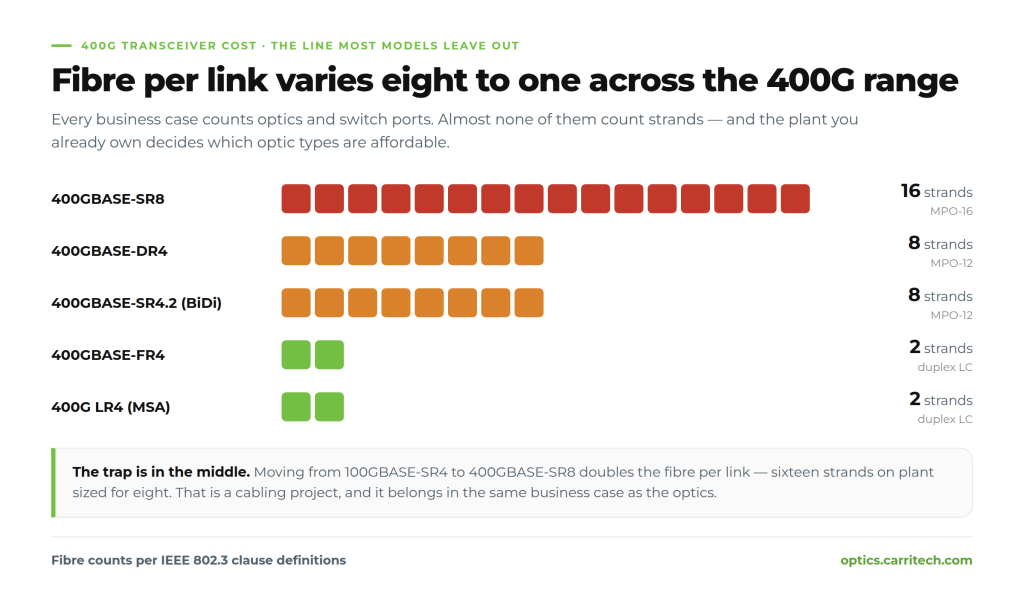
Fibre counts below follow the clause definitions in IEEE 802.3 rather than any vendor’s marketing sheet.
| Optic type | Fibre per link | Connector | Reach |
|---|---|---|---|
| 400GBASE-SR8 | 16 strands | MPO-16 | 100 m OM4 |
| 400GBASE-DR4 | 8 strands | MPO-12 | 500 m |
| 400GBASE-FR4 | 2 strands | Duplex LC | 2 km |
| 400GBASE-LR4 (vendor 10 km) | 2 strands | Duplex LC | 10 km |
| 100GBASE-SR4 | 8 strands | MPO-12 | 100 m OM4 |
| 100GBASE-LR4 / CWDM4 | 2 strands | Duplex LC | 10 km / 2 km |
Read that table as a cost table, because that is what it is.
One naming caveat, because it trips people up in tender documents. SR8, DR4 and FR4 are IEEE 802.3 PMDs. The 4λ parts sold at 10 km and 30 km are not — IEEE’s 4λ single-mode PMD is 400GBASE-LR4-6, which is specified to 6 km, and its 40 km part is 400GBASE-ER8, which uses eight wavelengths. The 10 km and 30 km 4λ modules everyone actually buys are vendor and MSA extensions. They work, they interoperate with each other, and they are the right choice for those distances — but if a specification says “IEEE 400GBASE-LR4”, it is describing something that does not exist, and that is worth catching before it reaches a contract.
If your structured cabling is duplex single-mode — the common case between halls and buildings — then FR4 and the 10 km 4λ parts slot into what you already have and SR8 is effectively unavailable to you at any price. If you are inside a rack or a row with MPO trunks already pulled, DR4 costs you nothing extra in fibre and FR4 is spending money on optics to save fibre you already own.
And note the trap in the middle of that table: moving from 100GBASE-SR4 to 400GBASE-SR8 doubles the fibre count per link. Sixteen strands per link, on plant sized for eight. That is not a transceiver decision, it is a cabling project, and it belongs in the same business case.
Breakout: where the money usually is
Breakout is where a 400G transceiver cost comparison stops being about optics and starts being about switches.
The most under-used lever in a 400G migration is that you do not have to run 400G end to end to benefit from buying it.
A 400GBASE-DR4 module is four independent 100G single-lambda lanes in one cage. Break it out and one 400G port on the spine feeds four 100G ports on four different leaves. You buy one 12 W module and four 100G modules instead of four 100G modules at each end, and — more to the point — you consume one switch port instead of four.
Whether that is cheaper depends entirely on the ratio between your switch port cost and your optic cost, which is the number you have and we do not. The arithmetic is simple enough to do on the back of an envelope:
- Native 100G: 4 leaf optics + 4 spine optics + 4 spine ports.
- Breakout from 400G-DR4: 4 leaf optics + 1 spine optic + 1 spine port.
You are trading three 100G optics for one 400G optic, and reclaiming three spine ports. On any spine switch with a meaningful per-port cost, that trade is heavily one-sided — and it gets more one-sided the higher up the chassis you go.
The catch is that breakout is a design decision, not a purchasing one. The port has to support it, the profile has to be configured, and the fibre has to fan out somewhere. Decide it at design time or you will end up buying the optics twice.
Sparing: the line with no published answer
This is the part of the 400G transceiver cost nobody can quote you, including us.
We looked for a published industry norm for transceiver sparing ratios when we wrote our end-of-life guide. There isn’t one. The large operators publish the metrics they track and not the values, and the absence is itself the finding: nobody can tell you what ratio to hold, because it depends on your failure rate, your lead times and how much downtime costs you.
What we can tell you is the shape of the calculation, and the part that catches people out.
Your spares holding is a function of three things: the number of live modules of that type, the annualised failure rate you actually observe, and the time it takes to get a replacement into the rack. The third one is the variable that changes most over the life of the estate, and it changes in one direction.
Optics go end-of-sale before the platforms they populate. We wrote a whole guide about this because it surprises people: a switch supported into 2027 with an optic that stopped shipping in 2023 is a normal, published, entirely ordinary situation. Once the OEM stops shipping, your replacement lead time is no longer a supply chain question — it is a market question, and the answer gets worse every quarter.
So the honest way to model sparing over five years is in two halves: the years when you can buy the part from the vendor, and the years when you cannot. If your 400G platform is early in its life, that second half may be outside your window. If you are standardising on optics for a platform that is already two years old, it is not.
This is the strongest argument for compatible optics that has nothing to do with price. A part that is manufactured to a standard rather than to a vendor’s shipping schedule does not have a last-ship date.
Warranty and replacement in year four
Two things belong in the model here, and they are usually conflated.
The first is warranty duration. OEM optics are typically covered for a fixed term, often tied to the support contract on the platform rather than the module. Ours carry a lifetime warranty. Over a five-year model that difference is not academic — it decides whether a failure in year four is a warranty claim or a purchase.
The second is what a failure actually costs beyond the part. An optic that fails at 2 a.m. costs an engineer’s night, a truck roll if the site is remote, and whatever your business attaches to the outage. The module price is frequently the smallest number in that list, which is why the sparing question above matters more than the unit cost question everyone starts with.
Compatibility: the line that turns a model into a decision
Everything above is arithmetic. This is the part that determines whether the arithmetic is available to you at all.
If the 400G optics for your platform are only obtainable from one source, you do not have a total cost of ownership model. You have a price list. The value of a compatible option is not only the unit price — it is that a second source exists at all, which means the sparing question has an answer, the end-of-sale question has an answer, and the five-year model has a second column.
What makes that second source real rather than theoretical is coding. An optic is coded for the platform it is going into, so the switch reads it, accepts it and reports it in the interface table like any other module. Get that wrong and the cheapest optic in the world is a paperweight. Get it right and the platform cannot tell the difference — which is the entire point.
The 400G range, cross-referenced
These are our 400G and 800G parts and what they map to. Every mapping is checkable against Cisco’s 400G optics ordering guide:
| Carritech part | Standard | Form factor | Reach | Fibre |
|---|---|---|---|---|
| CT-400G-QDD-SR8 | 400GBASE-SR8 | QSFP-DD | 100 m OM4 | MPO-16, 16 strands |
| CT-400G-QDD-SR4 | 400GBASE-SR4.2 (BiDi) | QSFP-DD | 70 m OM3 / 100 m OM4 / 150 m OM5 | MPO-12 |
| CT-400G-QDD-DR4 | 400GBASE-DR4 | QSFP-DD | 500 m | MPO-12, 8 strands |
| CT-400G-QDD-FR4 | 400GBASE-FR4 | QSFP-DD | 2 km | Duplex LC |
| CT-400G-QDD-LR4 | 400G 4λ long reach, 10 km (vendor/MSA) | QSFP-DD | 10 km | Duplex LC |
| CT-400G-QDD-ER4 | 400G 4λ extended reach (vendor/MSA) | QSFP-DD | 30 km | Duplex LC |
| CT-800G-OSFP-DR8 | 800GBASE-DR8 | OSFP | 500 m | MPO-16 |
| CT-800G-OSFP-SR8 | 800GBASE-SR8 | OSFP | 100 m OM4 | MPO-16 |
Every one of them carries the OEM cross-references for the platforms it is coded for. If you want to check a specific part number against what you already run, the compatibility checker will do it in about ten seconds.
How to build a 400G transceiver cost model in an afternoon
If you take one thing from this, take the shape of the spreadsheet:
- Count the links, not the ports. Capacity required, by reach band. Under 100 m, under 500 m, under 2 km, over 2 km. The reach bands pick the optic types for you.
- Count the strands you have on each of those paths. This is the constraint that overrides preference. Where you are short, price the cabling work and put it in the model — it is a capital cost with a twenty-year life, not an optics cost.
- Price two designs, native and breakout, using your switch port cost. On spine and core, breakout usually wins by more than people expect.
- Add power at three watts per hundred gigabits for 400G and three and a half to four and a third for 100G, times your cost per kilowatt-hour, times five years, times your PUE.
- Add the switches you avoid. This is normally the largest single number in the whole model and the one most often left out.
- Model sparing in two halves — while the OEM still ships the part, and after. Decide which supplier answers the second half before you commit to the first.
- Put warranty in as a probability, not a footnote. Failure rate times fleet size times replacement cost, per year, for five years.
Do that and the answer will not be the one you get from dividing one optic price by another. It is usually more favourable to 400G than people expect on power and switch count, and less favourable than people expect once the fibre plant is priced honestly.
Send us the list
We cannot tell you your 400G transceiver cost from here, because half the inputs are yours. If you have a build in front of you, the fastest way to get a real number is to send us the parts list — a BOM, a quote from someone else, a spreadsheet, or a photograph of a whiteboard. We will come back with the compatible equivalents line by line, with the reach and fibre requirements stated against each one so you can see where the cabling assumptions are hiding.
Or if you have one part number you want to check right now, the compatibility checker will tell you what it maps to.