Choosing 400G optics looks like a distance problem. You know how far the link has to go, you pick the part that reaches that far, and you order it.
It is not a distance problem. It is a fibre problem wearing a distance problem’s clothes — because the four letters on the end of the part number decide how many strands the link consumes, what connector it terminates in, and whether it can be broken out into smaller links later. Two optics that both “do 500 metres” can differ by eight strands and a completely different cabling plant.
This is the reach ladder, what each rung actually costs you, and the three orders that go wrong most often.
The one thing to get straight before choosing 400G optics: the names are not all IEEE names
Start here, because it is the source of more confusion than reach ever is.
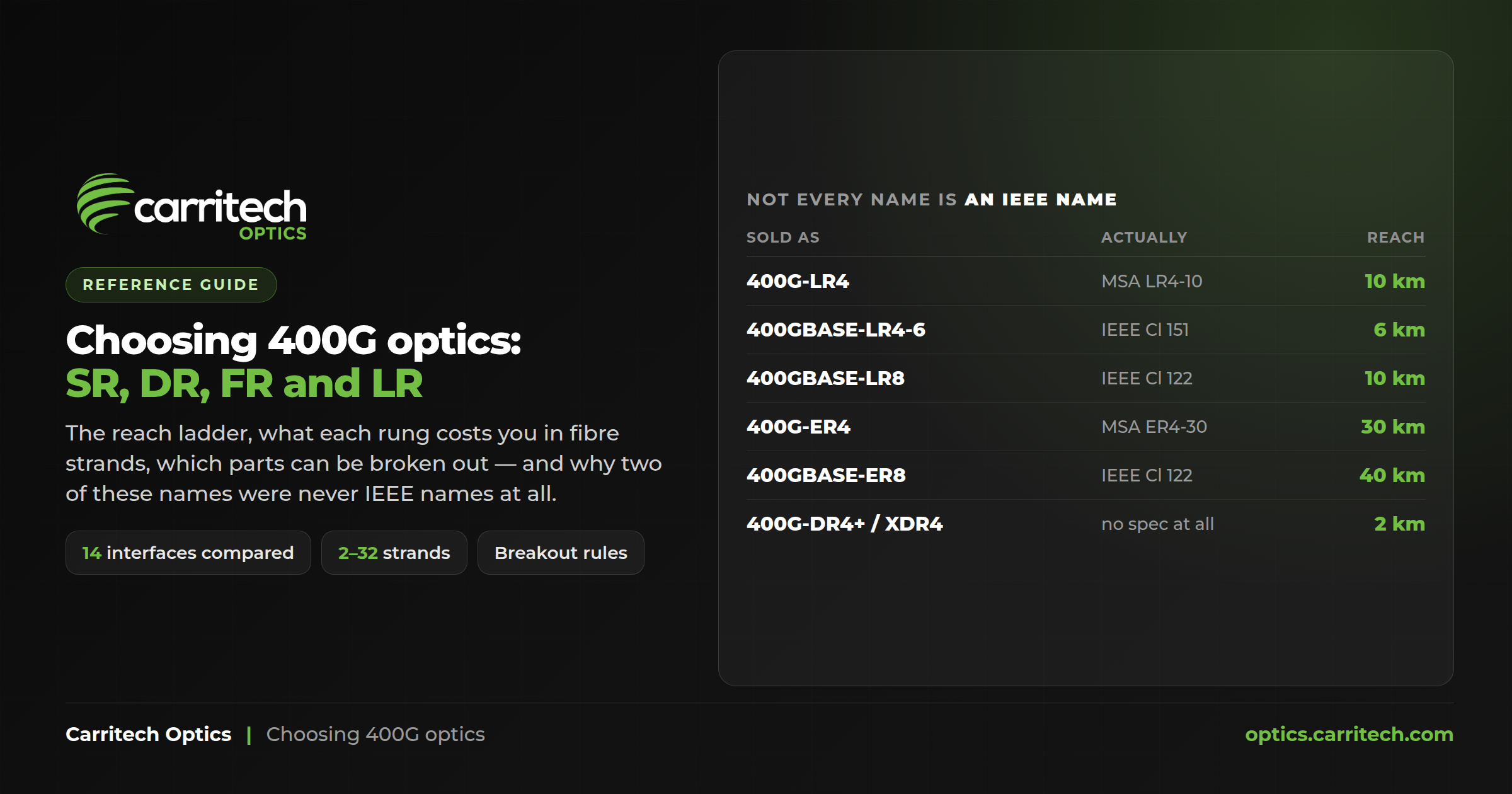
Some 400G interface names come from IEEE 802.3. Some come from a multi-source agreement between vendors. And at least one common name comes from nowhere at all — it is a marketing label for a part that a standards body later defined under a different name.
IEEE 802.3 has never defined a “400GBASE-LR4” or a “400GBASE-ER4.” Its 10 km part is 400GBASE-LR8 and its 40 km part is 400GBASE-ER8, both using eight wavelengths on a duplex pair. The only IEEE name containing “LR4” is 400GBASE-LR4-6, added by IEEE 802.3cu — and its reach is 6 km, not 10.
So what are the modules sold as 400G-LR4 and 400G-ER4? They come from the 100G Lambda MSA, which specifies 400G-LR4-10 at 10 km and 400G-ER4-30 at 30 km. Real specifications, written by a real group, widely implemented — just not IEEE clauses. Four-wavelength parts are also built to reaches beyond what the MSA documents, which is a vendor implementation rather than a specification, and worth confirming rather than assuming. SFF-8024, the document that assigns the identifier codes a module reports about itself, lists them separately from the IEEE PMDs for exactly that reason.
And 400G-DR4+ / 400G-XDR4, the 2 km version of DR4, has no IEEE clause and no MSA specification at all. It is a vendor extension. The standards-track equivalent arrived later as 400GBASE-DR4-2, added to Clause 124 by IEEE 802.3df in 2024.
None of that makes the non-IEEE parts bad. It does mean the four letters are not a guarantee of anything, and that two modules with the same name can be built to different documents. Check the lane structure and the reach, not the label.
The reach ladder
Here is the whole 400G range in one table. Strand count is per link, counting both directions.
| Interface | Defined by | Reach | Fibre | Strands | Connector | Lanes |
| 400GBASE-VR4 | IEEE Cl 167 (802.3db) | 50 m | OM4/OM5 | 8 | MPO-12 | 4 × 100G PAM4 |
| 400GBASE-SR4 | IEEE Cl 167 (802.3db) | 100 m | OM4/OM5 | 8 | MPO-12 | 4 × 100G PAM4 |
| 400GBASE-SR4.2 | IEEE Cl 150 (802.3cm) | 100 m OM4, 150 m OM5 | OM4/OM5 | 8 | MPO-12 | 8 × 50G, 2 per fibre |
| 400GBASE-SR8 | IEEE Cl 138 (802.3cm) | 100 m | OM4 | 16 | MPO-16 | 8 × 50G PAM4 |
| 400GBASE-SR16 | IEEE Cl 123 (802.3bs) | 100 m | OM4 | 32 | 2×16 MPO | 16 × 25G NRZ |
| 400GBASE-DR4 | IEEE Cl 124 (802.3bs) | 500 m | SMF | 8 | MPO-12 | 4 × 100G PAM4 |
| 400GBASE-DR4-2 | IEEE Cl 124 (802.3df) | 2 km | SMF | 8 | MPO-12 | 4 × 100G PAM4 |
| 400GBASE-FR4 | IEEE Cl 151 (802.3cu) | 2 km | SMF | 2 | Duplex LC | 4 × 100G, CWDM |
| 400GBASE-LR4-6 | IEEE Cl 151 (802.3cu) | 6 km | SMF | 2 | Duplex LC | 4 × 100G, CWDM |
| 400GBASE-FR8 | IEEE Cl 122 (802.3bs) | 2 km | SMF | 2 | Duplex LC | 8 × 50G, LAN-WDM |
| 400GBASE-LR8 | IEEE Cl 122 (802.3bs) | 10 km | SMF | 2 | Duplex LC | 8 × 50G, LAN-WDM |
| 400GBASE-ER8 | IEEE Cl 122 (802.3cn) | 40 km | SMF | 2 | Duplex LC | 8 × 50G, LAN-WDM |
| 400G-LR4-10 | 100G Lambda MSA | 10 km | SMF | 2 | Duplex LC | 4 × 100G, CWDM |
| 400G-ER4-30 | 100G Lambda MSA | 30 km | SMF | 2 | Duplex LC | 4 × 100G, LWDM |
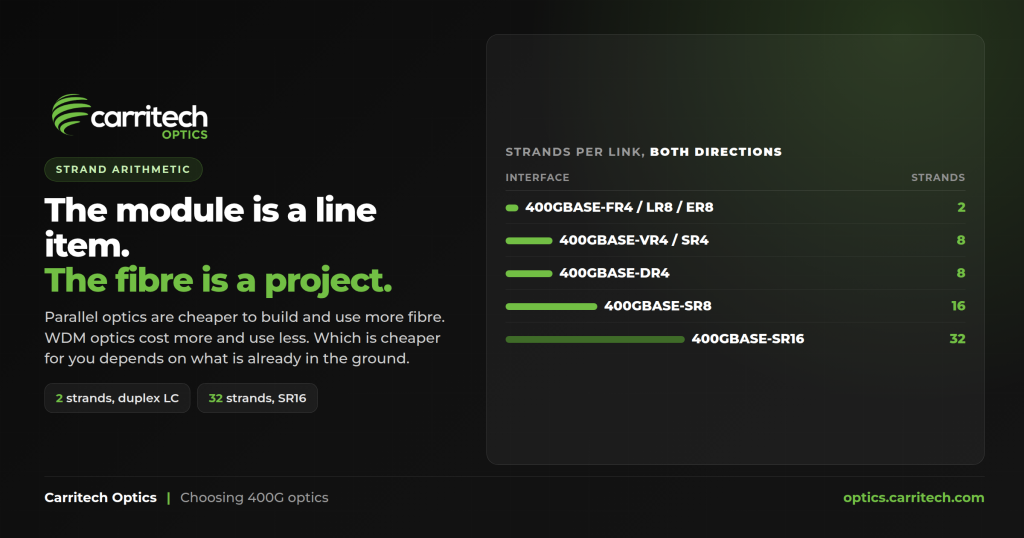
The arithmetic underneath it is simple enough to do in your head, and it is the most useful thing on this page:
- Duplex LC is always two strands. Every WDM part — FR4, FR8, LR4, LR8, ER8 — puts all its lanes down one fibre pair as separate wavelengths.
- A parallel part uses two strands per lane. MPO-12 with four lanes is eight strands. MPO-16 with eight lanes is sixteen. SR16 is thirty-two.
That is the entire trade. Parallel optics are cheaper to build and use more fibre. WDM optics are more expensive to build and use less fibre. Which one is cheaper for you depends on something the datasheet cannot know: whether you already have the strands.
Where choosing 400G optics gets expensive
Choosing 400G optics gets expensive in three specific places, and none of them is the module price.
Going from 100G SR4 to 400G SR8 doubles the fibre. A 100GBASE-SR4 link is eight strands on an MPO-12. A 400GBASE-SR8 link is sixteen, on an MPO-16 — a different connector, on trunk cabling sized for the old one. That is not a transceiver upgrade. It is a cabling project, and it belongs in the same business case as the optics rather than turning up as a change request three months later.
Going from 100G SR4 to 400G SR4 does not. The newer IEEE 802.3db parts — VR4 at 50 m and SR4 at 100 m — put 100G on each of four lanes instead of 50G on each of eight. Same eight strands, same MPO-12, four times the capacity. If your multimode plant is already MPO-12, this is the rung that costs you nothing in fibre.
Crossing from multimode to single-mode changes the plant, not the module. DR4 at 500 m is single-mode on an MPO-12. It looks like a small step up from SR4 at 100 m — same connector, same strand count — but it is a different fibre type end to end. In a building already pulled with OM4, “just go DR4” is a re-pull.
Breakout: what 400G optics can and cannot be split into
This is the part most reach comparisons leave out, and it is often the reason to choose one rung over another.
Breakout works when the 400G optic’s individual lanes are electrically and optically identical to a smaller standalone PMD. It is not a feature the module has; it is a consequence of how the standard was written.
- 400GBASE-DR4 breaks out to four 100GBASE-DR links. IEEE’s own comparison of Clause 124 against Clause 140 shows matching optical modulation amplitude, transmit power and extinction ratio per lane — the two are the same PMD, counted differently. One MPO-12 trunk fans out to four duplex LC links.
- 400GBASE-SR4 breaks out to four 100GBASE-SR1 links, on the same basis — both live in Clause 167.
- 400GBASE-SR8 breaks out to eight 50G links. Clause 138 carries 50GBASE-SR alongside it at the same lane rate.
- No WDM part breaks out at all. FR4, LR4, LR8, ER8 and the rest carry their lanes as wavelengths on a single fibre pair. There is nothing to fan out — IEEE’s own scoping discussions exclude them from breakout for exactly this reason.
Worth knowing: IEEE does not standardise breakout itself. It defines the PMD; the connectors and cable assemblies that make a fan-out physically possible come from the form-factor MSAs. So breakout is enabled by identical per-lane PMDs, not promised by a standard, and it is worth confirming your platform supports the port-splitting configuration before you buy the cassette.
The three most common mis-orders
Ordering a longer reach “to be safe.” Optical receivers have a maximum input power as well as a minimum. Putting a 10 km transmitter on a 40-metre patch can overload the far end, and the failure looks like a bad module rather than an obvious own goal. If a link is short, the short-reach part is not the risky choice — it is the correct one. Where a longer part genuinely is all you can get, that is an attenuator conversation.
Ordering a duplex part for a parallel plant, or the reverse. This is the mis-order we are asked about most when choosing 400G optics. Both will seat happily in the cage and neither will link. FR4 and DR4 are both single-mode and both cover a couple of hundred metres comfortably — one wants a duplex LC pair, the other wants an eight-strand MPO-12. The datasheet says so; the four letters do not.
Ordering “400G-LR4” and receiving a 6 km part, or ordering LR4-6 and expecting 10 km. This is the naming problem from the top of the article turning into a real delivery. If the requirement is 10 km on four wavelengths, the specification you want is the MSA’s 400G-LR4-10. If you will accept eight wavelengths, IEEE’s 400GBASE-LR8 does 10 km as well. 400GBASE-LR4-6 does 6 km and is a different part. Ask which document the module is built to, not what the label says.
Cost, briefly, and honestly
The cost side of choosing 400G optics follows a fairly predictable shape: parallel multimode parts sit at the bottom, parallel single-mode above them, four-wavelength WDM above that, and eight-wavelength long-reach at the top. More lasers and tighter wavelength control cost more.
We are not going to put figures on that, because module pricing moves and any number published here would be wrong within a quarter. What does not move is the arithmetic underneath: the module is a line item and the fibre is a project. A part that saves you a re-pull is cheap even when it is the more expensive module, and the reverse is true just as often.
If you want the rest of that model — power, port density, and the switches you do not have to buy — it is in the real TCO of 400G. And if you are weighing a single-fibre option lower down the range, the strand arithmetic for BiDi runs the same way in reverse.
Before you order: a checklist for choosing 400G optics
- Establish what is in the ground first. Fibre type, strand count, connector type, and whether the trunk is MPO-12 or MPO-16. This constraint overrides preference every time.
- Then pick the shortest reach that clears the distance. Over-reaching is the single most common error in choosing 400G optics — allow margin for patching and future re-routes, but do not reach for the longest part on the shelf.
- Check the lane structure, not the letters. Four lanes or eight, parallel or WDM, and which document the part is built to.
- Decide about breakout now. If the port might become four 100G links later, that decision belongs at purchase, because it rules out every duplex WDM option.
- Check the part number against what your platform actually accepts before you commit to a quantity.
You can check any 400G part number against a compatible equivalent — form factor, reach, media and connector side by side — in the compatibility checker. If the list you are working from is a quote or a bill of materials rather than a single part, send us the list and we will price it line by line.
Reference material worth keeping: the Fiber Optic Association on fibre testing and loss budgets, and the TIA Fiber Optics Tech Consortium standards tables, which track which IEEE amendment added what.