25 Gigabit Ethernet exists because of arithmetic, not ambition. Once 25G serial lanes became manufacturable, 100G stopped being ten lanes of 10G and became four lanes of 25G — and if you have a 25G lane, the cheapest thing you can do with it is terminate it on its own port. That is the whole story. 25G is not a speed somebody designed from first principles; it is one lane of 100G, sold on its own.
What makes it interesting is what it costs to adopt. A 25G SFP28 module is the same size as the 10G SFP+ it replaces, uses the same duplex LC patch leads, runs on the same single-mode and multimode fibre, draws about the same power and fits the same cage. For a 2.5× bandwidth increase, the cabling bill is zero. Very little else in optical networking offers that.
What it costs to get wrong is a different matter, and almost all of it comes down to one thing: forward error correction. A 25G link with healthy optical power at both ends that refuses to come up is, more often than not, a FEC configuration mismatch rather than an optics fault. This guide covers the variants, the FEC problem in detail, backward compatibility with 10G, single-fibre working, the fronthaul case, and which modules fit what.
Where 25G came from
25G arrived from industry before it arrived from the standards body. A group of large data-centre operators and silicon vendors formed what was then the 25 Gigabit Ethernet Consortium — now the Ethernet Technology Consortium, which still publishes the 25/50G Ethernet specification — and defined a single-lane 25G interface so that server NICs could be built before IEEE ratification. The formal standards followed quickly:
- IEEE 802.3by-2016 gave 25GBASE-SR over multimode, along with the backplane and twinax copper variants.
- IEEE 802.3cc-2017 added the single-mode interfaces, 25GBASE-LR at 10 km and 25GBASE-ER at 40 km. That was a 25 Gb/s over Single-Mode Fibre task force in its own right, and the gap between it and 802.3by is why some older platforms support SR and not LR.
- IEEE 802.3cd-2018 took the same lane up to 50G with PAM-4 signalling, which is where the single-lane story continues.
That two-stage history matters when you are buying for older hardware. A 2016-vintage switch may accept a 25GBASE-SR module and decline an LR, and the reason is the standard rather than the coding.
The SFP28 package
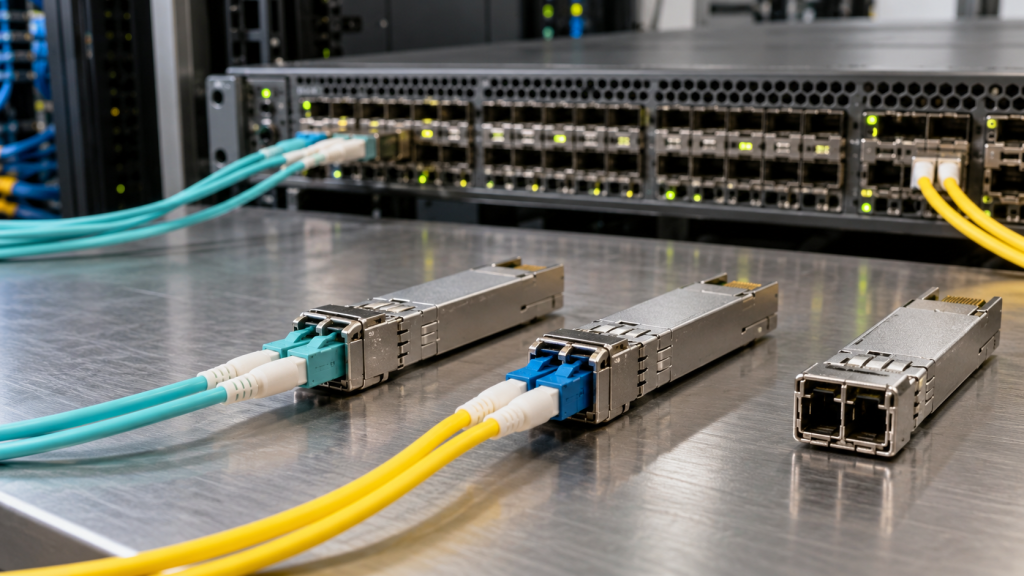
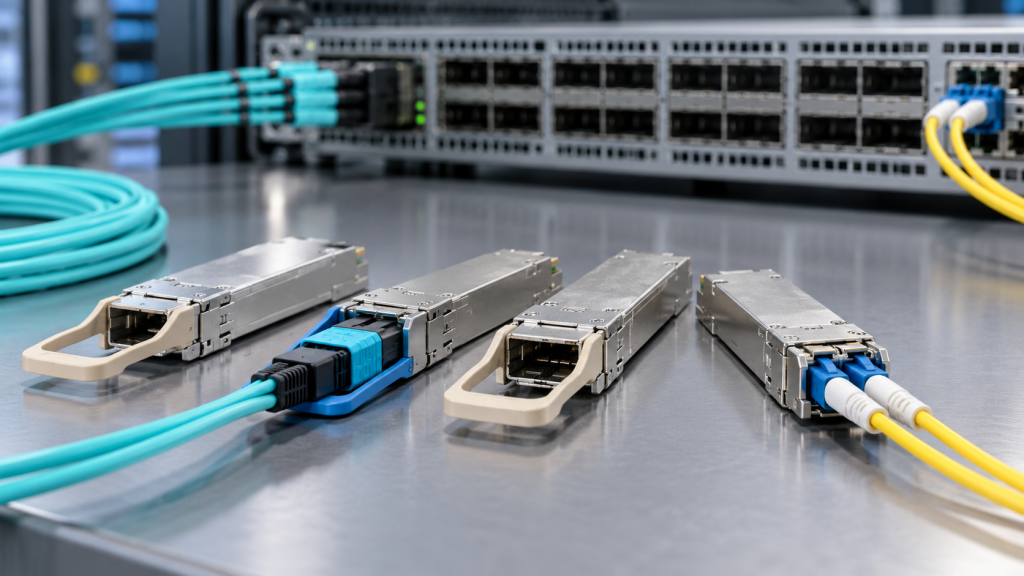
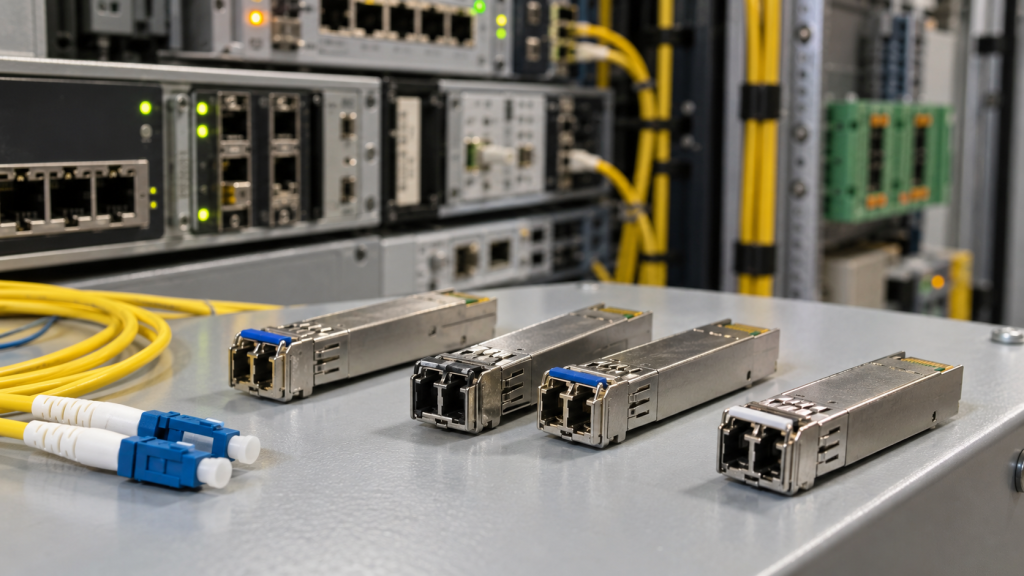
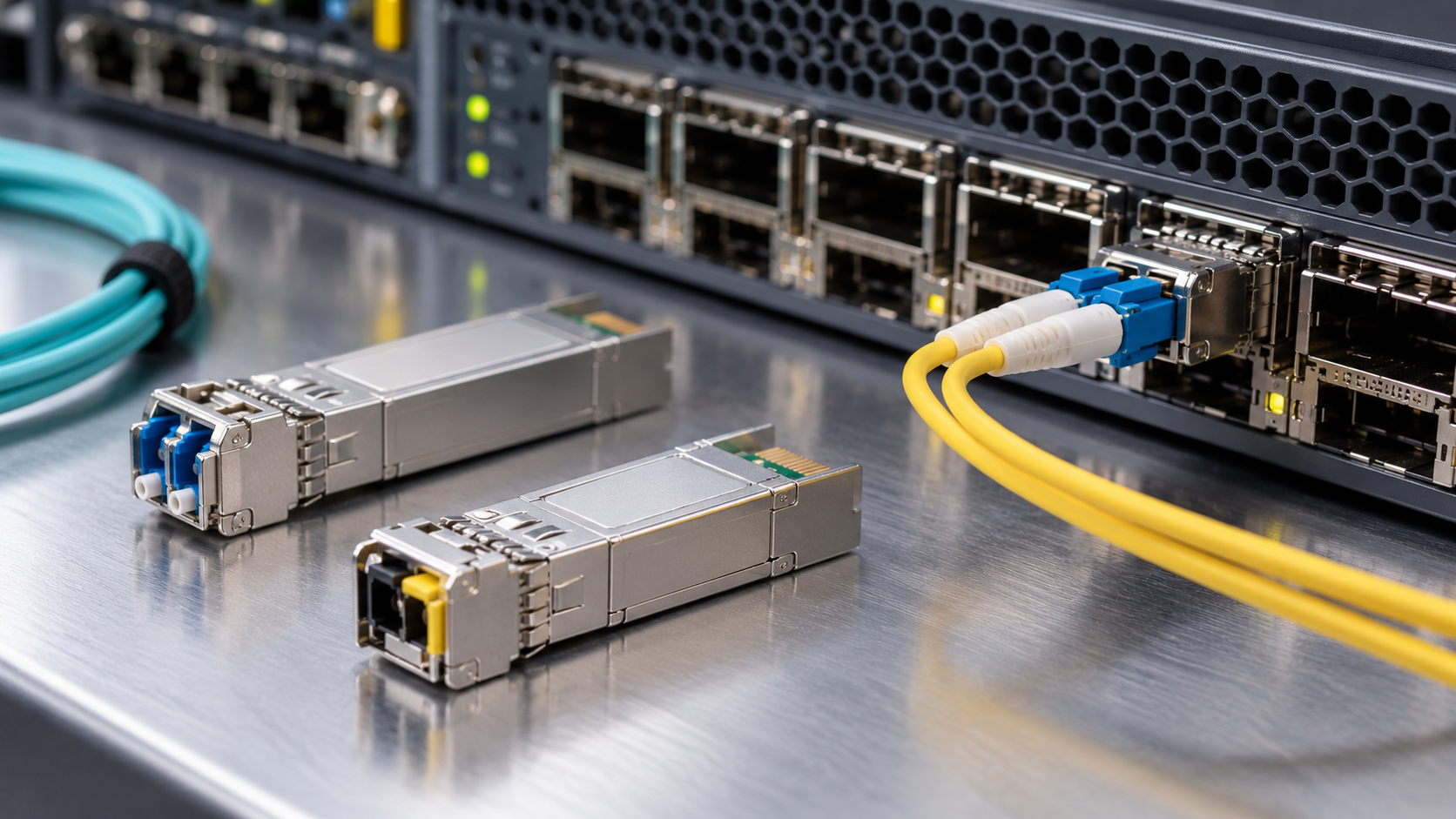
SFP28 is mechanically an SFP: the same footprint, the same latch, the same duplex LC optical interface, managed over I²C with the memory map defined in the SFF specifications at SNIA. The 28 is the electrical lane rating, not a new shape. Most optical SFP28 modules draw well under 1.5 W.
The compatibility rule is the familiar one, in the familiar direction. An SFP+ module works in an SFP28 cage, so a 25G-capable port will generally run your existing 10G optics at 10G. An SFP28 module in an SFP+ cage will not give you 25G, because the host cannot drive the lane that fast — some combinations will link at 10G, many will not link at all, and none of them will give you the speed you paid for. The broader comparison is in our guide to SFP+ vs SFP28.
The 25G SFP28 variants, compared
| Variant | Optics | Fibre and connector | Alcance | Standard |
|---|---|---|---|---|
| SR | 850 nm VCSEL, PIN | OM4 multimode, duplex LC | 100 m | IEEE 802.3by |
| LR | 1310 nm DML, PIN | Single-mode, duplex LC | 10 km | IEEE 802.3cc |
| ER | 1310 nm DML, APD | Single-mode, duplex LC | 40 km | IEEE 802.3cc |
| BX 20 / 40 | 1270 / 1330 nm pair | Single-mode, one fibre, simplex LC | 20 and 40 km | Vendor design |
| BX 60 / 80 | 1270 / 1330 or 1490 / 1550 nm | Single-mode, one fibre, simplex LC | 60 and 80 km | Vendor design |
| DAC and AOC | Twinax copper or active fibre | Fixed assembly | Metres to tens of metres | IEEE 802.3by (CR) |
Two notes on the long-reach end. The step from LR to ER is paid for on the receive side: an avalanche photodiode is several decibels more sensitive than the PIN diode in an LR module, and that sensitivity is what buys the extra thirty kilometres. It also means an ER module on a short span can be overloaded — put an attenuator in, or buy the right part. And there is no 25G equivalent of the 80 km and 120 km duplex optics that exist at 1.25G and 10G: past 40 km, the honest answer at 25G is a BiDi part, a wavelength on a WDM system, or a lower rate.
Worth checking the specific part rather than the category heading for wavelength. Reach names at this speed are consistent; the wavelength labelling in product titles across the industry is not, and 25GBASE-ER is a 1310 nm interface rather than the 1550 nm one the name might suggest by analogy with the slower ranges.
FEC: the reason your 25G link is down
If one thing earns its place in this guide, it is this. 25G is the only mainstream Ethernet speed where forward error correction is genuinely a configuration choice, which makes it the only speed where the two ends of a link can be configured to disagree about it.
At 10G there is no FEC over fibre and nothing to set. From 50G per lane upwards, RS(544,514) is mandatory and both ends run it whether you like it or not. At 25G there are three possibilities in play:
- RS-FEC, the Reed-Solomon code of Clause 108 — the same RS(528,514) family used at 100G. Mandatory on 25GBASE-SR, and the default on most optical links.
- FC-FEC, the fire code of Clause 74, weaker and lower latency. Common on copper and backplane links.
- No FEC, which some platforms allow on short, clean links.
Both ends have to agree. A switch set to RS-FEC and a NIC set to FC-FEC will show healthy transmit and receive optical power on both modules and a port that never comes up, and everything a monitoring system can see about the optics will look perfect. It is the single most common 25G fault, it has nothing to do with the module, and it is fixed in configuration. The mechanism, and how to read the counters once the link is up, is in our guide to forward error correction.
Three rules follow. Check FEC configuration at both ends before you touch the optics on any 25G link that will not establish. Do not expect a different module to change it — on standard Ethernet links the FEC lives in the host ASIC, not in the pluggable. And do not turn FEC off to clean up a counter: a non-zero corrected-error count at 25G is the system working, and switching off the correction does not remove the errors, only the repair.
Dual-rate parts, and running 25G ports at 10G
Because 25G and 10G share a cage and a connector, mixed-speed working is normal rather than exotic, and there are two distinct ways to do it.
- Put a 10G SFP+ in the 25G port. Usually works, costs nothing, and is how most organisations stage a 25G rollout: buy the switch now, re-use the optics, replace them as the servers arrive. The 10G SFP+ range is unchanged by any of this.
- Buy an explicitly dual-rate part. Modules such as SFP-10/25G-LR-S are specified for 10G and 25G operation, which matters when one part number has to cover ports at both speeds in the same estate. Dual-rate is a specification to look for, not an assumption to make.
One trap worth naming: a 25G module in a 25G port on a switch that has been left configured for 10G will link at 10G and look entirely healthy. If a new 25G server is slower than expected, check the configured port speed before the cabling. And if the far end is copper rather than fibre, copper SFP modules covers what is and is not possible in an SFP cage.
One fibre instead of two: 25G BiDi
Where the constraint is fibre count rather than distance or bandwidth — an access network, a street cabinet, a tower, a site with one strand where you need two — a BiDi part solves it directly. One wavelength each way down a single fibre, with a WDM filter inside the module and a simplex LC on the front.
Carritech’s 25G BiDi range runs from 20 km to 80 km in matched pairs. The rule that catches everyone is that the two halves are not interchangeable: a "U" part transmits on one wavelength and receives on the other, a "D" part does the reverse, and two of the same half will never link no matter how clean the fibre is. Order in pairs, and label the ends. The general case is covered in BiDi transceivers.
If the requirement is more channels rather than fewer fibres, WDM at 25G is thinner ground than at 10G, where the full CWDM and DWDM grids are available as pluggables — see 10G DWDM and CWDM SFP+. At 25G the practical options are BiDi for fibre relief, or taking the 25G signal into a transport system as a client.
Mobile fronthaul: the other 25G market
Outside the data centre, 25G has become the fronthaul rate for mobile networks, and it is a materially different buying problem. The interface between baseband and radio is specified as CPRI and eCPRI, with eCPRI built for 5G fronthaul over Ethernet, and the surrounding architecture comes from the O-RAN Alliance. Both of Carritech’s long-reach 25G designs, CT-SFP28-ER and the BiDi parts, are specified for CPRI and eCPRI applications as well as Ethernet.
Two things change when the link is fronthaul rather than a data-centre uplink. The environment is hostile — a cabinet at the base of a mast, not a machine room — so industrial and extended-temperature variants exist for a reason, and parts such as SFP-25G-ER-I, SFP-25G-ER-IT e MMA2P00-ASHT are the hardened equivalents of their commercial siblings. A hardened radio unit populated with commercial-temperature optics is not a hardened system, and the module is the part that fails, usually in the second summer. And the fibre is single and long, which is why the BiDi parts and the 40 km ER modules dominate the fronthaul order book rather than the SR parts that dominate inside a hall.
Getting 25G ports without buying 25G ports
If you have 100G QSFP28 ports going spare and need 25G, you probably already own the capacity. A QSFP28 port is four 25G lanes, and most platforms will configure it as 4 × 25G with a breakout harness — or take a single 25G module through a QSFP28-to-SFP28 adapter. The mechanics and the host-side caveats are in breakout explained, and the 100G side of it is in our guide to 100G QSFP28 transceivers.
Inside the rack, do not buy optics at all. A direct attach cable is cheaper, lower power and lower latency than two modules and a patch lead; the DAC 25G SFP28 e 25G SFP28 AOC ranges cover short and medium runs, and DAC vs AOC sets out where the line falls. This is the single most common avoidable cost in a 25G server build.
Is 25G still the right answer?
For server access and for aggregation into a 100G spine, usually yes, and for a specific reason: the cabling. 25G runs on the duplex LC single-mode and OM4 multimode plant that a 10G estate already has, and a 25G leaf uplinking at 100G needs no new fibre type anywhere in the design. 50G and 100G per lane are both faster per port and more demanding of the channel, and the step up to them is a design decision rather than a module swap.
Where 25G is the wrong answer is a pure east-west fabric being built new today, where 100G per lane is the better unit, or anywhere the port count rather than the per-port bandwidth is the constraint. If you are costing that comparison, choosing 400G optics, QSFP-DD vs OSFP and the IEEE 802.3 working group pages on what is still being actively specified are the useful inputs. And on the storage side, 32G Fibre Channel runs on the same 28 GBd lane as 25G Ethernet in the same SFP28 package — the subject of our guide to 16G and 32G Fibre Channel SFP+ modules.
Diagnostics and link budget
Every module here reports temperature, supply voltage, laser bias current and transmit and receive optical power. On a single-lane module there is no per-lane breakdown to compare, which makes the received power trend the main early-warning signal — worth trending rather than merely alarming on, as our guide to spotting a failing fibre link before it drops explains. On long single-mode spans the attenuation of ITU-T G.652 fibre sets the floor of the optical link budget, and on short multimode ones the connector count usually matters more than the distance. Connector cleaning is the cheapest margin available.
One 25G-specific point: because FEC is absorbing real errors on these links, a clean error counter is not proof of a healthy margin. A 25G link can sit a decibel from the edge and report nothing until a warm afternoon takes the last of it. The pre-FEC trend is the only visibility you get.
Six checks before you order
- Confirm the port is SFP28, not SFP+. A 25G module in a 10G cage does not give you 25G.
- Check FEC configuration at both ends. This is the first thing to look at on any 25G link that will not come up, and the last thing most people check.
- Confirm the fibre type and the reach. OM4 and 100 m for SR; single-mode for LR and ER. Single-mode vs multimode fibre covers how to tell what is installed.
- For BiDi, order matched U and D halves. Two of the same half will never link.
- Specify the temperature range against the actual environment. Industrial and extended-temperature variants exist because cabinets and radio enclosures get hot.
- Match the coding to the platform — see transceiver coding explained. 25G hosts police identification as firmly as any other.
The 25G SFP28 modules Carritech stocks
Eighty-four tested part numbers across the duplex and BiDi ranges, every one coded for the platform it is going into and measured against its specification before despatch. Grouped by OEM coding below.
Cisco and Cisco-coded
SFP-25G-SR, SFP-25G-SR-S, SFP-25G-SR-E, SFP-25G-LR, SFP-25G-LR-C, SFP-25G-LR-E, SFP-10/25G-LR-S, SFP-25G-ER, SFP-25G-ER-I, SFP-25G-ER-IT, SFP-25G-BX40U-I, SFP-25G-BX40D-I. The -I and -IT suffixes are the industrial and extended-temperature variants, and the BX parts are the single-fibre pair. Platform guidance is in compatible optics for Cisco platforms, Nexus 9300 compatible optics, Catalyst 9300 and 9500 compatible optics and the Cisco optics reference guide.
Junípero
JNP-SFP-25G-SR, JNP-SFP-25G-LR. See also Juniper QFX5120 compatible optics.
HPE, Aruba and H3C
JL293A, JL484A, JL486A, JL855A, Q2P64B, R0R42A, R9F89A, S0V69A, S2N63A, S2P33A, S2P34A, S6B58A, S0V70A, S0V71A.
Dell and Dell EMC
407-BBWK, 407-BBXU, 407-BBXZ, 407-BCBF, 407-BCHI.
Huawei
02311KNR, 02312LSE, 02312PDK, 02313FCC, 02313URP, 02315TLM.
Extreme, Brocade and Ruckus
10501, 10502, 10504, 25G-SR-SFP100M, 25G-LR-SFP10KM, E25G-SFP28-SR, E25G-SFP28-LR, E25GSFP28SR, E25GSFP28SRX, E25GSFP28LRX, XBR-25G-SR-01, XBR-25G-LR-01.
Ciena and transport platforms
XCVR-V00Z85, XCVR-V10V31, XCVR-V40V31. If an XCVR part number tells you nothing on its face, our guide to vendor part-number schemes explains how these are built.
NVIDIA and Mellanox
MMA2P00-AS, MMA2P00-ASHT, MMA2L20-AR — the HT suffix marking the extended-temperature design.
Firewall and security platforms
FN-TRAN-SFP28-SR, FN-TRAN-SFP28-LR, PAN-SFP28-25GBASE-SR, PAN-SFP28-25GBASE-LR, PAN-T-S28-25GBASE-SR, PAN-T-S28-25GBASE-LR.
D-Link and MikroTik
DEM-S2801SR, DEM-S2810LR, XS+85LC01D, XS+31LC10D.
Component and transceiver-vendor codings
FTLF8536W4BTV, FTLF1436W5BTV, SFP25G-SR, SFP25G-LR, SM6110-SR, SM6110-LR.
The Carritech base parts
Three duplex designs sit behind the whole 25G duplex range. CT-SFP28-SR is the 850 nm VCSEL module to 100 m on multimode with a PIN receiver; CT-SFP28-LR is the 1310 nm DML design to 10 km on single-mode; CT-SFP28-ER reaches 40 km using the same DML transmitter with an APD receiver, and is specified for CPRI and eCPRI as well as Ethernet. All three report full digital diagnostics.
The BiDi range is four matched pairs over a single fibre: CT-SFP28-BX-20U, CT-SFP28-BX-20D, CT-SFP28-BX-40U, CT-SFP28-BX-40D, CT-SFP28-BX-60U, CT-SFP28-BX-60D, CT-SFP28-BX-80U, CT-SFP28-BX-80D — 20 and 40 km on the 1270/1330 nm pair, then 60 and 80 km, with APD receivers from 40 km upwards.
Seven designs, eighty-four part numbers. The difference is the vendor identification string in the EEPROM, which is the stock problem set out in building a smarter transceiver stock strategy and solved with the Carritech Opticode coding box — hold one design per reach, code at the point of deployment.
Keeping 25G ports supplied
Carritech Optics holds the 16G, 25G and 32G range in UK and EU stock. Browse 25G duplex SFP28 e 25G BiDi SFP28 directly, the wider 25G transceiver range including cable assemblies, or the 100G QSFP28 modules the uplinks will want. Patch cords, copper SFPs and adapters e media converters are alongside for the jobs a duplex fibre module cannot do.
Every module is coded for the target platform and measured against its specification before despatch — see the 22 checks a module passes and our transceiver testing process, which verifies the receiver sensitivity and launch power a 40 km link lives or dies by — and carries a garantia vitalícia, with UK and EU stock and support behind it. On procurement, compatible optical transceivers vs OEM e do third-party optical transceivers void your warranty? answer the questions that always come up, and our accreditations e why choose us pages cover the rest.
Chasing a 25G link that will not come up, or working out whether a port will take an ER module? Tell us the platform at each end and the span and we will say. Our compatibility checker returns the tested Carritech equivalent of an OEM part number in seconds, upload a whole part-number list and we will price it, or request a quote.