The Cisco optics you actually need,
cross-referenced.
439 Cisco and Meraki part numbers matched to their compatible equivalents — transceivers, direct attach copper, active optical cables and single-fibre BiDi. One PDF you can keep on the desktop and stop googling from.
Not everything Cisco has ever made — nobody's guide is. These are the parts we are asked for most.
Get the guide
Tell us where to send it. The PDF arrives by email, and the download link is on the next page as well — so you do not have to wait for it.
We will only use your details to send you the guide and to answer you if you ask us something. We do not share your address with anyone.
An easy-to-read comparison table. Look up the Cisco part number, see the Carritech Optics lower-cost alternative.
Every row pairs a Cisco part number with the Carritech Optics transceiver built to the same specification, and shows you that specification so you can check the match rather than trust it. Here are six real rows from the guide.
| Cisco part number | Carritech equivalent | Specification |
|---|---|---|
| SFP-10G-SR-S | CT-SFP+SR | 10GBASE-SR · 300 m OM3 · 850 nm |
| GLC-LH-SMD | CT-SFP-LX | 1000BASE-LX/LH · 10 km · 1310 nm |
| QSFP-100G-SR4-S | CT-QSFP28-SR4 | 100GBASE-SR4 · 100 m OM4 · MPO-12 |
| SFP-H25G-CU3M | CT-25G-S28DAC-3 | 25GBASE-CR1 passive copper · 3 m |
| SFP-10G-BX40D-I | CT-SFP+-BX-40D | 10G BiDi · 40 km · downstream · TX 1330 / RX 1270 nm |
| QDD-400G-DR4-S | CT-400G-QDD-DR4 | 400GBASE-DR4 · 500 m · MPO-12 |

17 families, 439 part numbers
From 100M Fast Ethernet SFPs to 800G OSFP, and the cables most cross-reference guides leave out entirely. Cisco's own catalogue runs far wider than this once you count every DWDM channel and every spares SKU — what is here is what we are asked for and can match, which is the part that is useful to you.
- 97CWDM / DWDM SFP
- 39SFP+ / XFP — 10G
- 28SFP — 100M / 1G
- 26Active optical cable — 40G / 100G
- 19Direct attach copper — 40G / 100G
- 18QSFP28 — 100G
- 15CFP family — 100G
- 13QSFP-DD — 200/400G & BiDi
- 13Active optical cable — 10G / 25G
- 12Fibre Channel
- 12Cisco Meraki
- 11Direct attach copper — 10G / 25G
- 10Active optical cable — 400G
- 8SFP28 — 25G
- 8QSFP+ — 40G
- 6Direct attach copper — 200G / 400G
- 5OSFP — 800G
Matched on specification, never on the name
Two vendors can call entirely different optics "LH". Part-number letters are not evidence, so we do not match on them.
The standard does the work
Optics are built to public standards — IEEE 802.3, the Fibre Channel standards, and the form-factor specifications SFF-8472, SFF-8636 and CMIS. The standard belongs to nobody, and it does not go end-of-sale.
Coding decides whether the link comes up
What makes an optic "a Cisco optic" is the identity written into its EEPROM, which the switch reads on insertion. Ours are coded for the platform they are going into and tested in it before they ship.
The spec column is there to be used
Reach, fibre type, wavelength and connector against every row. Two optics can share a form factor and a speed and still be wrong for each other — the specification is how you tell.
Some of this you will not find by googling
There is no Cisco part called QSFP-100G-SR-BD. Half the internet lists one. The real parts are QSFP-100G-SR1.2 and QSFP-40/100-SRBD — and Cisco states plainly that those two do not interoperate with each other, despite publishing identical wavelengths for both.
That is the kind of thing that costs an evening in a data hall. It is in the guide, along with the BiDi upstream and downstream pairings, the reaches that differ between 10 km and 40 km parts, and the lengths Cisco sells that nobody else does.
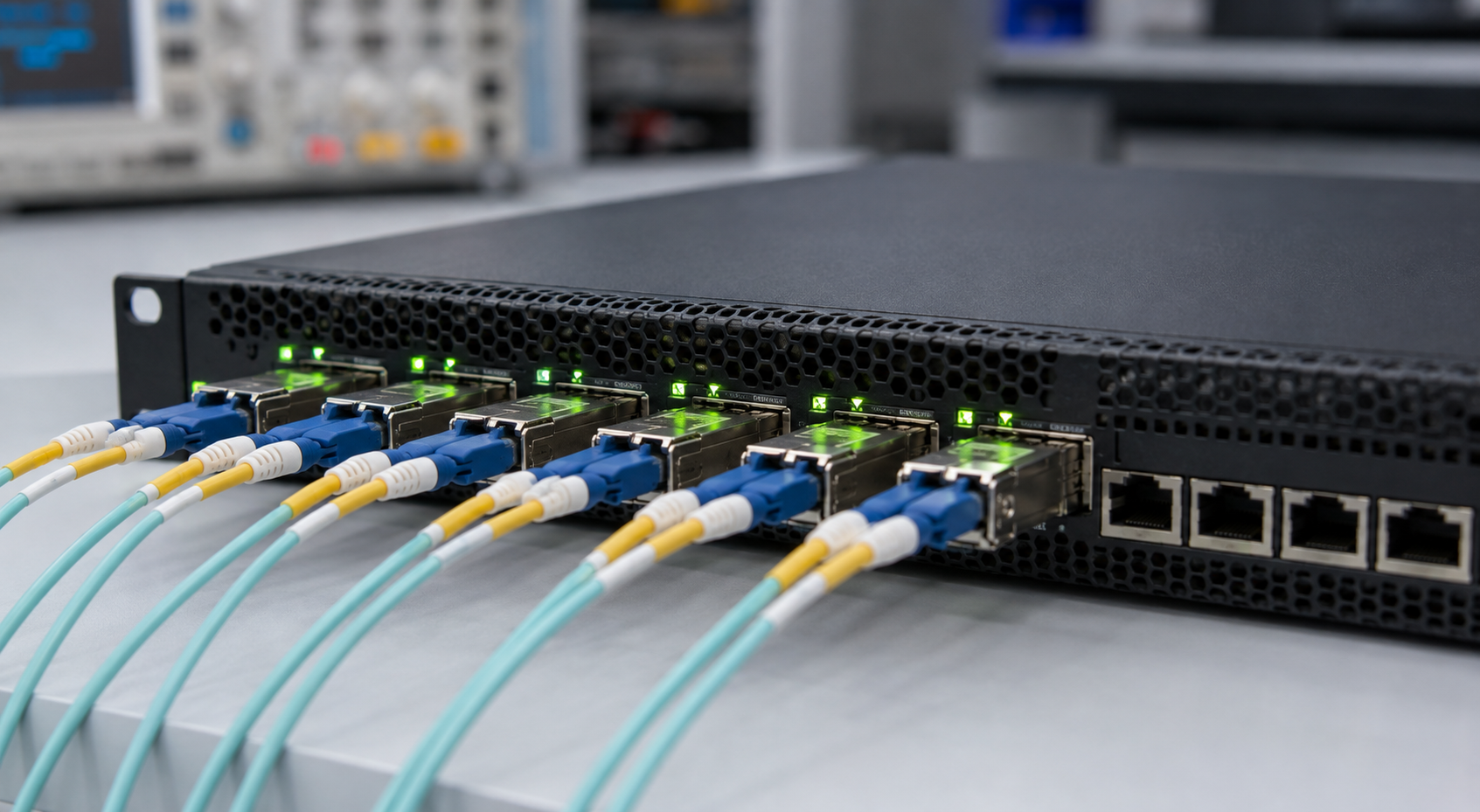
What using a compatible optic actually changes
It is not a blanket void
Cisco's published non-entitlement policy is conditional and discretionary: support may be withheld where a fault is traced to a third-party component — and where it is not attributable, Cisco says it will continue to provide support.
Keep a swap kit
Whatever you populate your estate with, keep two or three OEM modules on the shelf. If you raise a case on a port you will be asked to eliminate the optic as a variable. Being able to do that in ten minutes is worth the shelf space.
Lifetime warranty
On the module — not one year, and not tied to your support contract on the switch. Every optic is tested in real hardware before it ships, which is why we can offer it.
439 part numbers. One PDF. Free.
Name and email, and it is in your inbox — with the download link on the next page too, so you are not waiting on a mail server. No sales sequence you cannot leave. If the part you need is not in it, tell us and we will either find it or say so plainly.
Get the guide →Got a whole parts list rather than one part number? Send it over and we will price it line by line.