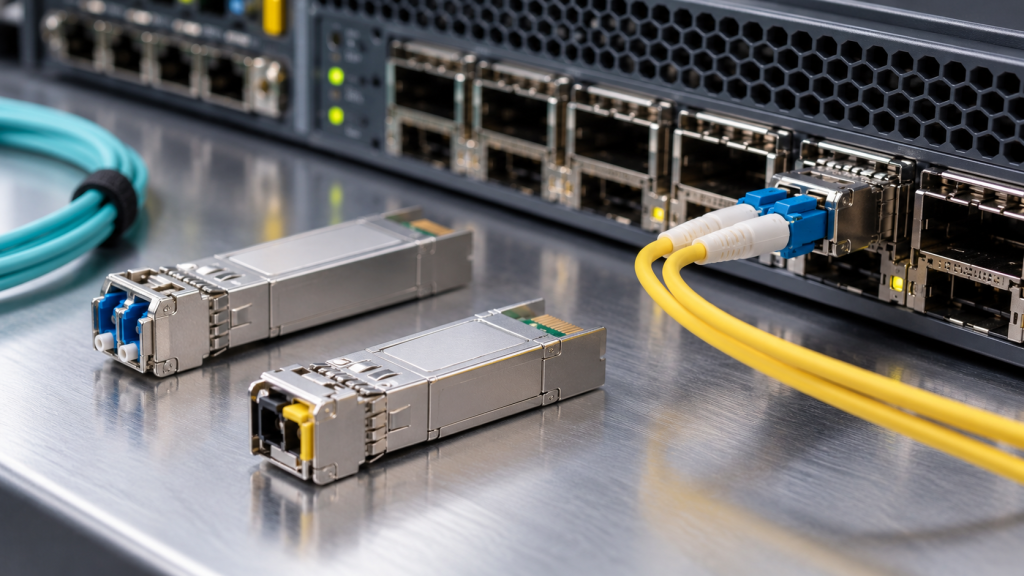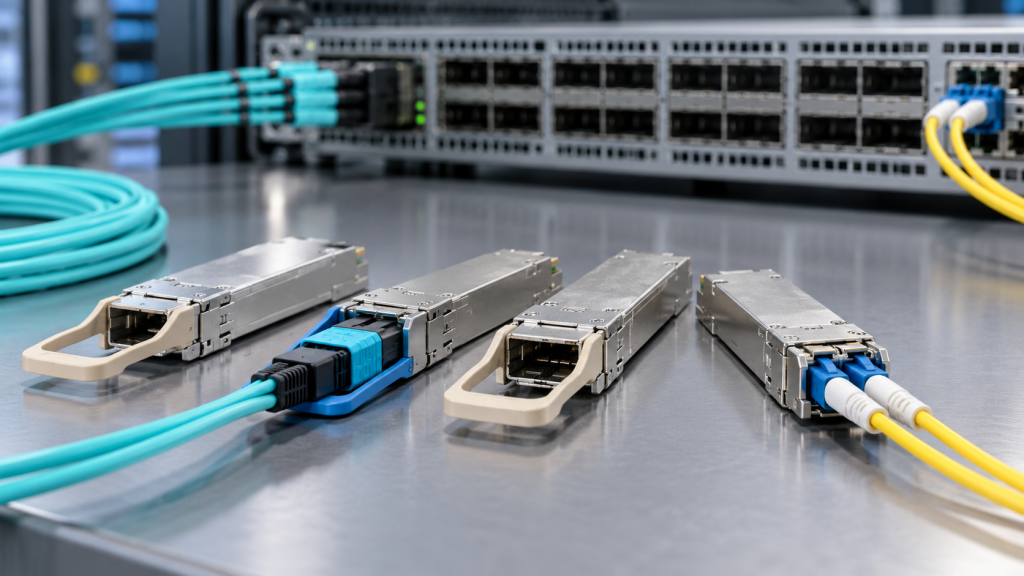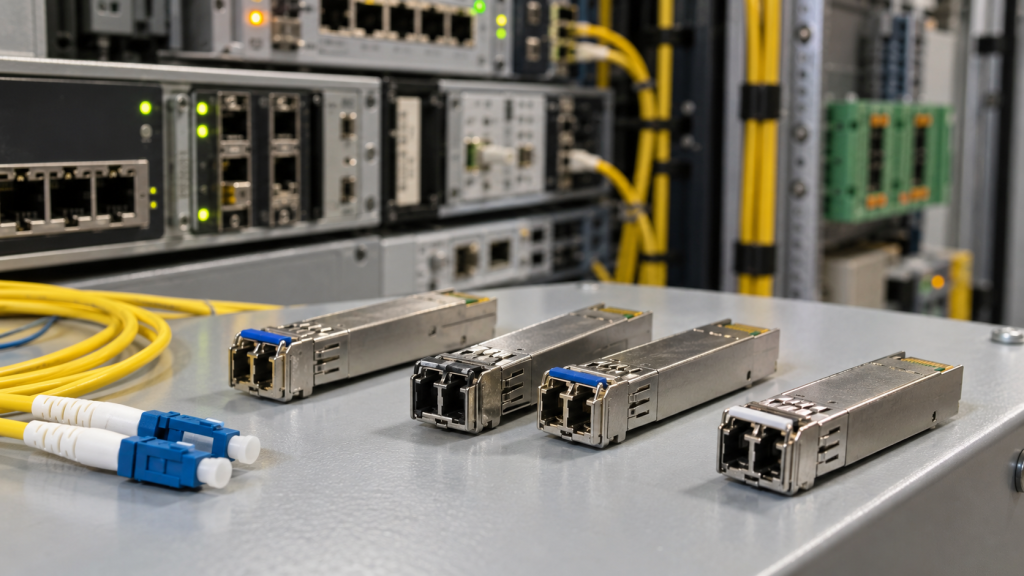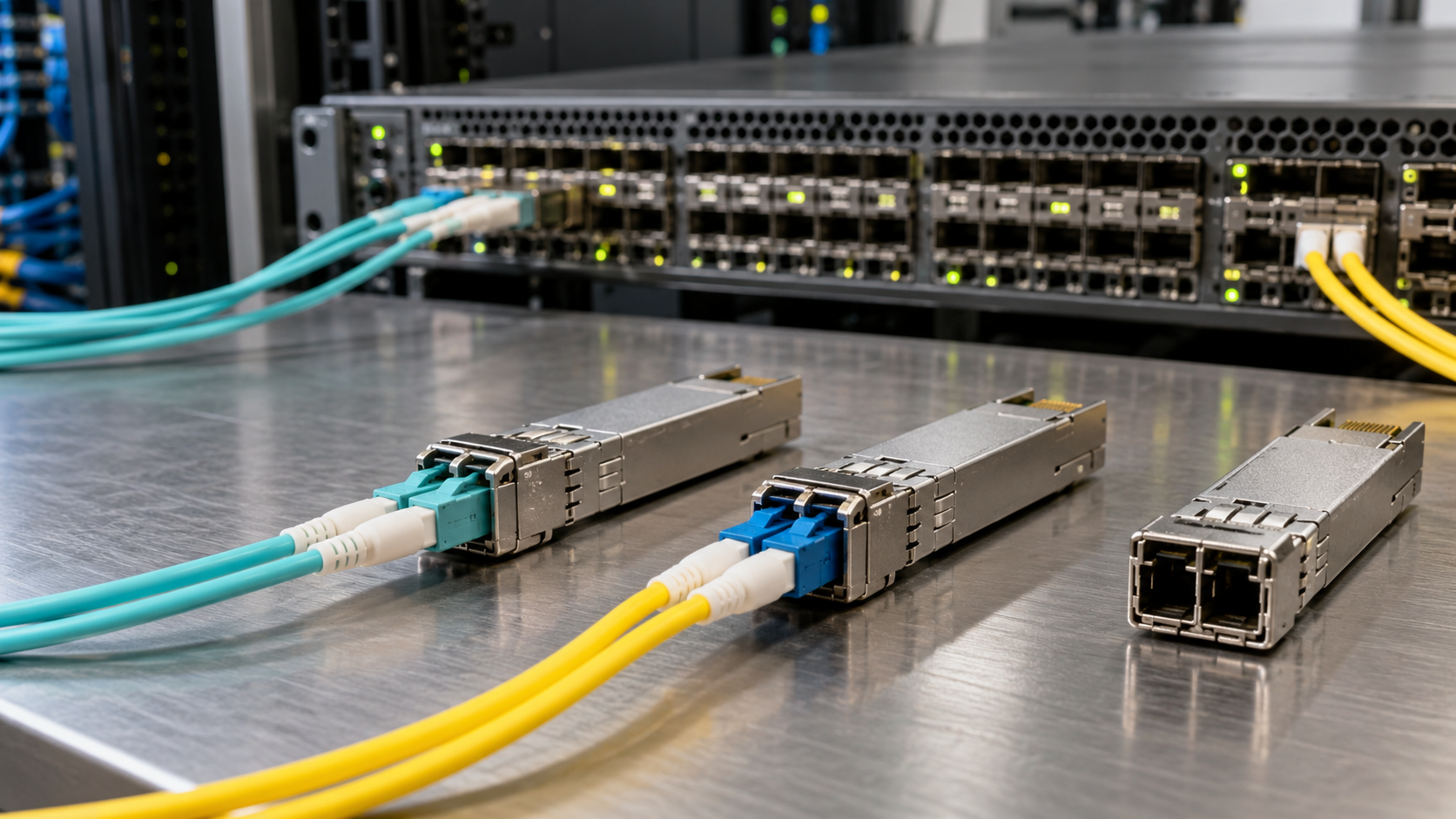
Pick up a 32G Fibre Channel SFP+ and a 25G Ethernet SFP28 and you are holding what is, mechanically and electrically, very nearly the same object: the same package, the same duplex LC, the same cage, a lane running at about 28 gigabaud. Then you put the Fibre Channel module in an Ethernet switch and nothing happens, and you discover that storage optics are a separate discipline with its own names, its own compatibility rules and its own idea of what a speed increase means.
16G and 32G Fibre Channel are where most production storage area networks actually live. 64GFC and 128GFC exist and are shipping, but the installed base of directors, fabric switches and host bus adapters running at 16 and 32 gigabits is enormous, it is in finance, government, healthcare and manufacturing, and it is not being replaced on a data-centre refresh cycle because the applications behind it will not tolerate the outage.
This guide covers the SW and LW naming, the speed and encoding story that explains the odd-looking line rates, the forward error correction that arrived with 32GFC, the backward-compatibility trap that catches people replacing 16G modules with 32G ones, and which of the 196 Fibre Channel modules Carritech holds fits what.
SW and LW, not SR and LR
Start with the names, because this is the first thing that trips up an engineer arriving from Ethernet. Fibre Channel describes its optical variants by wavelength rather than reach:
- SW — short wavelength. 850 nm VCSEL over multimode fibre, duplex LC. The direct equivalent of Ethernet’s SR. This is the overwhelming majority of what is deployed, because a SAN is normally a short-reach, latency-sensitive fabric inside one or two buildings.
- LW — long wavelength. 1310 nm DFB over single-mode fibre, duplex LC, 10 km. The equivalent of Ethernet’s LR, and used for inter-switch links between halls, buildings or campuses.
You will also meet SM y MM in part-number strings meaning single-mode and multimode, and in older documentation SN y LC describing the connector rather than the optics. What you will not meet is the long ladder of 40 km, 80 km and 120 km pluggables that exists in the Ethernet ranges. Fibre Channel stops at 10 km in a module, and past that the answer is a wavelength on a DWDM system or an IP encapsulation, not a longer optic. Our guide to Fibre Channel transceivers covers how the whole naming scheme maps onto the Ethernet one.
The speeds, and why the line rates look wrong
En Fibre Channel Industry Association publishes a speedmap, and the numbers on it repay a careful look.
| Generation | Line rate | Encoding | Throughput each way | Market availability |
|---|---|---|---|---|
| 8GFC | 8.5 GBd, NRZ | 8b/10b | 800 MB/s | 2008 |
| 16GFC | 14.025 GBd, NRZ | 64b/66b | 1,600 MB/s | 2011 |
| 32GFC | 28.05 GBd, NRZ | 64b/66b | 3,200 MB/s | 2016 |
| 64GFC | 28.9 GBd, PAM-4 | — | 6,400 MB/s | 2020 |
| 128GFC | 56.1 GBd, PAM-4 | — | 12,425 MB/s | 2024 |
| 256GFC | 112.2 GBd, PAM-4 | — | 24,850 MB/s | Market demand |
The figures in FCIA’s own July 2023 speedmap are quoted as full-duplex totals — 3,200 MB/s for 16GFC, 6,400 for 32GFC — so the column above halves them to give throughput in each direction. Fibre Channel is full duplex by definition and storage people quote it both ways; Ethernet people usually do not. It is a recurring source of confusion in capacity planning. The encoding column is left blank for the PAM-4 generations because this guide is about 16G and 32G, and the block coding above 32GFC is a longer story than it deserves here.
Now the interesting line. 16GFC doubled the throughput of 8GFC on a line-rate increase of only about 65%. The reason is the encoding change. 8GFC used 8b/10b, which spends a quarter of the line rate on encoding overhead. 16GFC moved to 64b/66b, which spends about 3%. A comparison of 25GbE and 32GFC presented to the IEEE 802.3 25G study group sets out the same arithmetic for the next generation up. 32GFC then doubled the line rate honestly, which is why its baud rate is exactly twice 16GFC’s.
The practical consequence of that encoding change is that 16GFC and 32GFC are electrically a different kind of link from 8GFC and below, with transmitter training on the electrical side and a different error model. It is the real generational boundary in the Fibre Channel catalogue, and it falls between 8G and 16G rather than between 16G and 32G.
FEC arrived with 32GFC
Here is the cleanest difference between the two ranges in this guide. FCIA is explicit that with FC-PI-6, the physical interface standard behind 32GFC, Fibre Channel used forward error correction for the first time. 16GFC has no mandatory FEC. 32GFC mandates RS(528,514) — the same Reed-Solomon code family the Ethernet world adopted for 100G in Clause 91 — and 64GFC moves to the stronger RS(544,514), which is part of why its baud rate had to rise to about 28.9 GBd to carry the extra parity.
Two things follow, and they matter when you are reading a fabric rather than buying for it:
- A 32GFC link with a busy corrected-error counter is working normally. Uncorrectable codewords are the counter that represents lost frames. Judged by 16GFC standards — where any error is an error — a healthy 32G link looks alarming. The mechanism is in our guide to forward error correction.
- The FEC costs latency, and it is a known quantity. The IEEE study-group comparison above puts total FEC latency at 278 ns for 32GFC. For a storage fabric that is a real number worth knowing rather than an abstraction, and it is the price of the reach and the cost reduction the coding buys.
What 32GFC does not have is the 25G Ethernet problem of two ends configured for different FEC. In Fibre Channel the coding is fixed by the generation rather than configured, so the FEC-mismatch fault class that plagues 25G Ethernet does not exist here. Speed negotiation handles it: 64GFC-capable devices exchange training frames that communicate the FEC type and lane count, so the fabric settles the question itself.
The backward-compatibility trap
This is the one to read twice, because it costs people outages.
FCIA’s own rule is that each new Fibre Channel generation must be backward compatible with at least two prior generations, which is why Fibre Channel fabrics stay mixed-speed for a decade at a time. The IEEE comparison above states the consequence plainly for this generation: a 32GFC port must support 8GFC and 16GFC through speed negotiation.
But that is a statement about the port, not about the pluggable in it. A module has its own specified rate range in its EEPROM, and the ranges are not all the same. Carritech’s 16G designs, CT-16G-SFP+SR y CT-16G-SFP+LR, are specified for 16G, 8G and 4G Fibre Channel. Carritech’s 32G designs, CT-32G-SFP+SR y CT-32G-SFP+LR, are specified for 32GFC and 16GFC.
So the failure mode is this: a 16G module is replaced with a 32G module in a port that still has an 8G or 4G device on the other end of it, on the entirely reasonable assumption that newer is a superset of older. The port is capable. The optic is not. The link does not come up, or comes up at a speed nothing expects, and the obvious suspects — the fibre, the far-end HBA, the zoning — all check out. Confirm the module’s rate range against the slowest device it will ever have to talk to, not against the switch’s data sheet.
The same logic applies in the other direction when consolidating: an elderly 4G array behind a 32G fabric needs a module that still reaches down to 4G somewhere in the path, which in practice means the 16G range. That is a good reason to keep a 16GFC line in stock rather than standardising everything on 32G.
Reach, fibre grade and the thing storage gets wrong
Both Carritech SW designs are specified to 100 m on multimode, and 100 m on OM4 is also what the IEEE comparison cites for 32GFC. That is the figure to design to, and it is shorter than the distances a 1G or 10G estate got used to over the same cable. Higher baud rates are less tolerant of modal dispersion, so the fibre grade matters more at 32G than it did at 8G, over exactly the same installed cable. An OM3 run that carried 8GFC comfortably for fifteen years may not carry 32GFC at the same length.
Three practical consequences:
- Re-measure before you re-rate. A speed upgrade on existing multimode is a cabling question as much as a module question. Work the optical link budget on the actual route, and confirm what is installed with single-mode vs multimode fibre.
- Connector cleanliness stops being housekeeping. SANs are patch-panel-dense environments and every mated pair is a decibel you did not budget for. Fibre optic connector cleaning is the cheapest margin available anywhere, and at 32G you need it.
- If the span is long, go LW early. An LW module on single-mode at 10 km costs more than an SW one and removes the whole argument. For inter-switch links between buildings it is almost always the right call.
Beyond 10 km, Fibre Channel over a DWDM wavelength is the standard answer, and the channel-planning side of that is in CWDM vs DWDM y 10G DWDM and CWDM SFP+. On ITU-T G.652 fibre the loss is the easy part; the dispersion and the latency budget of a synchronous replication link are the hard parts.
The package: SFP+ or SFP28?
Worth being precise about, because the catalogue naming across the industry is loose. A 16GFC module is an SFP+: one lane at 14.025 GBd, inside the SFP+ electrical envelope. A 32GFC module runs at 28.05 GBd, which is an SFP28-class electrical interface in an identical SFP mechanical package — and it is commonly sold, listed and labelled as "SFP+" because the shape and the connector have not changed. Carritech’s 32G parts are named CT-32G-SFP+SR and CT-32G-SFP+LR and described as SFP28 modules, which is accurate on both counts and confusing on neither if you know to read it that way.
The thing that actually matters is the host port. A 32GFC module needs a port built for a 28 GBd lane. It will not deliver 32G in a 16G cage, and a 16GFC module in a 32G port will negotiate down and work. Same rule, same direction, as everywhere else in this catalogue — and the same rule that governs 25G SFP28 on the Ethernet side, where the identical 28 GBd lane does a different job. Management and diagnostics follow the SFF specifications at SNIA in both cases.
Who writes the rules
Fibre Channel standards come from the INCITS Fibre Channel Technical Committee, known as T11 until 2022 and still called that by most of the industry. The physical-interface standards are the FC-PI series: FC-PI-5 for 16GFC, FC-PI-6 for 32GFC, FC-PI-7 for 64GFC. FCIA is the industry association that publishes the roadmaps and the educational material, including the 32GFC overview and the 64GFC FAQ that the figures above draw on.
It is a smaller and more conservative world than Ethernet, and that is the point of it. Specifications change slowly, backward compatibility is a stated requirement rather than a happy accident, and the installed base is treated as an asset rather than an obstacle. Which is exactly why the optics supply problem described in your optics will go end-of-sale before your switch does bites hardest here: the fabric is designed to last and the module line is not.
Buying optics for a SAN
Three things are different about storage procurement, and they all push in the same direction.
- Both ends police identification. In an Ethernet link the switch checks the module. In a Fibre Channel link the fabric switch checks it and so does the host bus adapter, so a module has to satisfy two different vendors’ expectations. That is why the part-number lists below are long and why transceiver coding is not optional in this part of the catalogue.
- The part numbers are opaque even by this industry’s standards. A storage optic may be coded for the array vendor, the switch vendor, the HBA vendor or the server OEM who shipped the whole thing, and the same optical design appears under four unrelated strings. There are over a hundred 32GFC codings below behind two optical designs.
- Change control is tighter. You cannot casually swap a module in a production fabric at month end, which means stock matters more than lead time and a tested equivalent available today beats a cheaper one in six weeks.
On the question that always comes up, compatible optical transceivers vs OEM y do third-party optical transceivers void your warranty? answer it straight, and the 16G, 25G and 32G overview covers where these ranges sit against each other.
Diagnostics on a storage link
Fibre Channel modules report the same digital diagnostics as any other pluggable: temperature, supply voltage, laser bias current, transmit and receive optical power. Everything in our guide to spotting a failing fibre link before it drops applies, and on a SAN it applies with more force, because the thing on the other end is storage and the application behind it does not degrade gracefully.
The one range-specific point: at 16GFC you have no FEC, so the error counters mean what they appear to mean and a rising count is a real and immediate problem. At 32GFC you have FEC, so the useful signal is the pre-FEC trend rather than the frame error count, and a link can sit close to the edge reporting nothing at all. Trend received optical power on both, and trend corrected errors on the 32G ports.
Seven checks before you order
- Confirm SW or LW. 850 nm on multimode, 1310 nm on single-mode, and they are not interchangeable.
- Confirm the module’s rate range, not the port’s. The 32G designs cover 32G and 16G; the 16G designs cover 16G, 8G and 4G. This is the most expensive mistake in the range.
- Check the multimode grade and the length. 100 m on OM4 at 32GFC, and an old OM3 run may not make it.
- Do not judge a 32G link by 16G error standards. Corrected errors are the FEC working.
- Match the coding to both ends. The switch and the HBA both police identification, and the qualification is per-platform.
- Beyond 10 km, stop looking for a module. Fibre Channel tops out at LW; past that it is a DWDM wavelength or an IP encapsulation.
- Buy from stock. A production fabric cannot wait for a lead time, and a change window missed is a change window gone.
The Fibre Channel modules Carritech stocks
One hundred and ninety-six tested part numbers across the 16G and 32G ranges — 86 at 16GFC and 110 at 32GFC — every one coded for the platform it is going into and measured against its specification before despatch. Grouped by OEM coding below, 16G first in each pair.
Cisco and Cisco MDS
At 16GFC, DS-SFP-FC16G-SW, DS-SFP-FC16G-SW-RF, DS-SFP-FC16G-LW, DS-SFP-FC16G-LW=, 10-2666-01, 10-2673-01. At 32GFC, DS-SFP-FC32G-SW, DS-SFP-FC32G-SW=, DS-SFP-FC32G-SW-RF, DS-SFP-FC32G-LW, DS-SFP-FC32G-LW=, DS-SFP-FC32G-LW-RF, MDS-32G-SW, 10-3206-01, 10-3207-01. Platform guidance is in compatible optics for Cisco platforms and the Cisco optics reference guide.
Brocade and Broadcom
At 16GFC, 57-0000088-01, 57-0000089-01, 57-1000487-01, 57-1000488-01, BRSFP-16GSW, BRSFP16G10K8P, BRSFP16G10KLW, XBR-000192, XBR-000193, XBR-000198, XBR-000199, XBR-000258, XBR-000458, XBR-000492, XBR-000493, XBR-000498, XBR-000499. At 32GFC, 57-1000332-01, 57-1000333-01, 57-1000485-01, 57-1000486-01, XBR-000212, XBR-000213, XBR-000238, XBR-000239, XBR-000278, XBR-000412, XBR-000413, XBR-000438, XBR-000439, XBR-000478, XBR-000479. The XBR and 57- series are the Brocade-coded parts that appear in director-class and fabric switches under several different badges.
HPE
At 16GFC, QK724A, QK725A, E7Y10A, R6B10A, R6B11A, R6W28A, 656435-001, 656436-001, 734839-001, 793444-001. At 32GFC, P9H28A, P9H29A, P9H30A, P9H32A, Q2P62A, Q9D30A, Q9D31A, R0L28A, R0Q23A, R4D50A, R6B12A, R6B13A, R6W26A, R7M17A, R9S31A, 855070-001, 855071-001, 855073-001, 878404-001, P06958-001, P24195-001, P29142-001.
Dell and Dell EMC
At 16GFC, 0M7HF, NHPNF, NKX77, TDTCP, 407-BBBB, 407-BBBC, 407-BBCC, 407-BBCD, 019-078-045, 100-652-588. At 32GFC, 2WMTW, 5FW65, 61D14, F6VG3, F7HPK, VGM76, 407-BBXH, 407-BBXI, 407-BBXM, 407-BBXN, 407-BBXO, 407-BCHF407, 407-BCHH, 407-BCIN, 407-BCJP, 407-BCJU, 407-BCJV, 407-BCJW, 407-BCKV, 407-BCMJ, 407-BCNZ, 407-BCOC, 407-BCOS, 407-BCOU, 407-BCQD, 407-BCSL, 407-BCWS, 565-BBIU, 590-TFJL.
IBM and Lenovo
At 16GFC, 00MY768, 00RY190, 00RY191, 00WC089, 03GH236, 4M27A65411, 4M27A65412, 4M27A65413, 4M27A65414, 88Y6393, 98Y2176. At 32GFC, 01KN789, 01KN793, 01KN795, 01KN799, 01YM942, 02CL041, 02PX560, 4M27A65416, 4M27A65417, 4M27A65418, 4M27A65419, 78P6616.
NetApp
332-00331, 332-00351, X6596-R6, X6601A-R6, X6602A-R6, X65403, X-48895-00-R6, ACHU, X-000212, X-000213, X-000238, X-000239, AJHE, AJHF, AJHJ, AJHK.
Host bus adapter codings
LP32-LW-OPT-1, LP32-LW-OPT-2, LP32-SW-OPT-1, LP32-SW-OPT-2 — the LP series being the Emulex-lineage HBA optics, which is the half of the link an Ethernet engineer does not expect to have to code for.
Juniper, Arista, Ciena, Huawei and Fujitsu
QFX-SFP-16GFC-SW, QFX-SFP-16GFC-LW, ARI-SFP-16GFC-SW-O, ARI-SFP-16GFC-LW-O, 160-9700-900, 160-9701-900, 34061588, 34061585, SFP-FC-32G-SW-MM850, SFP-FC-32G-SW-MM850-CM, S26361-F3873-L216. If a part number like these tells you nothing on its face, our guide to vendor part-number schemes explains how they are constructed, and Juniper QFX5120 compatible optics y Arista compatible optics cover those platforms.
Generic and other codings
SFP-16GFC-SW, SFP-16GFC-LW, SFP-16GB-SW-N2, SFP-16GB-LW-N2, SFP-32GFC-LW, SFP32-SR-SP, SFP32-LR-SP, S28-32GFC-SW-85C, 7101675, 7101676, 7101685, 7101686, 7103017, 7103018, 7103543, 7103544, 1061701131-01, 38041265, 8960-2301, AA359425.
The Carritech base parts
Four optical designs sit behind all one hundred and ninety-six part numbers above. CT-16G-SFP+SR is the 16GFC short-wavelength module: 850 nm VCSEL, PIN photodiode, 100 m on multimode, specified for 16G, 8G and 4G Fibre Channel. CT-16G-SFP+LR is the 16GFC long-wavelength equivalent: 1310 nm DFB, PIN receiver, 10 km on single-mode.
CT-32G-SFP+SR is the 32GFC short-wavelength module — an SFP28-class design with an 850 nm VCSEL and PIN photodiode to 100 m, specified for 32GFC and 16GFC — and CT-32G-SFP+LR is the 32GFC long-wavelength part, 1310 nm DFB to 10 km. All four report full digital diagnostics and draw well under the SFP+ power envelope.
Four designs, one hundred and ninety-six part numbers. The entire difference is the vendor identification string, and in storage that string has to satisfy two vendors rather than one — which is why the Carritech Opticode coding box and the approach in building a smarter transceiver stock strategy pay for themselves faster here than almost anywhere else. Hold four designs, code at the point of deployment, and a mixed Cisco, Brocade, HPE, Dell, IBM and NetApp estate stops needing a hundred line items of spares.
Keeping a storage fabric supplied
Carritech Optics holds the 16G, 25G and 32G range in UK and EU stock. Browse Canal de fibra 16G SFP y SFP+ de canal de fibra de 32 G directly, or the 16G y 32G transceiver ranges, with patch cords alongside. Where the fabric meets Ethernet, the 25G SFP28 y SFP+ 10G ranges are the other half of the cabinet.
Every module is coded for the target platform and measured against its specification before despatch — see the 22 checks a module passes and our transceiver testing process — and carries a garantía de por vida, with UK and EU stock and support behind it. Our accreditations, why choose us y support pages cover how we work, and the knowledge centre holds the rest of the technical library.
Holding a bill of materials full of storage part numbers from four different vendors for one fabric? That is the problem Carritech exists to solve. Our compatibility checker returns the tested Carritech equivalent of an OEM part number in seconds, upload the whole list and we will price it, or request a quote and tell us the switch, the HBA and the slowest device on the fabric.