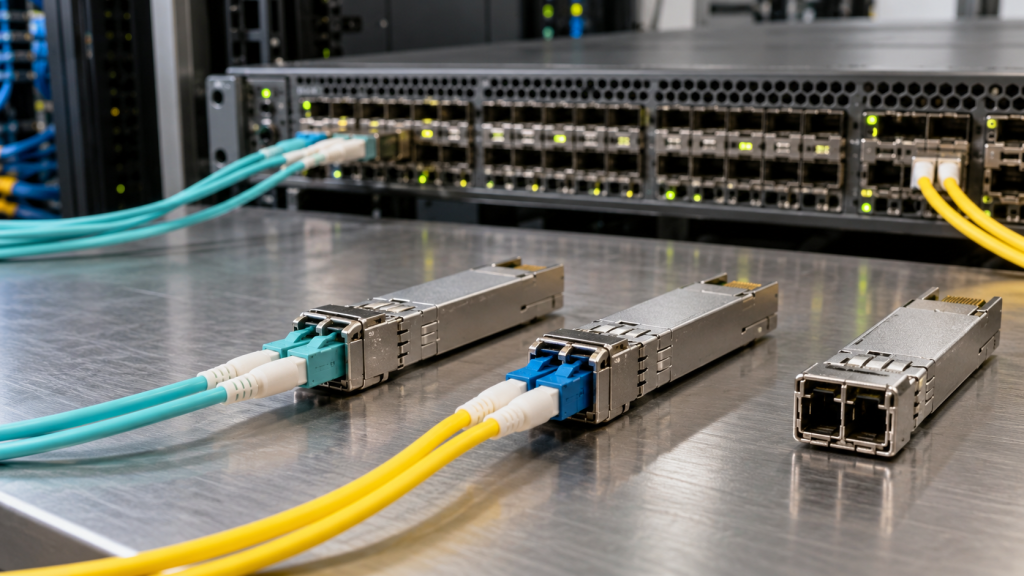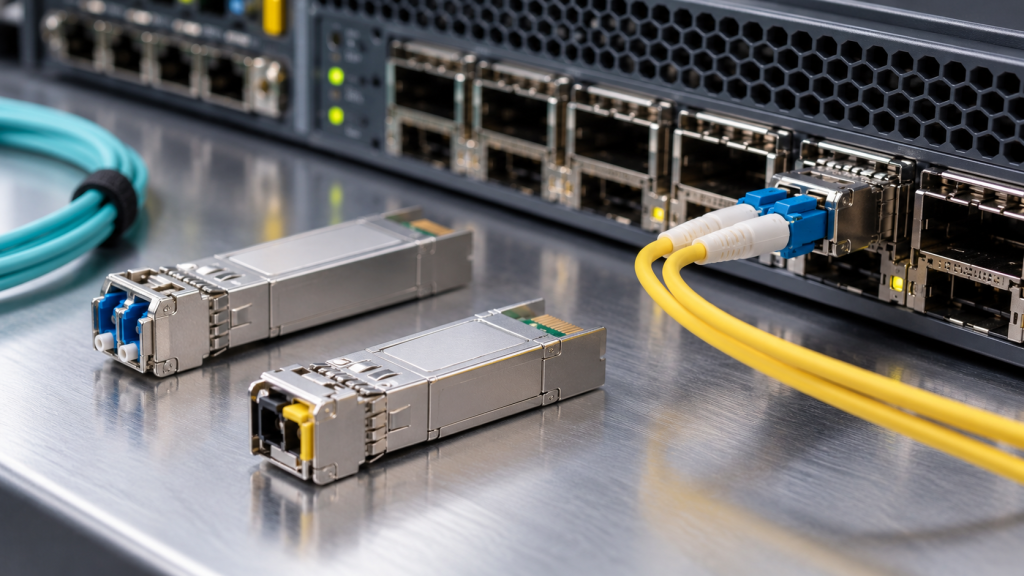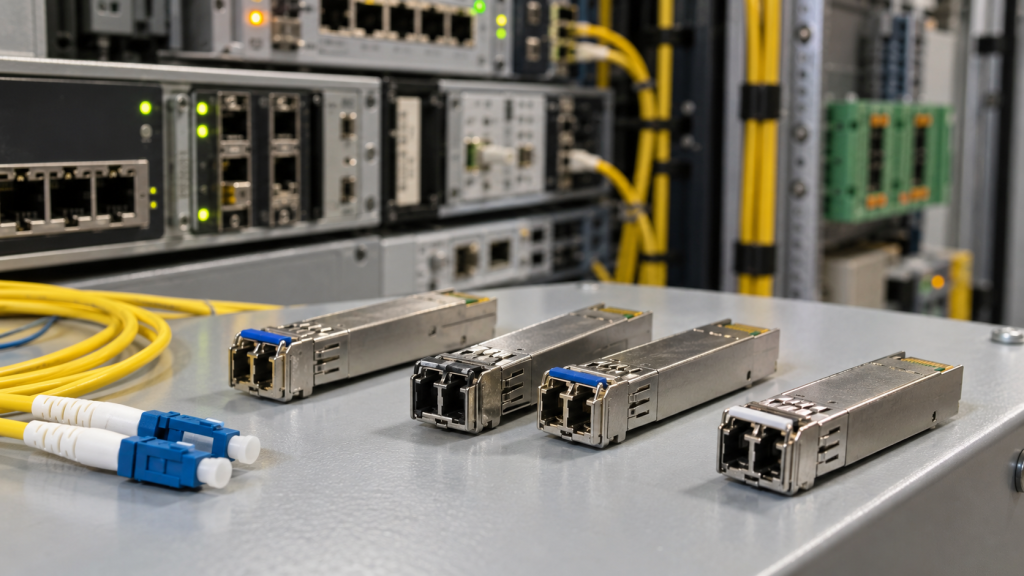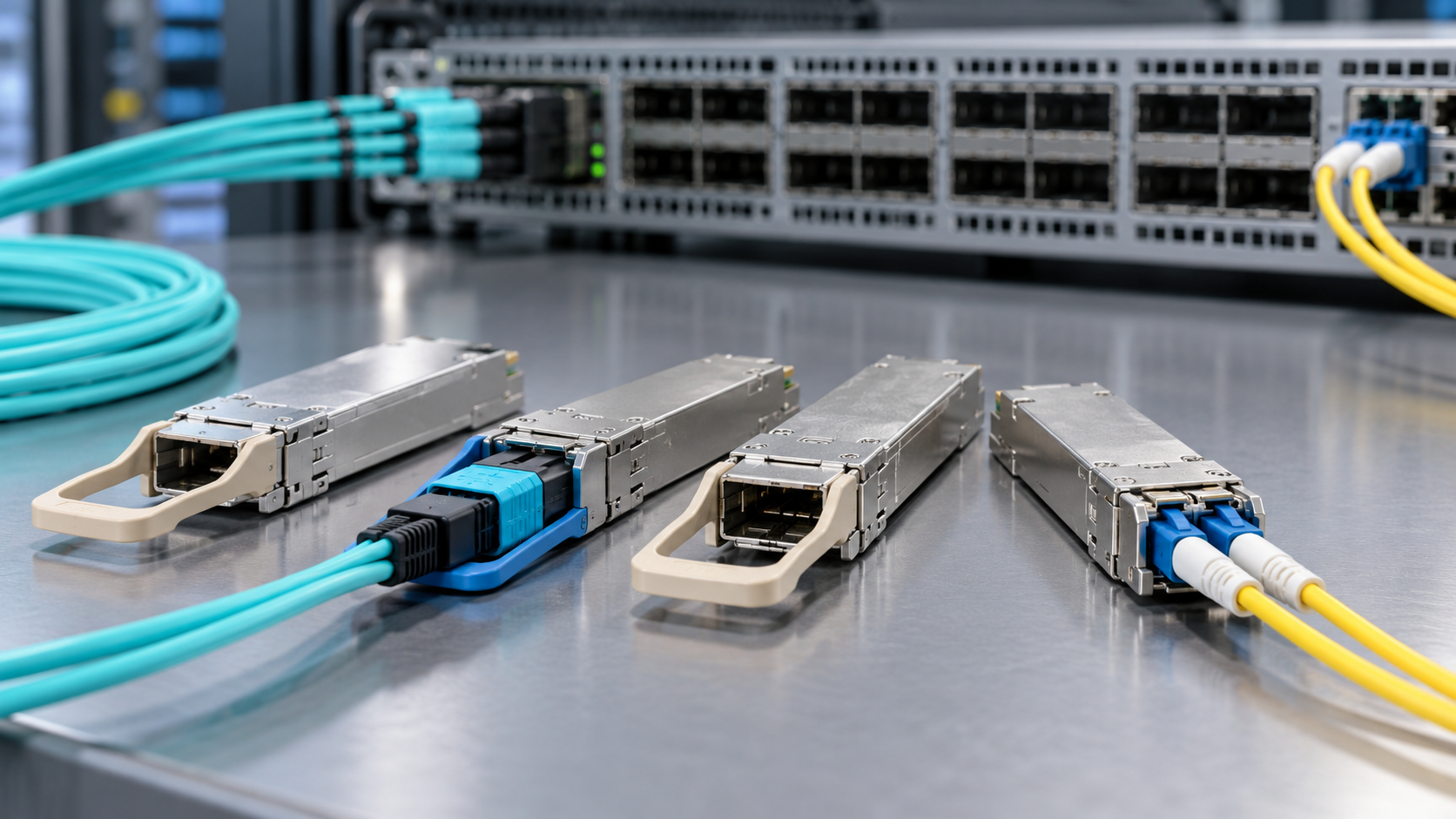
Every 100G form factor that came before it was a compromise. CFP was the size of a paperback. CFP2 and CFP4 shrank it but kept the MDIO management nobody’s tooling understood. CXP went nowhere. Then 25G serial lanes arrived, somebody put four of them in a package the same size as the 40G QSFP+ that switch vendors had already built cages for, and the argument ended. QSFP28 is the most widely deployed 100G package in the world, and it is the one on the front of almost every switch sold in the last decade.
Which is good news and a problem at once. The good news is that a 100G port is now a commodity. The problem is that "100G QSFP28" covers at least ten different optical interfaces, four of which reach somewhere between 500 m and 2 km, two of which are industry agreements rather than IEEE standards, and two of which share a name with something they will not interoperate with. Ordering the wrong one is easy and the module is not returnable once it has been coded.
This guide sets out what the variants are, which cabling and which fibre each one needs, the 2 km decision that catches most people, where forward error correction comes into it, why a ZR4 module is not 100GBASE-ZR, and which of the 211 modules Carritech holds fits what.
What QSFP28 actually is
QSFP28 is a four-lane pluggable package roughly 72 mm long, 18.35 mm wide and 8.5 mm tall, carrying four electrical lanes at 25.78 Gbit/s each with NRZ signalling, managed over I²C against the SFF-8636 memory map maintained through the SFF specifications at SNIA. Most variants draw 3.5 W or less. The Ethernet interfaces that run over it come from IEEE 802.3ba and the amendments that followed it, principally 802.3bm-2015 y 802.3cu-2021.
Two mechanical facts shape how 100G estates actually get built. A QSFP+ module fits a QSFP28 cage, which is why 40G optics keep turning up in equipment bought years after 40G stopped being specified — the subject of our guide to 40G QSFP+ transceivers. And the four lanes can be split, so one QSFP28 port is also four independent 25G interfaces. The reverse does not hold: a QSFP28 module does not work in a QSFP+ cage, because the host cannot drive 25G lanes it was never designed for.
The 100G QSFP28 variants, compared
Ten interfaces cover essentially all QSFP28 deployment. Three of them are not IEEE standards, and that is flagged rather than glossed over, because it changes the question from "does it comply" to "does it interoperate with the thing at the far end".
| Variante | Optics | Fibre and connector | Llegue a | Standard |
|---|---|---|---|---|
| SR4 | 850 nm VCSEL × 4 | OM4 multimode, MPO-12 | 100 m | IEEE 802.3bm |
| SR-BD / SRBD | 850 / 900 nm, PAM-4 | OM4 multimode, duplex LC | 100 m | Vendor design |
| PSM4 | 1310 nm DFB × 4 | Single-mode, MPO ribbon | 500 m (MSA) | MSA |
| CWDM4 | 1271–1331 nm × 4 | Single-mode, duplex LC | 2 km | MSA |
| LR4 | 1310 nm LAN-WDM × 4 | Single-mode, duplex LC | 10 km | IEEE 802.3ba |
| LR1 | 1310 nm single λ, PAM-4 | Single-mode, duplex LC | 10 km | IEEE 802.3cu |
| ER4 Lite | 1310 nm LAN-WDM × 4 | Single-mode, duplex LC | 30 km, or 40 km with FEC | Vendor design |
| ER4 | 1310 nm LAN-WDM × 4, APD | Single-mode, duplex LC | 40 km | IEEE 802.3ba |
| ZR4 | 1310 nm LAN-WDM × 4, APD | Single-mode, duplex LC | 80 km | Vendor design |
| EZR4 | 1310 nm LAN-WDM, SOA | Single-mode, duplex LC | 100 km | Vendor design |
Note what is missing from that list: there is no 100G QSFP28 equivalent of SR10, the ten-lane multimode interface that 802.3ba originally specified. SR10 belongs to the CFP generation and needs a 24-fibre MPO; SR4 needs twelve. Both are "100G short reach over multimode" and they will not talk to each other, which is one of the traps set out in our guide to CFP, CFP2 and CFP4.
The 2 km decision: CWDM4 or PSM4
Between SR4’s 100 m and LR4’s 10 km sits the single most common 100G requirement in a modern data centre: a link that has to cross a campus, a building or a couple of halls. Two designs compete for it, neither of them an IEEE standard, and the choice is almost entirely about fibre rather than optics.
- PSM4 is parallel single-mode. Each 25G lane gets its own fibre pair — eight fibres in an MPO ribbon — with four uncooled 1310 nm DFB lasers and no multiplexer. Cheap optics, four times the fibre.
- CWDM4 multiplexes four coarse wavelengths from 1271 to 1331 nm onto a single duplex LC pair. More expensive optics, a quarter of the fibre.
The rule of thumb is the cost of the fibre. Inside a building where the ribbon is already pulled, PSM4 is usually cheaper overall and has the useful property that it breaks out into four 25G links with a fan-out harness. Between buildings, where single-mode pairs are scarce and a ribbon means a new duct, CWDM4 wins outright, and it wins by more than the module price difference. If you are weighing it against lighting more wavelengths, the reasoning in CWDM vs DWDM y 10G DWDM and CWDM SFP+ scales down a speed.
Two cautions. The published CWDM4 reach assumes host FEC is enabled — Carritech’s CT-QSFP28-CWDM4 is specified that way, and a CWDM4 link run without FEC should not be expected to make 2 km. And PSM4 reach is the one figure in this part of the catalogue where published numbers vary most between vendors and MSA revisions, so work it from the optical link budget for the actual route rather than the headline kilometre.
FEC is part of the interface now
This is the generation where forward error correction stopped being optional. 100GBASE-SR4, and every other 4 × 25G PMD on the list above, is specified with Clause 91 RS-FEC in the path. The raw error rate off a 25G-per-lane receiver is not low enough to use unprotected, and the standard assumes the host is correcting it.
Three practical consequences, all of which generate support calls:
- A busy corrected-error counter on a 100G port is normal. Uncorrectable codewords are the counter that represents damage. If you are reading a QSFP28 port with instincts trained on 10G, start with our guide to forward error correction.
- FEC is in the host, not the module. You cannot buy a QSFP28 with better FEC, and swapping brand of optic does not change the coding.
- Disabling FEC does not get you a cleaner link. On these PMDs it gets you a link that does not come up, or one that comes up and drops frames. The one speed where FEC is genuinely a configuration choice is 25G per lane on its own, covered in our guide to 25G SFP28 transceivers.
ZR4 is not 100GBASE-ZR
This one is worth a section because the names are a trap and the two things are not remotely the same product.
ZR4, as sold in QSFP28, is a direct-detection module: the same four LAN-WDM wavelengths as LR4 and ER4, pushed harder, with avalanche photodiode receivers to recover them at 80 km. It is a vendor design rather than an IEEE PMD, it plugs into an ordinary QSFP28 port, and it behaves like a long grey optic.
100GBASE-ZR is something else entirely. It was specified in IEEE 802.3ct, approved in 2021 as the amendment for 100 Gb/s operation over DWDM systems, and it is coherent: combined phase and amplitude modulation, a digital signal processor doing the detection, and a target reach of at least 80 km over a DWDM line system. Different optics, different power envelope, different management, and not interoperable with a ZR4 module at the far end.
If what you need is 100G across a metro span on somebody else’s DWDM infrastructure, coherent is the right family and the comparison in 400ZR vs OpenZR+ and the design questions in data centre interconnect are the place to start. If what you need is 100G across 80 km of your own dark fibre, a ZR4 in a switch port is very likely cheaper and simpler. The reach comparison between the direct-detection options is in 100G ZR4 vs LR4 vs ER4.
Two things to plan around with any of the long-reach parts. They have real optical gain to spend, so they are intolerant of a short link — an 80 km module on a 5 km span can saturate its own receiver, and the fix is an attenuator or the right part. And at 40 km and beyond the published distance is a specification point, not a promise about aged cable with six splices and four patch panels in it. Work the budget, and read fibre optic connector cleaning first, because it is the cheapest decibel available anywhere.
"100G BiDi" means two different products
Ask for a 100G BiDi module and you may get either of two unrelated designs. Both reduce fibre count, both are vendor rather than IEEE designs, and they have nothing else in common.
- SR-BD over multimode. Two wavelengths, 850 and 900 nm, PAM-4 signalling, 100 m on OM4, over a duplex LC multimode pair. Its whole purpose is to avoid re-cabling: it runs on the duplex patch leads already installed for 10G and 40G rather than needing a 12-fibre MPO like SR4. Carritech’s part is CT-Q40/100-SRBD, which runs at both 40G and 100G.
- BX over a single single-mode fibre. One wavelength each way down one fibre, on a simplex LC, built on the single-wavelength PAM-4 optics of 100GBASE-LR1. Reaches run from 10 km to 80 km. These are sold in matched upstream and downstream halves and two of the same half will never link — the same rule as every other BiDi product, set out in BiDi transceivers.
Pick by the problem. If the constraint is multimode duplex cabling you do not want to replace, SR-BD. If the constraint is that there is literally one fibre to the site, BX. They are not alternatives to each other.
Breakout: one port, four 25G interfaces
Because the four lanes are independent, most platforms can configure a QSFP28 port as 4 × 25G. With an SR4 module and an MPO-to-8×LC harness, one port becomes four 25GBASE-SR interfaces; with PSM4 and a single-mode harness, four 25GBASE-LR. A QSFP28-to-SFP28 adapter achieves something similar one port at a time, letting a 100G cage take a single 25G module.
This is usually the cheapest 25G capacity you will ever buy, because you already own it. Two caveats, both the same at every speed: the host has to support the split, which is a platform capability rather than a module one, and a fan-out harness adds connector pairs to a budget that may not have room for them. The mechanics are in breakout explained, and the modules you land on are in the 25G SFP28 range.
Inside the rack, use cable
For a short 100G hop between adjacent racks, two modules and a patch lead is the expensive answer. A direct attach cable costs less, draws almost nothing and adds no optical budget to manage; an active optical cable gets you to tens of metres with the same simplicity. The 100G QSFP28 DAC y 100G QSFP28 AOC ranges cover both, including breakout assemblies that fan one QSFP28 out to four SFP28 in one piece. DAC vs AOC sets out where the line falls.
What interoperates with what
The useful principle is that interoperability is a property of the PMD, not the package. A 100GBASE-LR4 is a 100GBASE-LR4 whether it is in QSFP28, CFP, CFP2 or CFP4, so a QSFP28 switch port will light a link to an elderly CFP line card at the far end over the same duplex single-mode pair. That is what makes a one-end-at-a-time migration possible, and it is the basis of any sane exit from a CFP chassis.
What does not interoperate is anything where the lane count, the wavelength plan or the fibre type differs: SR4 and SR10, SR4 and SR-BD, CWDM4 and PSM4, ZR4 and coherent ZR. Confirm the PMD at both ends before the part number, and if the fibre type itself is in doubt, single-mode vs multimode fibre covers how to tell what is installed. Where ribbon cabling is involved, MPO polarity explained will save you an afternoon.
Power, density and what comes next
A QSFP28 SR4 draws about 3.5 W against roughly 1.5 W for a 40G SR4 — better per bit, worse per port, which matters in a chassis with a fixed thermal budget and a front panel full of cages. The long-reach parts draw more: Carritech specifies CT-QSFP28-ER4 under 4.5 W against under 3.5 W for the SR4 and LR4 designs. The numbers across the whole catalogue are in optical transceiver power consumption.
Density is where QSFP28 is finally being overtaken. 32 ports of 100G in 1U was extraordinary in 2016 and is unremarkable now, and the 400G and 800G packages do four and eight times the traffic in a comparable face. If you are costing a refresh rather than a module order, choosing 400G optics, QSFP-DD vs OSFP y the 800G and 1.6T migration path are the right starting points. But a 100G port that does its job needs replacing when the port is the constraint, not when the industry moves on, and the Ethernet Alliance roadmap is a useful sanity check on which of those you are actually looking at.
One thing is worth noticing early. QSFP28 has been current for a decade, which means the optics for it are now being manufactured by fewer vendors than at the peak, and the less common variants — ER4, ZR4, PSM4, the BiDi parts — are where availability tightens first. That is the pattern described in your optics will go end-of-sale before your switch does, and 100G is early in it rather than exempt from it.
Diagnostics worth watching
Every module here reports temperature, supply voltage, laser bias and per-lane transmit and receive optical power, with the management model defined in the SFF specifications and, on newer hosts, the OIF’s Common Management Interface Specification. On a four-lane module that per-lane breakdown is the most useful troubleshooting data available anywhere: one cold lane is one fibre, one connector or one MPO position, not a dead module. Errors spread evenly across all four lanes point at the module, the host channel or temperature instead. Our guide to spotting a failing fibre link before it drops covers how to trend it, and on single-mode spans the attenuation of ITU-T G.652 fibre is where the budget starts.
Six checks before you order
- Confirm the PMD at the far end, not just the speed. "It’s 100G" is not enough information to pick a part number.
- Confirm the connector. SR4 and PSM4 need MPO; CWDM4, LR4, LR1, ER4 and ZR4 need a duplex LC pair; BX needs a simplex LC. This is the most common 100G ordering error.
- Check the fibre. OM4 for SR4 and SR-BD, single-mode for everything else, and a single-mode module on multimode fibre will not work at all.
- Leave FEC enabled. These PMDs assume it, and CWDM4’s published reach depends on it.
- Work the budget on long spans, and check the short ones too. ER4, ZR4 and EZR4 can be saturated by a link that is too short as easily as defeated by one that is too long.
- Match the coding to the platform — see transceiver coding explained. Identification is policed per-platform, and a correct optic with the wrong coding is a module the switch will not accept.
The 100G QSFP28 modules Carritech stocks
Two hundred and eleven tested part numbers across the duplex and BiDi ranges, every one coded for the platform it is going into and measured against its specification before despatch. Grouped by OEM coding below.
Cisco and Cisco-coded
QSFP-100G-SR4, QSFP-100G-SR4-S, QSFP-100G-SR4-E, QSFP-100G-SR1.2, QSFP-100G-SM-SR, QSFP-100G-SRBD, QSFP-40/100-SRBD, QSFP-40/100G-SM4, QSFP-100G-CWDM4, QSFP-100G-CWDM4-S, QSFP-100G-PSM4, QSFP-100G-PSM4, QSFP-100G-PSM4-S, QSFP-100G-PSM-IR, QSFP-100G-LR4, QSFP-100G-LR4-S, QSFP-100G-LR4-I, QSFP-100G-LR, QSFP-100G-LR, QSFP-100G-LR-S, QSFP-100G-LR1, QSFP-100G-ER4-Lite, QSFP-100G-ER4L, QSFP-100G-ER4L-S, QSFP-100G-ERL4, QSFP-100G-ZR4, QSFP-100G-ZR4-S, QSFP28-100G-ZR4, MA-QSFP-100G-LR4, MA-QSFP-100G-SR4, QSFP-100G-B20U4-I, QSFP-100G-B20D4-I. Platform guidance is in compatible optics for Cisco platforms, Nexus 9300 compatible optics, Catalyst 9300 and 9500 compatible optics and the Cisco optics reference guide.
Arista
QSFP-100G-ER4L-AR, QSFP-100G-LR1-AR, QSFP-100G-ZR4-AR, QSFP-100GBASE-LR4, QSFP-100GBASE-SR4. See also Arista compatible optics.
Juniper
JNP-QSFP-100G-SR4, JNP-QSFP-100G-LR4, JNP-QSFP-100G-CWDM, JNP-QSFP-100G-PSM4, JNP-QSFP28-100G-PSM4, JNP-QSFP-100G-ER4L, JNP-QSFP-100G-LR1, JNP-QSFP-100G-BXSR, JNP-QSFP-40/100G-SM4. For platform specifics, JNP-QSFP-100G-LR4 compatible optics y Juniper QFX5120 compatible optics.
HPE, Aruba and H3C
JH420A, JH673A, JL274A, JL275A, JL309A, JL310A, JL743A, JQ344A, Q2F19A, Q8J73A, R0Z30A, S2T35A, S3N89A, S6H32A, S6H33A, 845972-B21, QSFP28-100G-LR1-HPE, QSFP28-100GB-ZR4-HPE, QSFP28-40/100G-SM4-HPE.
Dell and Dell EMC
407-BBVO, 407-BBWV, 407-BBYM, 407-BBZX, 407-BCDH, 407-BCEX, 407-BCPY, 407-BCRB, 407-BCWC, QSFP28-100G-ER4L-DL, QSFP28-100G-LR1-DL.
Huawei
02311GBW, 02311KNU, 02311MNN, 02311RUF, 02311VYF, 02311YXR, 02312NVQ, 02312RVM, 02314DBR, 02314GYT, 02314HES, 02315GHV, 02315GHW, 02315GHX, 02315GHY.
Nokia, Ciena and transport platforms
3HE10051AA, 3HE10550AA, 3HE10551AA, 3HE11239AA-80, 3HE12229AA, 3HE16558AA, 3AL82073AA, 3AL82074AA-80, 3AL82075AA, 160-9400-900, 160-9401-900, 160-9401-901, 160-9402-900, 160-9403-900, 160-9404-900, 160-9433-900, XCVR-Q10V31, XCVR-Q30V31, XCVR-Q80V31, XCVR-100G-ER4L, XCVR-100G-LR1, AA1405001-E6, AA1405005-E6. The 3HE, 3AL and XCVR schemes describe nothing on their face — Nokia compatible optics and 3HE part numbers explains how they work.
Extreme, Brocade and Ruckus
100G-ER4LT-QSFP40KM, 100G-LR4-QSFP2KM, 100G-QSFP28-CWDM4-2KM, 100G-QSFP28-LR4-10KM, 100G-QSFP28-LR4-LP-10KM, 100G-QSFP28-LR4L-2KM, 100G-QSFP28-SR4, 100G-QSFP28-PIR4-500M, 10401, 10403, 10403-80, 10404-LR1, 10405, 10405-ER4L, 10407, 10450, E100G-QSFP28-CWDM4-2KM, E100G-QSFP28-ER4L, E100G-QSFP28-LR1, E100G-QSFP28-LR4-10KM, E100G-QSFP28-LR4-LP-10KM, E100G-QSFP28-LR4L-2KM, E100G-QSFP28-SR4, E100G-QSFP28-SR4-A, E100GQSFP28LRX, E100GQSFP28SRX, XBR-100G-LR4-01, XBR-100G-SR4-01, XBR-100G-SR4-0288.
NVIDIA and Mellanox
MMA1B00-C100D, MMA1L10-CR, MMA1L10-CR-80, MMA1L30-CM, MMS1C10-CM.
Firewall, security and load balancer platforms
FN-TRAN-QSFP28-CWDM4, FN-TRAN-QSFP28-ER, FN-TRAN-QSFP28-LR, FN-TRAN-QSFP28-SR, PAN-QSFP28-100GBASE-BIDI, PAN-QSFP28-100GBASE-CWDM4, PAN-QSFP28-100GBASE-ER4, PAN-QSFP28-100GBASE-LR4, PAN-QSFP28-100GBASE-SR4, PAN-T-Q28-100GBASE-LR4, PAN-T-Q28-100GBASE-SR4, F5-UPG-QSFP28-SR4, F5-UPG-QSFP28-SRBD. Appliances are all-fibre and the things either side of them often are not, which is why these codings come up as often as switch ones — and why copper SFP modules turn up in the same cabinets.
Allied Telesis, Netgear, Ubiquiti and MikroTik
AT-QSFP28-LR4, AT-QSFP28-SR4, ACM761, ACM762, UACC-OM-QSFP28-LR4, UACC-OM-QSFP28-SR4, XQ+31LC02D, XQ+31LC10D, XQ+85MP01D.
Component and transceiver-vendor codings
FTLC1154RDPL, FTLC1154RDPL3, FTLC1155RGPL4, FTLC1156RDPL, FTLC1157RGPL, FTLC4353RKPL, FTLC9555NEPM, FTLC9555SEPM, FTLC9558REPM, SPQ-CE-ER-CDFL-M, SPTSLP4SLCDF, SM9110-SR4, ET7402-ZR4, TOM-100G-Q-LR4-80, GBPS-ER4, HCD00D20I0000-0-80KM, QSFP28-100G-PSM4, QSFP28-100G-PSM4-IR, QSFP28-100G-SR4-MP, QSFP100G-LR4, QSFP100G-SR4.
The Carritech base parts
Ten optical designs sit behind all 195 duplex part numbers above. In order of reach: CT-QSFP28-SR4, CT-QSFP28-CWDM4, CT-QSFP28-PSM4, CT-QSFP28-LR4, CT-QSFP28-LR1, CT-QSFP28-ER4-L, CT-QSFP28-ER4, CT-QSFP28-ZR4, CT-QSFP28-EZR4, CT-Q40/100-SRBD.
The BiDi range is ten parts in five matched pairs, from 10 km to 80 km over a single fibre: CT-QSFP28-BX-10U, CT-QSFP28-BX-10D, CT-QSFP28-BX-20U, CT-QSFP28-BX-20D, CT-QSFP28-BX-30U, CT-QSFP28-BX-30D, CT-QSFP28-BX-40U, CT-QSFP28-BX-40D, CT-QSFP28-BX-80U, CT-QSFP28-BX-80D.
Ten designs, two hundred and eleven part numbers. The difference between them is almost entirely the vendor identification string in the EEPROM — which is the stock problem set out in building a smarter transceiver stock strategy and solved with the Carritech Opticode coding box, which lets you hold one design per reach and code at the point of deployment.
Keeping 100G ports supplied
Carritech Optics holds the 40G QSFP+ and 100G QSFP28 range in UK and EU stock. Browse 100G duplex QSFP28 y 100G BiDi QSFP28 directly, the wider 100G transceiver range including cable assemblies, or 200G y 400G if that is where the port is heading. Patch cords y adapters are alongside.
Every module is coded for the target platform and measured against its specification before despatch — see the 22 checks a module passes and our transceiver testing process — and carries a garantía de por vida, with UK and EU stock and support behind it. On the procurement questions, compatible optical transceivers vs OEM y do third-party optical transceivers void your warranty? answer them straight, and our accreditations, why choose us y support pages cover how we work. The knowledge centre holds the rest of the technical library.
Not sure whether a span wants CWDM4 or PSM4, or whether a line card will break a port out to 4 × 25G? Tell us the platform, the cabling and the distance and we will say. Our compatibility checker returns the tested Carritech equivalent of an OEM part number in seconds, upload a whole part-number list and we will price it, or request a quote.