SFP-10G-SR is the most deployed 10G optic in the world. It is also the one most often ordered by the wrong name, populated into fibre that cannot carry it, and blamed for faults it did not cause.
This is the reference page for it: what the standard actually specifies, how far it genuinely goes on each grade of fibre, the difference between the four Cisco variants that all look interchangeable, the equivalent part number from thirty other vendors, and the compatible alternative if the one you want has gone last-ship.
What SFP-10G-SR actually is
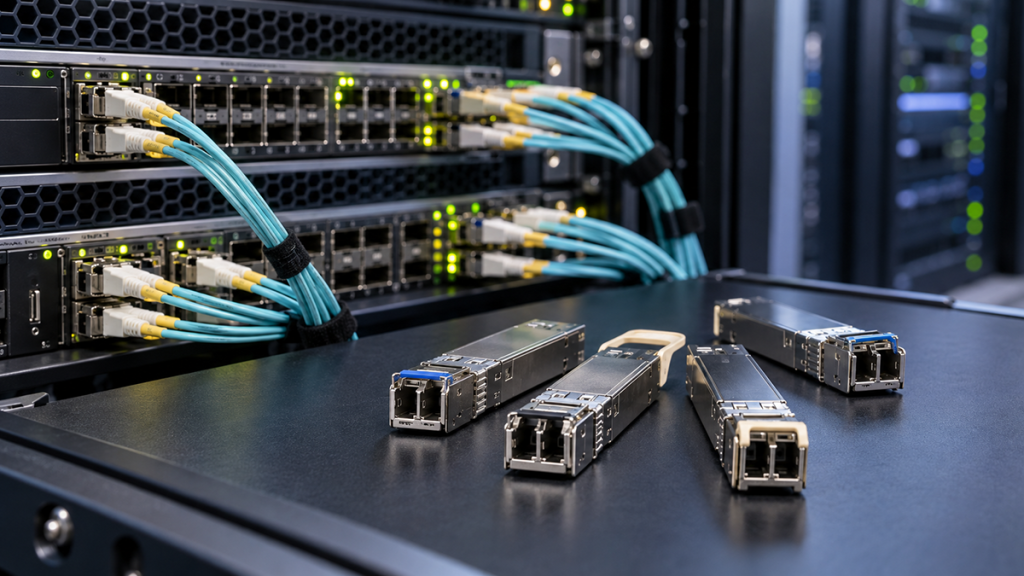
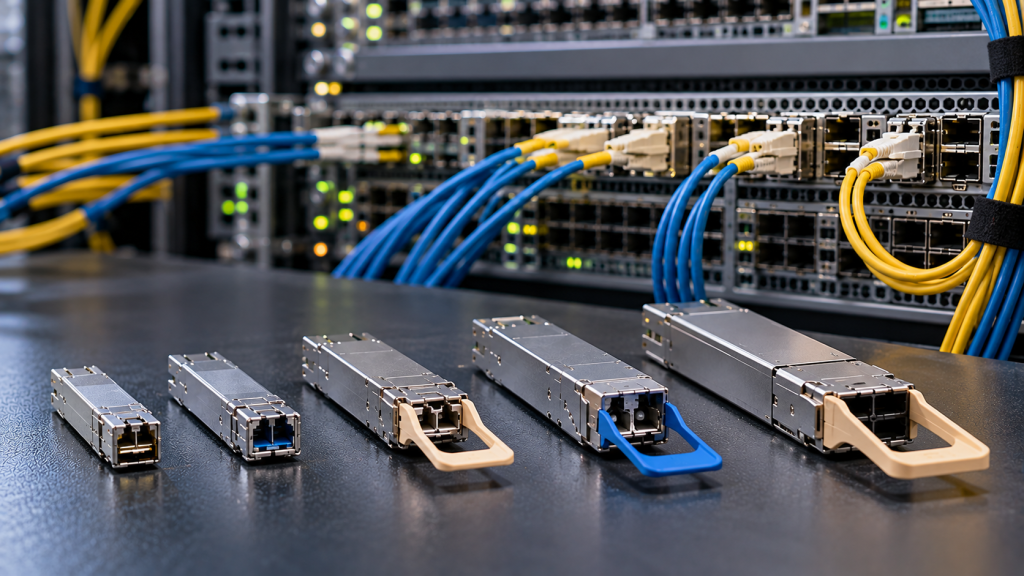
SFP-10G-SR is an 850 nm short-reach optical transceiver in the SFP+ form factor, with a duplex LC connector, running 10 Gigabit Ethernet over multimode fibre.
The standard behind it is IEEE 802.3 Clause 52, introduced as IEEE 802.3ae-2002 and now part of the IEEE 802.3-2022 rollup. The “S” is short reach; the “R” is the 64B/66B encoding defined in Clause 49. The SFP+ electrical and mechanical interface is SFF-8431, and the diagnostic interface is SFF-8472 — both now maintained by the SNIA SFF Technology Work Group.
Cisco’s published figures for its own SFP-10G-SR, from the 10GBASE SFP+ modules datasheet:
| Paramètres | Valeur |
| Longueur d'onde | 840–860 nm, nominal 850 |
| Connecteur | Duplex LC/PC |
| Transmit power | −7.3 to −1.2 dBm |
| Receive power | −9.9 to −1.0 dBm |
| Consommation électrique | 1 W |
| Operating temperature | 0 to 70 °C (commercial) |
| Digital optical monitoring | Yes |
Two things people frequently misquote. Cisco publishes a minimum receive power of −9.9 dBm, not a “receiver sensitivity” — the labels are not interchangeable. And Cisco does not publish a link budget figure at all; anything you see quoted as one is somebody’s arithmetic on the two power ranges above. The number that is actually specified is the channel insertion loss in the standard: 2.6 dB on OM3, 2.9 dB on OM4 (TIA Fiber Optics Technology Consortium).
How far SFP-10G-SR really goes
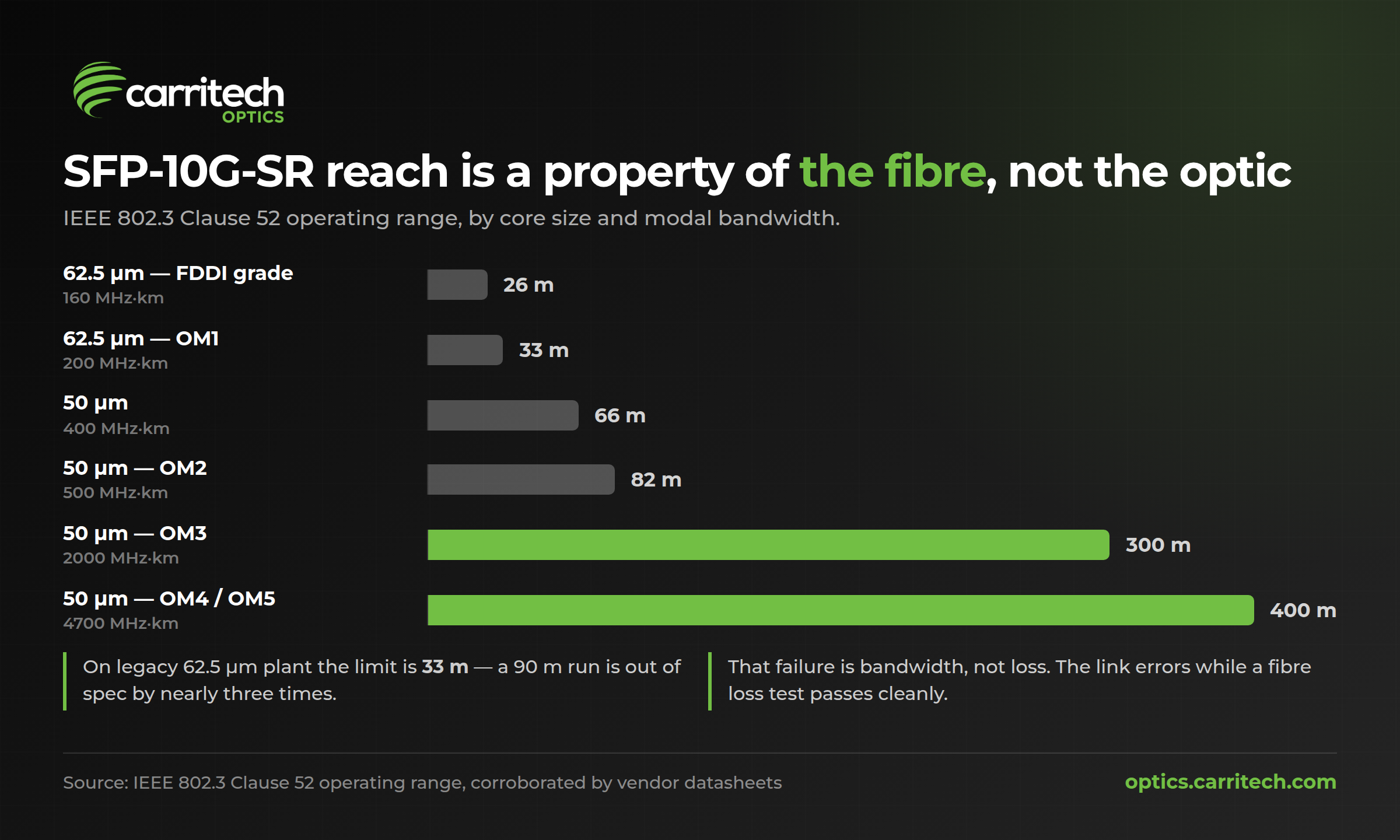
The reach is not a property of the transceiver. It is a property of the fibre’s modal bandwidth, and the standard indexes it that way — by core size and MHz·km, not by OM grade.
| Fibre | Modal bandwidth | Atteindre |
| 62.5 µm (FDDI grade) | 160 MHz·km | 26 m |
| 62.5 µm (OM1) | 200 MHz·km | 33 m |
| 50 µm | 400 MHz·km | 66 m |
| 50 µm (OM2) | 500 MHz·km | 82 m |
| 50 µm (OM3) | 2000 MHz·km | 300 m |
| 50 µm (OM4/OM5) | 4700 MHz·km | 400 m |
The bottom two rows are the ones everybody quotes. The top four are the ones that catch people out. An SFP-10G-SR link across 90 m of 1990s 62.5 µm riser is out of specification by a factor of nearly three, and the failure mode is instructive: the channel insertion loss allowance for those grades is only 1.6 dB, so a loss test passes cleanly while the link errors. You are bandwidth-limited, not loss-limited, and the fibre tester will not tell you that.
Worth correcting a widespread claim: 400 m on OM4 is an IEEE number, not vendor marketing. It was added through the 802.3 maintenance process and published in IEEE 802.3-2012, as the Ethernet Alliance announced at the time. It is also deliberately conservative, because the standard has to work with a minimally compliant transmitter rather than a typical one.
The other end of the range matters too. The standard’s operating range starts at 2 m, and Cisco states plainly that the minimum cabling distance for SR modules is 2 m per IEEE 802.3ae. There is no need to attenuate a short SR link: maximum launch power and maximum receive power are both around −1 dBm, so at zero channel loss the receiver sees precisely what it is rated for. That is a real difference from ER and ZR-class single-mode optics, where launch power genuinely does exceed receiver overload, and it is where the “always fit an attenuator” folklore comes from.
SFP-10G-SR, SR-S, SR-X and SR-I are not the same part
Cisco sells four modules whose optics are identical — same wavelength, same power, same reach table — and whose differences live entirely in temperature grade and protocol support. Ordering the wrong one is a common and expensive mistake.
| Part | What it is |
| SFP-10G-SR | The baseline. 10GBASE-SR, commercial temperature 0 to 70 °C. |
| SFP-10G-SR-S | “S-Class”. Same optics, commercial temperature. Cisco states it does not support FCoE. |
| SFP-10G-SR-X | Multirate 10GBASE-SR, 10GBASE-SW and OTU2/OTU2e. Extended temperature, −5 to 85 °C. |
| SFP-10G-SR-I | Multirate as above, industrial temperature range. |
Two practical consequences.
If you are running FCoE, the S-class part is the wrong part, and it is the one most likely to be quoted to you because it is the cheapest. That restriction is stated by Cisco in the datasheet, not inferred.
And if you are buying SFP-10G-SR-X, you are buying a module that stopped shipping on 16 May 2023. Cisco announced it end-of-life on 14 February 2022, with end-of-sale on 14 February 2023 and a last date of support of 29 February 2028 (end-of-life bulletin). Cisco’s own recommended replacement is SFP-10G-SR-I. This is exactly the pattern covered in our guide to transceiver end-of-life planning: the switch is still supported, the optic is not orderable.
Neither plain SFP-10G-SR nor SFP-10G-SR-S carries an end-of-sale announcement as of August 2026. That is an absence of a bulletin, not a commitment — worth re-checking rather than assuming.
Beyond that, be careful what you believe about “S-class”. Cisco does not state that DOM is removed, that the reach is reduced, that the warranty is shorter or that the optical performance is lower. None of that is in Cisco’s documentation, and all of it circulates freely.
The same optic under thirty other part numbers
Every vendor in the market sells this module. It is the same 850 nm 10GBASE-SR optic in every case; what changes is the identity written into the EEPROM, which is what the host switch reads to decide whether to accept it.
| Vendor | Part number |
| Cisco | SFP-10G-SR, SFP-10G-SR-S |
| Cisco Meraki | MA-SFP-10GB-SR |
| Genévrier | SFPP-10GE-SR, EX-SFP-10GE-SR, QFX-SFP-10GE-SR, SRX-SFP-10GE-SR |
| Arista | SFP-10G-SR |
| HPE Aruba | J9150D, J9150A (X132) |
| HPE Networking | JD092B (X130) |
| HPE server / BladeSystem | 455883-B21 |
| Dell EMC | 407-BBOU, 407-BBPC |
| Huawei | SFP-10G-SR / OMXD30000 (02318169) |
| Extreme Networks | 10301, AA1403015-E6, 10GB-SR-SFPP |
| Ruckus / Brocade | 10G-SFPP-SR, 10G-SFPP-SR-S, 10G-SFPP-SR-SA |
| NVIDIA / Mellanox | MFM1T02A-SR |
| Fortinet | FN-TRAN-SFP+SR |
| Palo Alto Networks | PAN-SFP-PLUS-SR |
| Alcatel-Lucent Enterprise | SFP-10G-SR |
| Ubiquiti | UACC-OM-MM-10G-D, UF-MM-10G |
| Netgear | AXM761 |
| TP-Link | TXM431-SR |
| Zyxel | SFP10G-SR |
| D-Link | DEM-431XT |
| Intel | E10GSFPSRX |
| Check Point | CPAC-TR-10SR-B |
A few of these deserve a note rather than a row.
HPE’s four numbers are four different product lines, not four names for one thing. J9150A and J9150D are the ProCurve/Aruba X132 line, D being the current revision. JD092B is the X130 line, which comes from the H3C/Comware side of the business and is not interchangeable with the X132 family in HPE’s own compatibility matrices. 455883-B21 is a server and BladeSystem option, not a switch code at all.
Juniper’s platform prefixes are ordering codes. EX-SFP-10GE-SR and QFX-SFP-10GE-SR both map to Juniper internal part 740-021308; SFPP-10GE-SR maps to 740-031980.
Some parts that look like SR are not. Arista’s SFP-10G-SRL is “short reach lite” at 100 m on OM3, not 300 m. Intel’s E10GSFPSR is a dual-rate 1G/10G module. Fortinet’s FN-TRAN-SFP+SRI and Extreme’s 10G-SR-SFP300M-ET are extended-temperature variants. Substituting a standard-reach, commercial-temperature part for any of these shortens a link or a temperature range that was working.
The SFP-10G-SR compatible alternative
Our equivalent is CT-SFP+SR. It is built to the same Clause 52 specification, coded for the platform it is going into, tested on that platform before it ships, and carries a lifetime warranty.
| Cisco SFP-10G-SR | Carritech CT-SFP+SR | |
| Standard | 10GBASE-SR, IEEE 802.3 Clause 52 | 10GBASE-SR, IEEE 802.3 Clause 52 |
| Longueur d'onde | 850 nm | 850 nm |
| Émetteur | — | 850 nm VCSEL |
| Connecteur | Duplex LC | Duplex LC |
| Reach on OM3 | 300 m | 300 m |
| Reach on OM4 | 400 m | 400 m |
| Power | 1 W | Under 1 W |
| DOM | Yes | Yes |
| Coding | Cisco | Coded to order, per platform |
The word doing the work in that table is coding. A 10GBASE-SR optic is a 10GBASE-SR optic; the fibre does not know who made it. What decides whether the port comes up is the identity in the transceiver’s EEPROM and what the host does with it. That is why the useful question a supplier can ask you is not “which optic do you want” but “which switch is it going into” — and a supplier who does not ask is guessing.
What the switch does with a compatible SFP-10G-SR
This varies by platform and it is worth knowing before you order rather than after.
On Cisco IOS platforms, an optic the switch does not recognise is typically error-disabled outright, logging %PLATFORM_PM-6-MODULE_ERRDISABLE and %PM-4-ERR_DISABLE: gbic-invalid. The documented mitigations are no errdisable detect cause gbic-invalid and service unsupported-transceiver (Cisco troubleshooting note). Entering the latter prints a warning and brings the port up.
On NX-OS the behaviour is different, and it surprises people: the switch logs a warning and brings the port up anyway. We covered the consequences of that, and the FEC trap that follows from it, in the Nexus 9300 compatible optics guide.
Correctly coded optics do not hit any of this. The reason to know it is that “the port won’t come up” and “the optic is faulty” are different problems with different fixes.
Why SFP-10G-SR links fail, and why it is rarely the optic
When a short-reach multimode link misbehaves, the transceiver is the first thing swapped and almost never the cause. The documented causes, in rough order of how often they turn up:
Contaminated or damaged end faces. Every major test vendor calls this the leading cause of fibre-related faults — Fluke Networks, EXFO and the TIA consortium all say so, though none of them publishes a defensible percentage, so treat the “85%” figure that circulates with caution. What is quantified is the recovery: Fluke reports cleaning end faces recovering up to 1.39 dB. On a 2.6 dB OM3 channel budget, that is more than half the budget sitting on a connector. Cisco’s inspection and cleaning procedure specifies 200× magnification minimum, and inspect-clean-reinspect rather than clean-and-hope.
A 62.5 µm patch lead in a 50 µm channel. Launching 62.5 µm into 50 µm costs roughly 1.0 to 1.3 dB with a VCSEL source, measured by the Fiber Optic Association. That is 40 to 50 percent of an OM3 budget from a single joint. The reverse direction is nearly lossless, which is why the fault appears in one direction only and looks like a failing transceiver.
A mode conditioning patch cord. Cisco is unambiguous: MCP “should never be used in 10GBASE-SR links in the 850-nm window”, because it can couple a few dBm directly into the far receiver and saturate it — producing high bit error rate, link flaps, link down, and eventually irreversible damage (Cisco product bulletin). Mode conditioning cords belong on 1000BASE-LX and LRM over legacy fibre, nowhere near SR.
Trusting DOM as a power meter. SFF-8472 specifies transmit and receive optical power accuracy of ±3 dB. The entire OM3 channel budget is 2.6 dB. DOM is an excellent trend and screening tool and a poor measurement instrument, and a link that looks marginal in show interface transceiver detail may be fine, or may be considerably worse than it reports.
Warranty and support, stated accurately
Vendors are widely believed to void support if you fit a third-party optic. That is not what Cisco’s policy says, and it is worth being precise because the real position is more workable than the folklore.
Cisco’s non-entitlement policy states that where Cisco believes a fault can be traced to a third-party component, it may withhold support at its discretion. It also states, in the same document, that if Cisco concludes the fault is not attributable to that component, Cisco will continue to provide support.
So it is conditional and it is discretionary. It is not a blanket void, and anyone telling you otherwise — in either direction — is overstating their case.
The practical mitigation costs almost nothing: keep two or three OEM optics on the shelf as a diagnostic swap kit. If you raise a case on a port, you will be asked to eliminate the optic as a variable, and being able to do that in ten minutes rather than ten days is worth the shelf space regardless of what you populate the other forty-six ports with.
Check a part number
If you have an SFP-10G-SR part number in front of you — from any of the vendors above, or one not listed — the compatibility checker will tell you the equivalent, the specification, and whether it is a direct match. No form, no account, no waiting on a quote.
Check SFP-10G-SR in the compatibility checker →
Or browse the full range by form factor and speed.