Every network engineer has heard the warning, usually from a vendor account manager: “third-party optics will take your network down.” It’s a powerful fear. The optic is a £50–£500 part sitting in a £50,000 switch, carrying traffic your whole business depends on — and if it fails at 2am, nobody wants to be the person who saved a few hundred pounds on an unbranded transceiver.
So let’s take the question seriously rather than defensively: are compatible optical transceivers actually as good as OEM modules? The honest answer is that it depends entirely on whose compatible transceivers you’re talking about — and once you understand how optics are made and tested, you’ll know exactly what separates a safe purchase from a risky one.
Where transceivers actually come from
Here’s the part the warning leaves out: switch vendors don’t make transceivers. Cisco, Juniper, Arista, HPE and the rest design switches and routers; the optical modules that plug into them are manufactured by specialist optical component makers, largely in the same group of factories, and then branded, coded and priced by the OEM. The optic inside an OEM-labelled module and the optic inside a quality compatible module are frequently closer relatives than the price difference suggests — sometimes down to sharing production lines.
What the OEM adds is real, but it’s specific: their label, their firmware coding, their supply chain, and their support relationship. What they also add is margin — optics are one of the most heavily marked-up items on any network hardware order, precisely because they’re bought after the switch decision is made, when the buyer is locked in.
What “MSA-compliant” actually means
Compatible optical transceivers and OEM modules alike are built to Multi-Source Agreements (MSAs) — industry standards that define, in exact detail, a module’s dimensions, pinout, electrical interface, connector, power envelope and management interface. SFP+, QSFP28, QSFP-DD, OSFP: each form factor is an MSA specification that every manufacturer builds against, OEM and independent alike.
This is why compatibility is an engineering fact rather than a marketing claim. An MSA-compliant 10GBASE-SR module produces the same 850nm signal over the same multimode fibre to the same specification whoever’s name is on it. Your switch reads the module’s EEPROM, checks the coding, and passes traffic. It has no way of knowing — or caring — what the label says. The switch cares about three things: does it fit, does it speak the standard, and is it coded correctly. All three are testable before a module ever reaches your rack.
What separates good compatible optical transceivers from bad ones
If the standards are identical, why do cheap compatibles sometimes deserve their reputation? Because MSA compliance is the floor, not the ceiling — and the difference between suppliers is everything built on top of it:
- Component quality. The laser, driver and receiver inside a module vary in grade. Budget assemblers buy the cheapest batch available that week; quality suppliers specify components and stick to them.
- Coding accuracy. A module that’s electrically perfect but mis-coded for your platform will be rejected by the switch, or worse, half-work. Getting coding right for each host platform — and keeping it right across OEM firmware updates — is skilled, ongoing work.
- Testing before shipment. This is the biggest divider. A cheap module is tested at the factory in aggregate batches, if at all. A properly qualified one is tested as the individual unit you receive, in real host hardware.
- What happens when something’s wrong. Failure rates on well-made optics are low, but nothing is zero. The difference is whether your supplier answers the phone, ships a replacement overnight, and covers the module for life — or disappears behind a marketplace storefront.
How we test at Carritech Optics
We tell customers not to take compatibility on trust — including from us. Every transceiver we ship goes through qualification before it leaves:
- Live traffic testing in real host hardware — the module passes traffic in the platform families it’s coded for, not just a test jig
- Digital diagnostics (DDM/DOM) verification — the module reports accurate temperature, voltage, and optical power figures, so your monitoring sees exactly what it would see from an OEM part
- Optical performance checks — transmit power, receiver sensitivity and signal integrity measured against the MSA specification
- Coding verification — confirmed against the target OEM platform before dispatch
And because we stand behind that process, every module carries a Garanzia a vita. Most OEM optics carry one to five years, often tied to a support contract you pay for separately. We think the warranty gap says more than any datasheet: the party that tests every unit is comfortable guaranteeing it for life.
When OEM transceivers genuinely make sense
An honest comparison has to include the cases where paying the OEM premium is rational — and there are some:
- Support-contract sensitivities. If a platform is under an OEM support agreement whose terms you can’t risk complicating — for example on a critical system where you want zero ambiguity in a fault call — the premium can be worth it for that subset of your estate. (Though note: simply using compatible optics doesn’t void hardware warranties; vendors can decline to support a fault they attribute to a third-party module, which is a narrower thing. We cover this in detail in a separate article.)
- Contractual or certification requirements. Some managed-service contracts and certified designs specify OEM parts end to end. If the paperwork says OEM, that conversation happens above the transceiver level.
- Single-line-item simplicity. If you’re buying two optics a year, the saving may not justify a second supplier relationship. The economics of compatibles compound with volume — port counts in the dozens and up.
What’s not on this list: performance, reliability, or monitoring visibility. Done properly, those are equivalent — that’s what the standards and the testing are for.
How to evaluate any compatible supplier — a checklist
Whether you buy compatible optical transceivers from us or anyone else, these seven questions separate the professionals from the box-shifters:
- Do they test every unit in real host hardware before shipping — or batch-sample at best?
- Will they show you DDM/DOM output from your module’s platform, proving full monitoring visibility?
- Can they code for your specific platform, and re-code if your estate changes?
- What’s the warranty — lifetime, or a year of small print?
- Do they hold European stock with real lead times, or drop-ship from the far side of the world?
- Can you get a compatibility answer before you buy — instantly, in writing?
- Is there an engineer on the phone when something needs diagnosing, or a ticket queue?
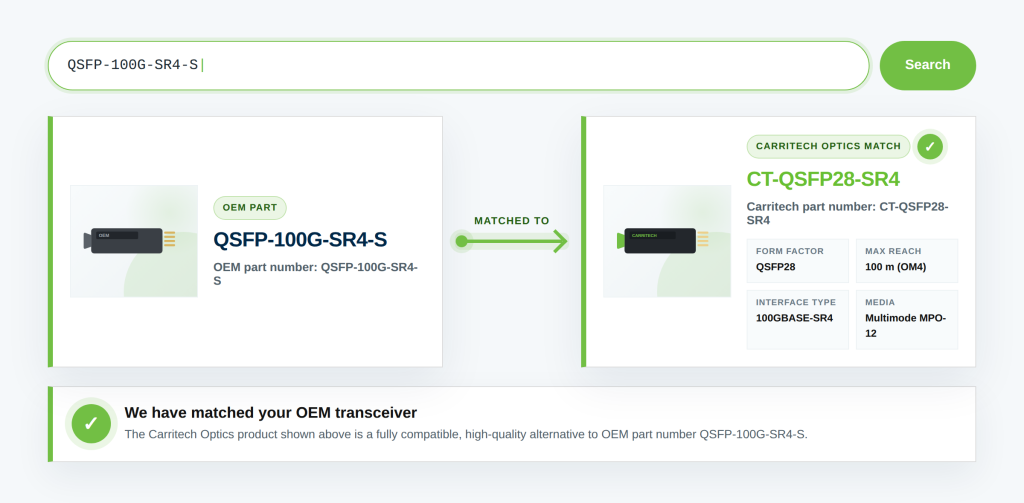
On that sixth question: we built a tool so you don’t even have to ask. Our compatibility checker takes any OEM part number — or your hardware model — and shows you the tested Carritech equivalent in seconds, with full specifications. If we haven’t matched your part yet, it says so honestly, and a human checks it for you.
The bottom line
Are compatible optical transceivers as good as OEM? From the right supplier: yes — same standards, same performance, same monitoring, verified per-unit before shipment, and typically at a fraction of the OEM list price. From the wrong supplier: genuinely, no. The label was never the thing protecting your network. The testing was.
Check your part number now → Compatibility Checker