A 400G switch port is expensive, and most of the servers and leaf switches you want to connect to it do not run at 400G. Breakout is how you stop wasting the difference: one 400G port becomes four 100G links, or two 200G links, and suddenly the port density on that line card makes financial sense.
It is also where a surprising number of deployments come unstuck, because the physical cabling, the optics and the switch configuration all have to agree. Here is how 400G breakout actually works and what to specify.
Why breakout exists
A 400G module is not one 400 gigabit signal. It is eight electrical lanes of 50G, or four optical lanes of 100G, aggregated into a single port by the switch ASIC. Because those lanes are independent underneath, the switch can be told to present them as separate interfaces instead of one.
That is the whole trick. Breakout is not a conversion or an adapter — it is the host choosing to stop bonding lanes that were always separate. The optics and cabling simply have to deliver each lane to the right place.
The three ways to break out 400G
1. DR4 to four 100G links, over single-mode
This is the most common data centre pattern. A 400GBASE-DR4 module carries four parallel single-mode lanes at 100G each, at 1310 nm, out to 500 m through an MPO-12 connector. The TIA Fiber Optics Tech Consortium’s standards summary sets out the specification.
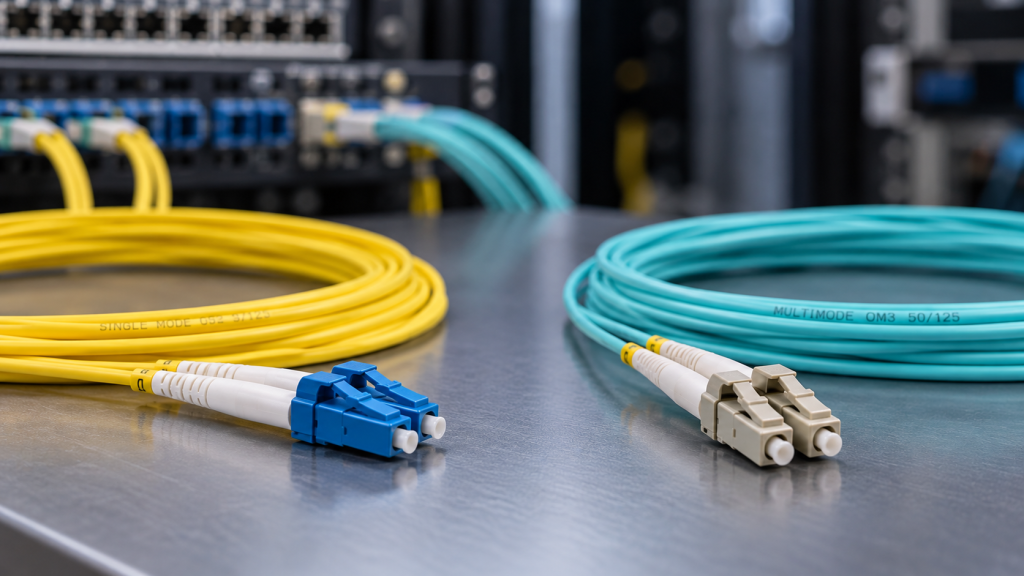
Because each of those lanes is a complete 100G signal in its own right, an MPO-to-LC breakout harness can fan them out to four separate 100G single-lane modules at the far end. One 400G port on the spine, four 100G ports on four different leaves, over one trunk cable. The whole arrangement is built on IEEE 802.3 Ethernet interfaces at both ends, which is why it interoperates across platforms.
2. SR8 to eight 50G links, or four 100G, over multimode
On multimode fibre, a 400G SR8 module uses eight lanes at 850 nm through an MPO-16 or dual MPO-12 arrangement. It can be broken out to eight 50G links, or paired into four 100G links, depending on the host. Reach is short — typically under 100 m on OM4 — so this is a top-of-rack and intra-row pattern rather than a cross-campus one.
3. Passive DAC breakout, inside the rack
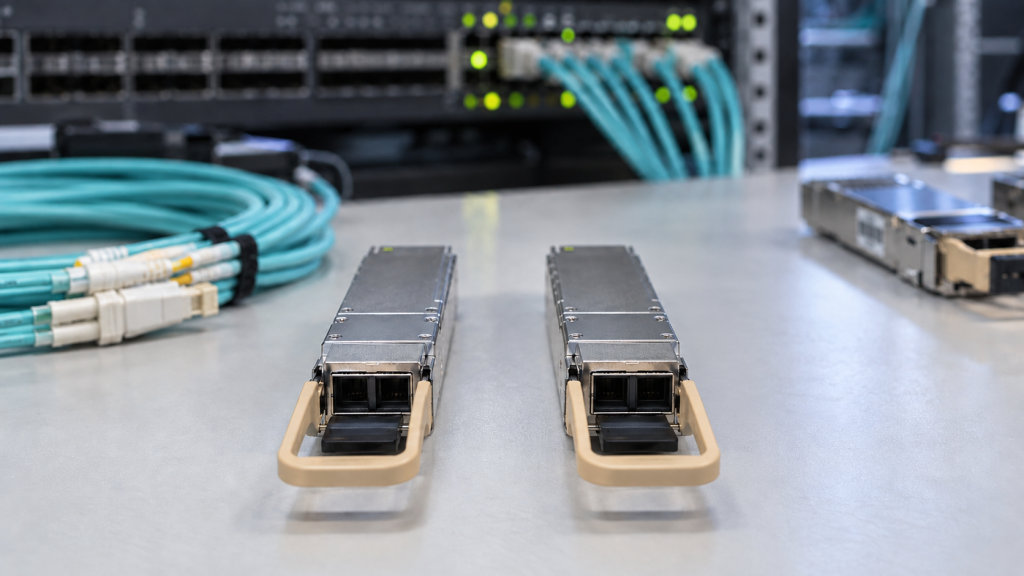
For anything within a few metres, skip the optics entirely. A breakout direct attach cable has a 400G QSFP-DD or OSFP connector at one end and four 100G QSFP28 connectors at the other, with copper in between. No lasers, negligible power draw, and nothing to fail. Our 400G QSFP-DD DAC range covers this, with 400G QSFP-DD AOC for the same topology at longer distances. The trade-offs are in our comparison of DAC vs AOC.
What each option needs at a glance
| Method | Breaks out to | Media | Reach | Far-end module |
|---|---|---|---|---|
| 400G DR4 | 4 x 100G | Single-mode, MPO-12 | 500 m | 100G DR |
| 400G SR8 | 8 x 50G or 4 x 100G | Multimode, MPO-16 | Up to ~100 m | 50G / 100G SR |
| 400G to 2 x 200G | 2 x 200G | Single-mode or copper | Varies | 200G QSFP-DD |
| Breakout DAC | 4 x 100G | Passive copper | 1–3 m | 100G QSFP28 |
| Breakout AOC | 4 x 100G | Active optical | Up to ~30 m | 100G QSFP28 |
The five things that go wrong
The port does not support breakout
Not every 400G port on a switch can be broken out, and on many platforms the ones that can are restricted to particular port groups. Some require a reload after the configuration changes. Check the platform documentation for the specific model before you design around it — this is a switch limitation, not an optics one, and no module will work around it.
The far-end module does not match the lane
A DR4 lane is a 100G single-lane 1310 nm signal. It pairs with a 100G DR module at the far end — not with a 100G LR4 or CWDM4, which use four wavelengths on a duplex pair and expect a completely different optical arrangement. Matching the breakout lane type to the far-end optic is the single most common specification error.
Polarity on the breakout harness
Parallel optics means MPO, and MPO means polarity. Get the type wrong across a trunk and harness combination and transmit meets transmit at the far end — the link stays down with perfectly healthy optics at both ends. Our guide to MPO polarity types A, B and C explains how to get this right first time.
Loss budget on the harness
Each MPO connection and each fan-out adds insertion loss, and a breakout link often has more mated pairs than the equivalent point-to-point. At 500 m on DR4 there is usually margin to spare, but on multimode at 100 m there may not be. Work the numbers — our guide to optical link budget shows how.
Coding, on both ends
A breakout link touches two different platforms more often than a standard link does, so it needs two different vendor codings. A module coded for the wrong host will be rejected or will fill the log with warnings. See transceiver coding explained, or handle it yourself with the Carritech Opticode coding box.
Does breakout actually save money?
Usually, yes — but the saving is in port count rather than in optics. One 400G DR4 module plus four 100G DR modules is not obviously cheaper than four separate 100G links. What it saves is a 400G switch port doing the work of four 100G ports, one trunk cable instead of four, and a line card that supports four times the servers.
Against that, the aggregate bandwidth is capped: four 100G links off one 400G port cannot burst beyond 400G in total. If that matters, it is an argument for native ports. Our analysis of the real TCO of 400G works through the power and price side.
Which form factor to break out from
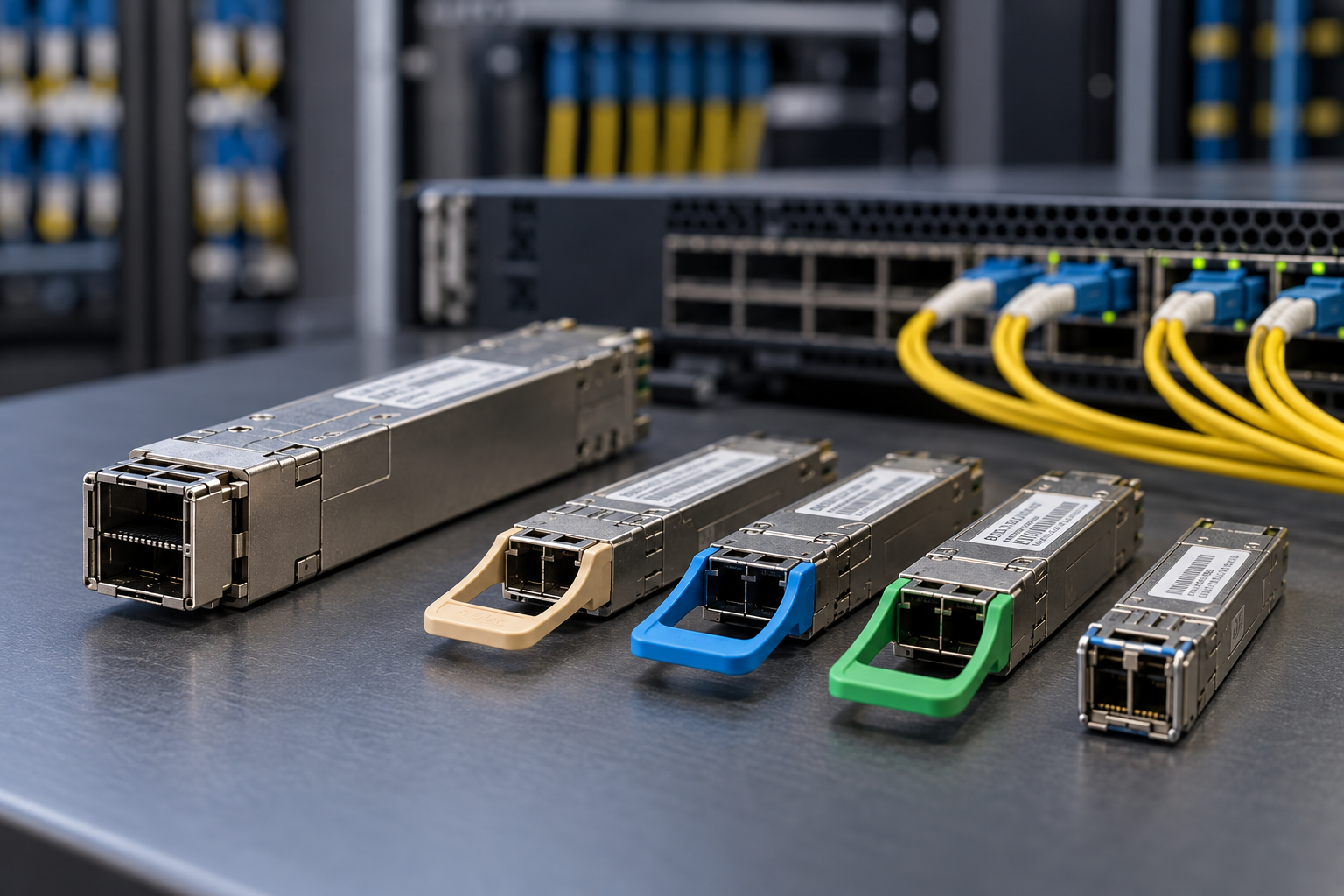
At 400G the choice is usually QSFP-DD; at 800G, OSFP is more common, and it breaks out to two 400G links or eight 100G links on the same principle. If you are still deciding, our comparison of QSFP-DD vs OSFP covers lanes, thermals and backwards compatibility, and 800G and 1.6T migration looks further ahead.
Getting the parts right first time
Carritech Optics supplies every piece of a breakout deployment: 400G QSFP-DD e 800G OSFP modules, the 100G QSFP28 optics at the far end, and the DAC e DOC breakout cables for short runs. Everything is coded and tested for the platforms it is going into — see the 22 checks a module passes before it reaches you — and carries a Garanzia a vita, with UK and EU stock and support behind it.
Have OEM part numbers already? Our compatibility checker returns the tested Carritech equivalent in seconds. Or send us the switch models at both ends and the distances, and we will specify the whole breakout for you — request a quote.