Fibre Channel is the part of the data centre that nobody blogs about and everybody depends on. The storage fabric has been quietly moving block traffic for twenty-five years, it does not go down, and the people who run it are not looking for excitement. Which is precisely why its optics get ordered on autopilot — and why the resulting ordering mistakes are so consistent.
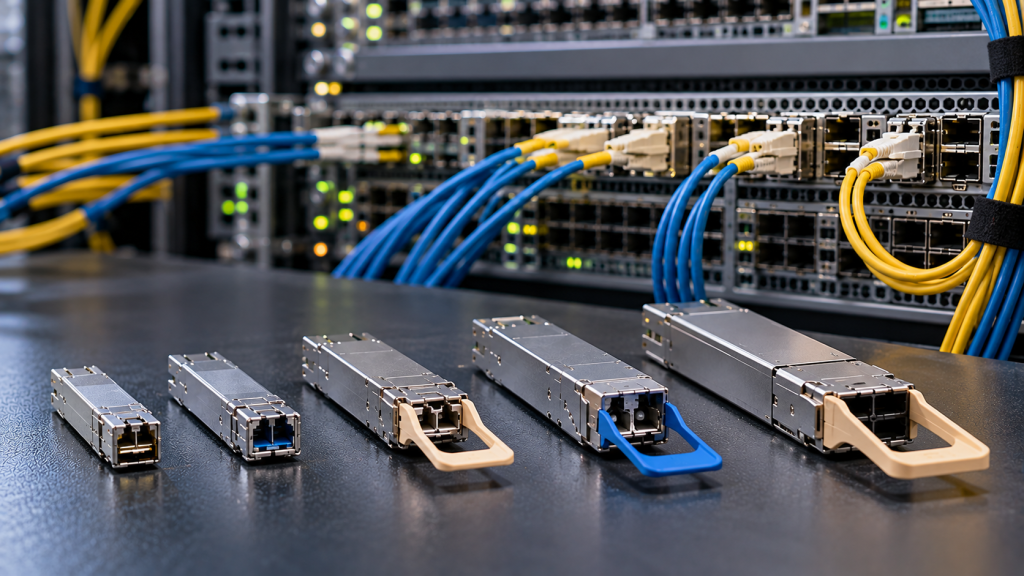
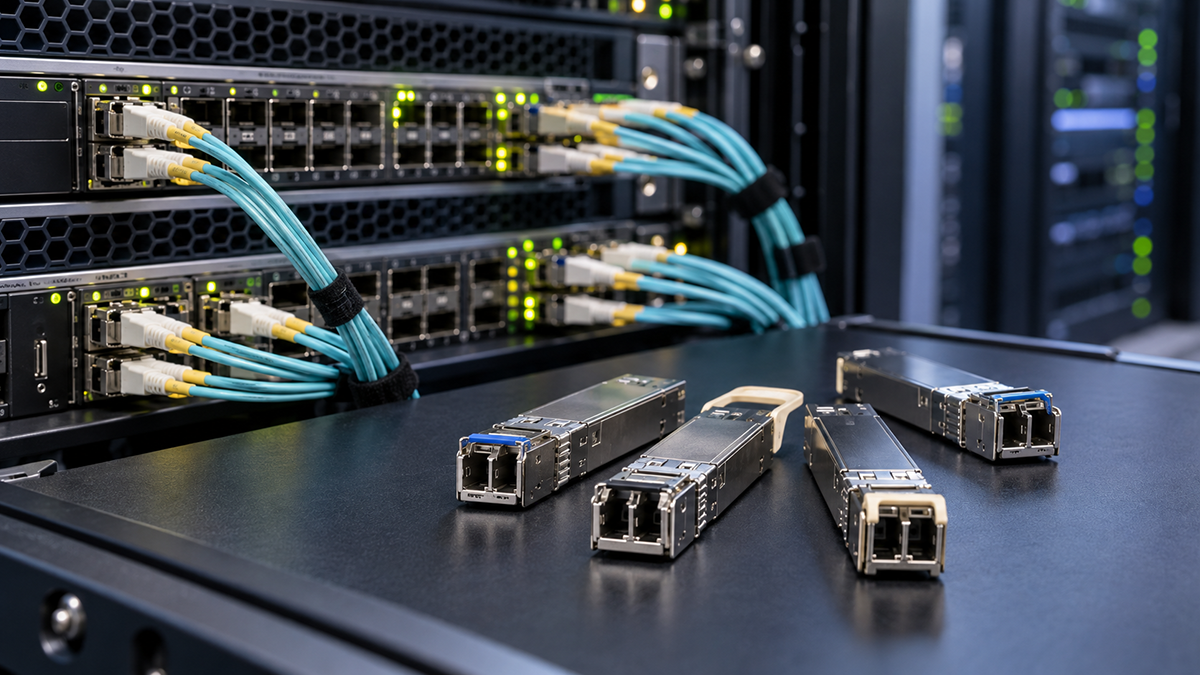
Fibre Channel transceivers look like Ethernet ones. They are the same SFP+ and SFP28 mechanical packages, they use the same LC connectors, and they go into cages that are physically identical. They are not interchangeable, the speed negotiation rules are stricter than Ethernet’s, and the switches are far less forgiving about which module they will accept. This guide covers all of it.
The speeds, and why the numbers are misleading
Fibre Channel speeds are named for usable throughput, not line rate. A 16GFC link does not run at 16 gigabaud — it runs at 14.025 GBd, and the “16G” comes from the 1,600 MB/s of payload it carries in each direction. Get this straight early, because it explains why 32GFC optics are not simply 25G Ethernet optics with a different label.
| Generation | Speed | Line rate | Modulation | Module |
|---|---|---|---|---|
| — | 8GFC | 8.5 GBd | NRZ | SFP+ |
| Gen 5 | 16GFC | 14.025 GBd | NRZ | SFP+ |
| Gen 6 | 32GFC | 28.05 GBd | NRZ | SFP28 |
| Gen 6 | 128GFC (4 × 32G) | 4 × 28.05 GBd | NRZ | QSFP28 |
| Gen 7 | 64GFC | 28.9 GBd | PAM-4 | SFP56 |
| Gen 8 | 128GFC (serial) | 56.1 GBd | PAM-4 | SFP112 |
Two traps in that table.
- There are two different things called 128GFC. Gen 6 128GFC is four 32G lanes in a QSFP, used for inter-switch links. Gen 8 128GFC is a single 56.1 GBd PAM-4 lane in an SFP112. Same name, different physics, different module, and they do not substitute for each other. Always say which one you mean.
- The generation names are marketing labels, not standards. Il Fibre Channel Industry Association applies a “Gen” number when a new physical-interface standard lands. The standards themselves are the FC-PI series, and they are what a datasheet will actually cite.
As of 2026 the installed base is overwhelmingly 16G and 32G, 64GFC is the current shipping high end, and 128GFC is at market entry. Those first two are where almost all purchasing happens, and they are where Carritech’s 16G Fibre Channel SFP+ e 32G Fibre Channel SFP+ ranges sit.
SW, LW and ELW
Fibre Channel uses its own naming for the optical interface, and it predates the Ethernet SR/LR convention that most people now think in.
- SW — short wave. 850 nm VCSEL over multimode fibre. The Ethernet equivalent is SR.
- LW — long wave. 1310 nm DFB over single-mode, 10 km. The Ethernet equivalent is LR.
- ELW — extended long wave. Vendor extensions reaching 25 km. Worth knowing that this is not a FC-PI-defined variant — the longest standardised single-mode reach is 10 km LW — so ELW behaviour and wavelength are implementation-specific rather than guaranteed to interoperate.
If you are used to Ethernet part numbers, the mapping is simple enough: SW means multimode, LW means single-mode. The same fibre-identification rules apply as everywhere else, and our guide to single-mode vs multimode fibre covers how to tell what is already in the ground.
How far SW actually goes, by fibre grade
This is the table people most often get wrong, because multimode reach falls sharply as speed rises and the numbers are shorter than Ethernet engineers expect.
| Fibre | 16GFC SW | 32GFC SW | 64GFC SW |
|---|---|---|---|
| OM1 (62.5 µm) | 15 m | not supported | not supported |
| OM2 | 35 m | 20 m | — |
| OM3 | 100 m | 70 m | 70 m |
| OM4 | 125 m | 100 m | 100 m |
| OM5 | 125 m | 100 m | 100 m |
| Single-mode (LW) | 10 km | 10 km | 10 km |
Three points that follow directly from it.
OM2 is finished. Twenty metres at 32GFC is not a data centre link; it is a link within one row if you are lucky. The FCIA states outright that OM1 and OM2 are not recommended for Fibre Channel, and the numbers show why. If your SAN cabling is orange, budget for a re-pull before you budget for 32G optics.
OM5 buys Fibre Channel nothing. This surprises people who paid for it. OM5’s advantage is short-wavelength WDM across 850–950 nm, as the TIA Fiber Optics Tech Consortium describes. Fibre Channel SW optics are single-wavelength 850 nm parts, so they cannot use the extra spectrum. Every vendor table lists OM4 and OM5 with identical FC reach, because they are identical.
Those distances assume a tight loss budget. The standardised OM3 and OM4 reaches are quoted against around 1.5 dB of total connector loss. Add a patch panel at each end and a cross-connect in the middle and the real reach is shorter than the table. Work it properly — our guide to optical link budget shows the arithmetic, and it matters more on a 70 m link than on a 10 km one.
Speed negotiation: the two-generations rule
This is the single most useful thing in this article. Fibre Channel guarantees backward compatibility for two generations, and no further. It is an explicit FCIA policy, and both major switch vendors implement it identically.
| Transceiver | Negotiates down to | Will not do |
|---|---|---|
| 8G SFP+ | 8 / 4 / 2 G | 1 G |
| 16G SFP+ | 16 / 8 / 4 G | 2 G |
| 32G SFP28 | 32 / 16 / 8 G | 4 G |
| 64G SFP56 | 64 / 32 / 16 G | 8 G |
The port speed is whatever the two ends can both reach. A 64G switch port and a 16G host adapter negotiate at 16G and work perfectly. A 64G switch port and an 8G device have no overlap at all and the link simply will not come up — no error that points at the cause, no partial operation, just a port that stays down.
In practice this bites during director refreshes, because the old kit is almost always at the storage end: an ageing tape library, a backup appliance, a legacy array on a maintenance contract nobody wants to touch. The new fabric goes in, everything modern comes up, and one device will not. Check the oldest thing on the fabric before you order, not after.
FEC is mandatory at 32G, and that changes troubleshooting
16GFC can run without forward error correction, and on optical links it generally does. From 32GFC onwards, FEC is not optional:
- 16GFC: FEC optional, and a configuration choice that must match at both ends. A mismatch is a classic link-will-not-come-up cause.
- 32GFC: RS-FEC (528, 514), mandatory.
- 64GFC and 128GFC: RS-FEC (544, 514), mandatory — stronger correction for the PAM-4 signalling.
Two consequences worth internalising. First, the whole class of 16G FEC-mismatch faults disappears at 32G and above, because there is nothing to mismatch. Second, the error counters mean something different. A 32G link with a busy pre-FEC error rate can be entirely healthy — FEC is doing exactly what it exists to do. What matters is the post-FEC state and the uncorrected codeword count. Judging a 32G link by the standards you used at 16G will have you replacing modules that are fine.
FEC is also part of why 32GFC reaches only 70 m on OM3 where 16GFC reaches 100 m. Doubling the baud rate costs more margin than the stronger coding gives back.
FC-NVMe: why 32G arrived when it did
NVMe over Fibre Channel maps NVMe onto the FC transport, replacing SCSI command semantics while leaving the fabric, the zoning, the name server and the optics entirely alone. FCP and FC-NVMe coexist on the same wire, from the same server, through the same switches, with arrays presenting both simultaneously. That is the whole appeal: you get the protocol change without a fabric change.
The optics angle is specific and often missed. FC-NVMe requires a Gen 6 host adapter — the fabric can stay at 16G, but the server side has to be 32G. That is why 32G HBAs shipped well ahead of 32G director refreshes, and why a lot of estates today run 32G adapters into 16G fabrics. If that is you, the adapter-side optics are 32G SFP28 parts even though the link negotiates at 16G.
Coding: Fibre Channel is stricter than Ethernet
On an Ethernet switch, an unrecognised module often links up with a warning in the log. Storage fabrics do not work that way, and this is the thing most likely to cost you an evening.
- Brocade FOS supports only transceivers qualified for Brocade products. An unqualified module puts the port into a
Mod_Invstate — reported inswitchshowas a speed mismatch or incompatible SFP, logged in the system error log, and not passing traffic. There is no documented override command. - Cisco MDS validates the module EEPROM and holds failing ports down. Since NX-OS 9.3(1) it also detects duplicate serial numbers, error-disabling every port carrying a cloned identity and logging it. Coding that is merely plausible is no longer enough.
The mechanism is the same EEPROM identification string described in transceiver coding explained; the enforcement is just harder. The optical and electrical behaviour is standards-defined by the INCITS Fibre Channel Technical Committee (the group formerly known as T11) and the SFF management specifications maintained through SNIA. The vendor string is not.
Two practical consequences. Qualification is per switch model, so “a Brocade 32G SW module” is not automatically supported on every Brocade switch — check the model. And because there is no override, a properly coded module is not a nice-to-have on a storage fabric; it is the difference between a working port and a dead one. Everything Carritech ships for Fibre Channel is coded for the target platform and tested before despatch, which is what the 22 checks a module passes covers.
A naming wrinkle that causes mis-ordering
Several switch vendors market their 32G and 64G Fibre Channel modules as “SFP+” in product names and datasheets, even though the electrical form factor is SFP28 and SFP56 respectively. Component manufacturers and server vendors use the correct names. So “it says SFP+ on the box” is not evidence that a module is 16G — read the speed, not the form factor label. Getting this backwards is how a 32G module ends up ordered as a 16G replacement, or vice versa.
The same confusion exists in the other direction across our own category naming: Carritech lists both ranges under the SFP+ heading because that is how the industry orders them, while the 32G parts are SFP28 modules. Our overview of 16G, 25G and 32G optical transceivers covers where each fits, and the SFP+ vs SFP28 comparison covers the electrical difference.
Fibre Channel optics Carritech stocks, by platform
Nearly 200 tested Fibre Channel modules across the two ranges, coded for the switch, director, array or adapter they are going into. A representative selection follows.
Brocade and Broadcom
At 16G, XBR-000492 e XBR-000493 are the short-wave parts and XBR-000498, XBR-000499 e XBR-000458 the long-wave ones, alongside XBR-000192, XBR-000198 and the 57- coded equivalents 57-1000487-01 e 57-1000488-01. There are also the BRSFP-16GSW e BRSFP16G10KLW parts.
At 32G, XBR-000238 e XBR-000239 for short wave, XBR-000478 e XBR-000479 for long wave to 10 km, plus XBR-000212, XBR-000412, XBR-000438 and the 57-1000485-01 e 57-1000332-01 variants.
Cisco MDS
DS-SFP-FC16G-SW e DS-SFP-FC16G-LW at 16G, with the spares-coded DS-SFP-FC16G-SW-RF and the 10-2666-01 e 10-2673-01 equivalents. At 32G, DS-SFP-FC32G-SW e DS-SFP-FC32G-LW, plus DS-SFP-FC32G-SW-RF, MDS-32G-SW and the 10-3206-01 e 10-3207-01 codes. For Cisco Ethernet platforms more broadly, see our guide to compatible optics for Cisco platforms.
HPE
16G: QK724A, QK725A, 656435-001, 656436-001, 793444-001 e R6B10A. 32G: 855070-001, 855071-001, P9H28A, P9H29A, Q9D30A, R0Q23A e R6B12A.
Dell and Dell EMC
16G: 407-BBBB, 407-BBCC, 0M7HF, NKX77 and the EMC-coded 019-078-045 e 100-652-588. 32G: 407-BBXH, 407-BBXM, 407-BCHH, 2WMTW e F6VG3.
IBM and Lenovo
16G: 00MY768, 00RY190, 88Y6393 and the Lenovo 4M27A65411 e 4M27A65413. 32G: 01KN789, 01KN795, 78P6616, 4M27A65416 e 4M27A65418.
NetApp, Emulex and others
NetApp array and switch codes include X6596-R6, X6601A-R6 e X-48895-00-R6 at 16G, with X-000238 e X-000212 at 32G. For host adapters, the Emulex-coded LP32-SW-OPT-1 e LP32-LW-OPT-1. Where Fibre Channel runs into Ethernet switching there are also the Juniper QFX-SFP-16GFC-SW and Arista ARI-SFP-16GFC-SW-O codes.
The Carritech base parts
Behind all of those codings sit four optical designs. CT-16G-SFP+SR is an 850 nm VCSEL part supporting 4G, 8G and 16G at under 1 W; CT-16G-SFP+LR is the 1310 nm DFB equivalent to 10 km at under 1.2 W. At 32G, CT-32G-SFP+SR covers 16G and 32G to 100 m on OM4, and CT-32G-SFP+LR to 10 km. All four are available in commercial and industrial temperature versions with full digital diagnostics.
That is also the stock argument in miniature. One optical design, a dozen vendor codings — which is exactly the situation the Carritech Opticode coding box exists for, and the case made in building a smarter transceiver stock strategy.
Six checks before you order
- Check the oldest device on the fabric. Two generations back is the limit, and the thing that breaks it is never the new kit.
- Read the fibre, not the jacket colour. OM2 will not carry 32GFC any useful distance, and the print on the cable is definitive where colour is only a convention.
- Do not pay for OM5 on a Fibre Channel link. It performs identically to OM4 here.
- Match the coding to the exact switch model, not just the vendor. Qualification lists are per-platform.
- Check the speed on the part, not the form-factor label. “SFP+” on a 32G module is a naming convention, not a speed.
- Inspect and clean every end face before mating. At 70 m on OM3 with FEC already spending margin, contamination has nowhere to hide — see fibre optic connector cleaning.
Getting SAN optics that come up first time
Carritech Optics supplies Fibre Channel modules across the 16G e 32G ranges, coded for Brocade, Cisco MDS, HPE, Dell, IBM, Lenovo, NetApp and the host adapters that plug into them. Our 16G e 32G overview pages are the quickest way in, and patch cords are available alongside.
Every module is tested before despatch — see our transceiver testing process — and carries a Garanzia a vita, with UK and EU stock and support behind it. On the question that always comes up with storage vendors, do third-party optical transceivers void your warranty? gives the straight answer.
Have a list of OEM part numbers from a director refresh? Our compatibility checker returns the tested Carritech equivalent in seconds, or upload the whole list and we will price it. Not sure whether your existing fabric will negotiate with what you are buying? Send us the switch models and the oldest device on the fabric, and we will tell you — request a quote.