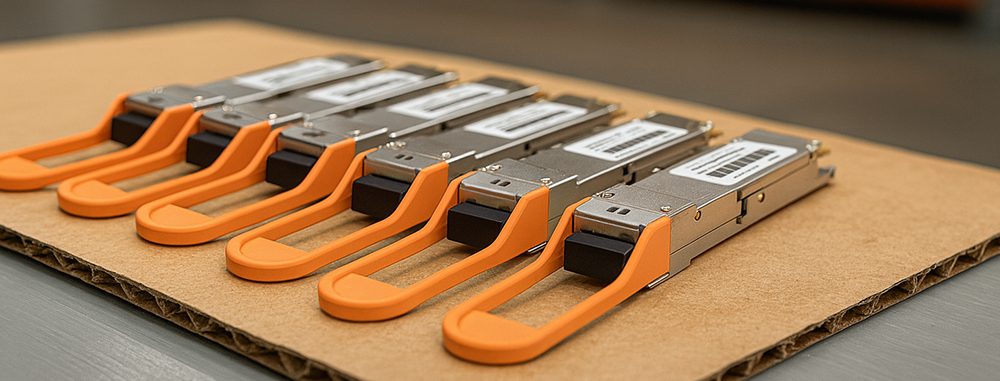
When it comes to Cisco networks, optical transceivers are often treated as a fixed cost. Many organisations default to OEM optics without question, assuming they are the only reliable option.
In reality, that is no longer the case.
Compatible optical transceivers have become a proven, widely adopted alternative, offering the same performance and reliability as OEM modules, but with far greater flexibility and cost efficiency. For networks running Cisco platforms, understanding how compatible optics work and how to use them effectively can have a significant impact on both performance and long-term cost.
What are compatible optics?
Compatible optical transceivers are third-party modules designed to operate seamlessly with OEM equipment such as Cisco switches and routers. They are engineered, tested and programmed to match Cisco specifications, ensuring they behave exactly as expected within the network environment.
These are not generic or “unverified” components. High-quality compatible optics are built to meet or exceed the same standards as OEM products, with rigorous testing to guarantee interoperability, stability and performance.
At Carritech Optics, this compatibility is a core part of the offering. Their transceivers are designed to integrate with major OEM platforms, including Cisco, providing a flexible and open approach to network design.
Why Cisco networks are moving toward compatible optics
The shift toward compatible optics is being driven by a combination of commercial and operational factors.
Cost is the most obvious driver. OEM transceivers often carry a significant premium, while compatible alternatives can deliver the same functionality at a substantially lower price point. Across large deployments, this difference becomes a major factor in overall network spend.
However, the decision is not purely about cost. Flexibility is just as important. Compatible optics allow network operators to avoid vendor lock-in, making it easier to scale infrastructure, support multi-vendor environments, and respond quickly to changing requirements.
Availability also plays a key role. With ongoing supply chain challenges affecting OEM lead times, having access to a broad range of compatible transceivers ensures networks can continue to expand and operate without delay.
The range of compatible optics available for Cisco platforms
One of the biggest advantages of using compatible optics is the breadth of options available. Rather than being limited to a specific OEM catalogue, networks can choose from a wide range of form factors, speeds and distances to match their exact requirements.
At Carritech Optics, this includes:
- 1G and legacy SFP modules for access and long-distance applications
- 10G SFP+ transceivers for enterprise and data centre environments
- 25G SFP28 and 40G QSFP+ optics for higher-density switching
- 100G QSFP28 modules for core and aggregation layers
- 200G, 400G and 800G transceivers for next-generation networks
This broad portfolio allows Cisco-based networks to scale from legacy infrastructure through to modern high-speed deployments, all within a consistent and compatible framework.
For example, widely used Cisco-compatible modules include:
- SFP-10G-SR for short-range data centre links
- SFP-10G-LR for campus and enterprise backbone connections
- QSFP-100G-LR4 for high-capacity 10km links
- QSFP-100G-ER4 for extended reach up to 40km
Each of these options is available as a compatible solution, providing the same operational behaviour as Cisco-branded equivalents.
Compatibility: what actually matters
One of the most common concerns around compatible optics is whether they will work reliably with Cisco equipment.
In practice, compatibility is not guesswork. It is achieved through precise programming and validation.
Modern compatible transceivers are coded to match Cisco requirements, allowing switches and routers to recognise them as native modules. At Carritech, this is supported by solutions such as programmable coding tools, which allow transceivers to be configured for specific OEM environments, ensuring seamless integration across networks.
This means compatibility is not just about “working” — it is about ensuring the module behaves exactly as expected in terms of monitoring, diagnostics and performance.
Performance and reliability in real-world networks
Performance is often the deciding factor when evaluating compatible optics. The assumption is that OEM products are inherently more reliable, but in reality, high-quality compatible transceivers undergo extensive testing before deployment.
At Carritech Optics, every transceiver is tested in a controlled environment to ensure consistency, stability and compliance with industry standards before it reaches the customer.
In practical terms, this means:
- Stable data transmission across specified distances
- Full support for digital optical monitoring (DOM)
- Consistent performance under real network conditions
- Reliable operation across multi-vendor environments
For network operators, the end result is indistinguishable from OEM performance, but with far greater commercial flexibility.
Where compatible optics make the biggest impact
Compatible optics can be used across virtually any part of a Cisco network, but there are certain areas where they deliver the most value.
In high-density data centre environments, where hundreds or thousands of ports are in use, reducing the cost per transceiver has a direct and measurable impact on overall infrastructure spend.
In legacy or extended-life networks, compatible optics provide a reliable way to maintain and expand systems without relying on discontinued or difficult-to-source OEM components.
In multi-site or metro networks, they enable scalable, cost-effective connectivity across longer distances, without introducing unnecessary complexity.
Across all of these scenarios, the key benefit is the same: achieving the required performance without overpaying for specification or branding.
A smarter approach to Cisco optics
Choosing optics for Cisco platforms should not be about defaulting to OEM. It should be about selecting the right solution for the network.
Compatible transceivers offer a proven way to achieve this. They combine performance, flexibility and cost efficiency, allowing organisations to build and maintain networks that are both technically robust and commercially sustainable.
At Carritech Optics, this approach is built into the product offering. With thousands of compatible transceivers available, covering everything from legacy SFP modules through to high-speed 800G optics, networks can be designed, upgraded and maintained with confidence.
Final thought
Cisco platforms are designed to deliver high performance and reliability, but the optics used within them do not have to come at a premium.
Compatible transceivers provide a smarter alternative, enabling networks to scale efficiently, reduce costs and maintain flexibility without compromising on quality.
For organisations looking to optimise their infrastructure, the question is no longer whether compatible optics work.
It is why you would not use them.