
How the Optical Transceiver Industry Is Evolving for the Next Generation of Networks

The optical transceiver industry is changing quickly. As networks carry more data, support more cloud services and connect increasingly demanding digital infrastructure, optical modules are no longer viewed as simple plug-in components. They are now a critical part of network performance, scalability, energy efficiency and long-term upgrade planning. For telecom operators, data centres, enterprises, cloud […]
Why 200G QSFP-DD Transceivers Are a Practical Upgrade Path for High-Capacity Networks

As network traffic continues to grow, many organisations are looking for ways to increase capacity without immediately jumping into a full 400G or 800G migration. For data centres, telecom operators, cloud environments and enterprise networks, 200G connectivity can provide a practical middle step between established 100G infrastructure and next-generation high-speed optical networks. 200G transceivers can […]
Why Optical Link Budget Matters When Choosing Transceivers

Optical transceivers are often selected by speed, form factor and distance. A network team may search for a 10G SFP+, 100G QSFP28 or 400G QSFP-DD module and then choose a reach such as 300m, 2km, 10km, 40km or 80km. While these details are important, they do not tell the full story. One of the most […]
Optical Transceiver Coding Explained: How Programming Helps Ensure OEM Compatibility
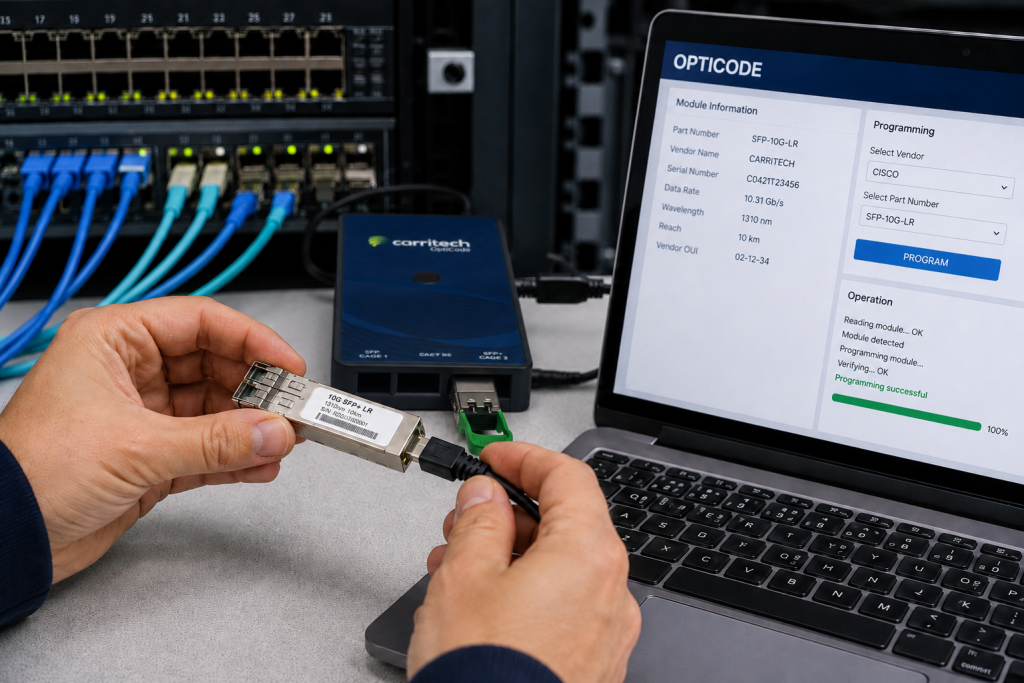
Optical transceivers may look like simple plug-in modules, but compatibility is not always as simple as matching the speed, reach and connector type. In many modern networks, especially multi-vendor environments, the same optical specification may need to work across switches, routers, firewalls, servers and optical transport equipment from different OEMs. A module may physically fit […]
Why Tunable Optical Transceivers Can Reduce Complexity in DWDM Networks

Dense Wavelength Division Multiplexing, or DWDM, is a powerful way to increase fibre capacity by carrying multiple optical channels over the same fibre pair. For telecom operators, data centres, ISPs and infrastructure teams, DWDM can make better use of existing fibre assets and support high-capacity connectivity across metro, regional and long-distance networks. However, DWDM networks […]
How to Build a Smarter Optical Transceiver Stock Strategy for Multi-Vendor Networks

For many network teams, optical transceivers are small components with a big operational impact. They sit at the edge of critical connections, linking switches, routers, transport platforms, servers and optical networks. When the right module is available, installations, upgrades and maintenance windows can move quickly. When the right module is missing, a simple requirement can […]
800G Optical Transceivers: What They Are, Where They Are Used, and When You Need Them

The demand for faster optical networking is accelerating. As data centres, cloud platforms, AI infrastructure and telecom networks handle ever-increasing volumes of traffic, the industry is moving beyond 100G and 400G links toward higher-capacity solutions capable of supporting far greater bandwidth within the same physical footprint. One of the most important technologies in that shift […]
SFP+ vs SFP28: What Is the Difference Between 10G and 25G Optics?

As network traffic continues to grow, many organisations are looking beyond traditional 10G connectivity and considering whether 25G is the right next step. That often leads to one of the most common questions in optical networking: what is the difference between SFP+ and SFP28? At a glance, the two module types look very similar. Both […]
Compatible Optics for Cisco Platforms: What You Need to Know

When it comes to Cisco networks, optical transceivers are often treated as a fixed cost. Many organisations default to OEM optics without question, assuming they are the only reliable option. In reality, that is no longer the case. Compatible optical transceivers have become a proven, widely adopted alternative, offering the same performance and reliability as […]
The Optical Transceiver Mistake Costing Networks Thousands

In optical networking, one of the most common and costly mistakes is not a technical failure, but a purchasing decision. Across enterprise networks, data centres and telecom environments, optical transceivers are often over-specified. The logic seems sensible at first: choose a higher-reach or higher-spec module to “future-proof” the network and avoid potential issues later. In […]