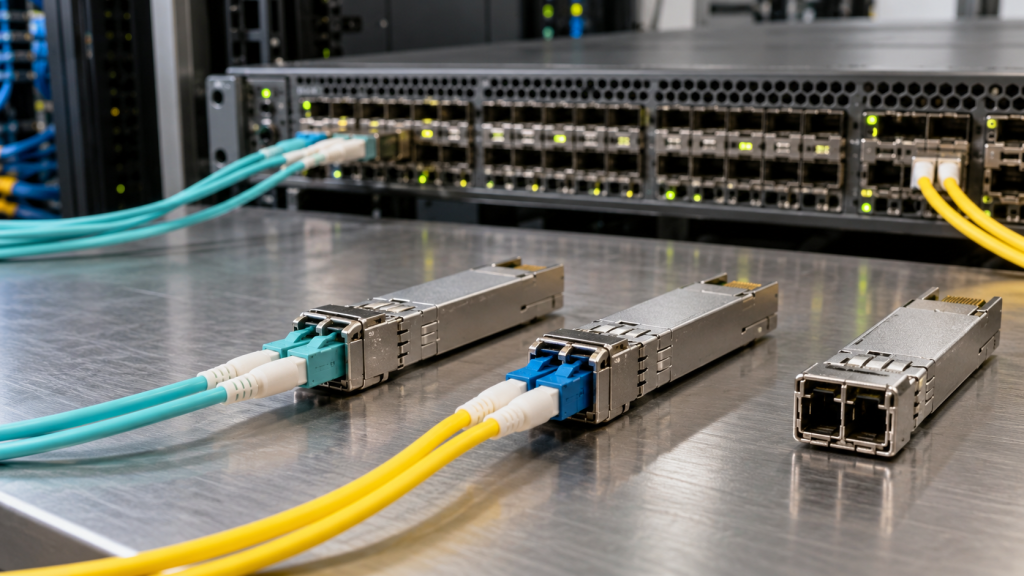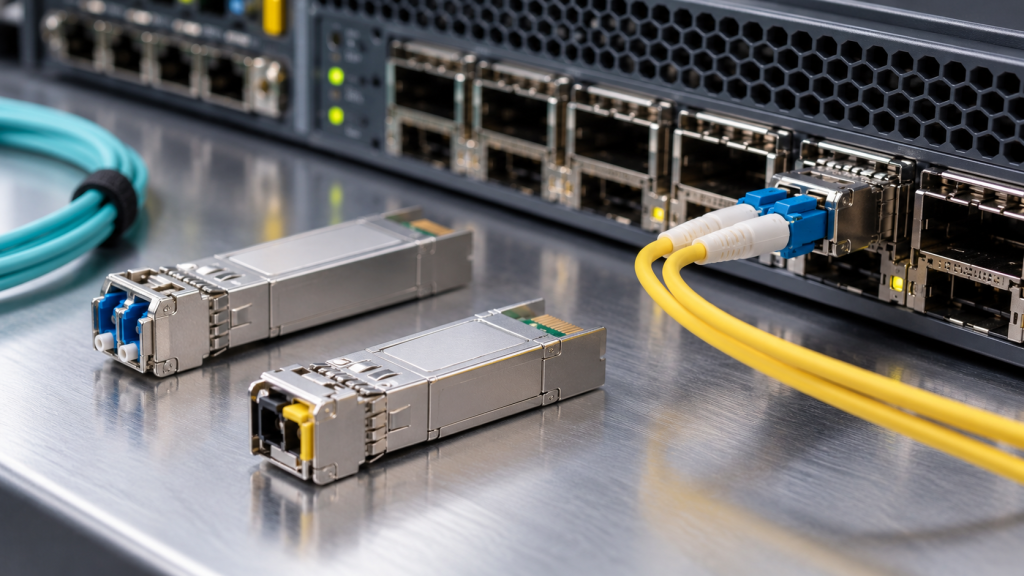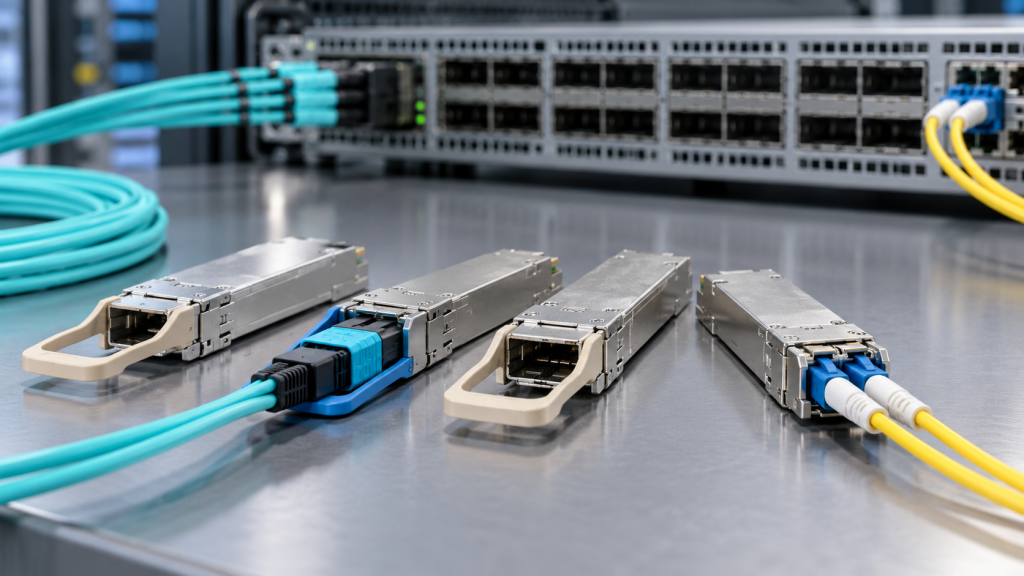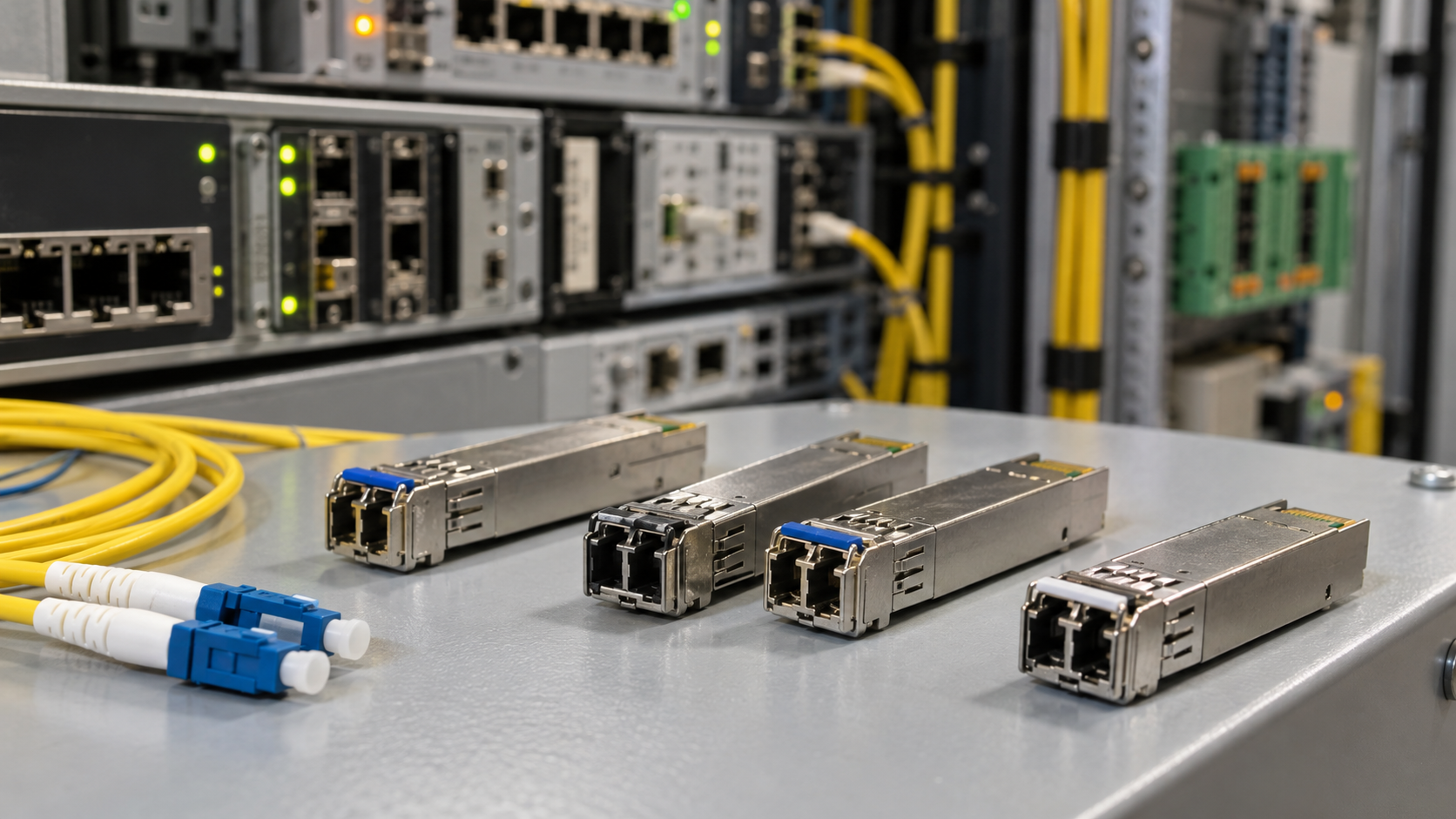
The fastest optic in the Carritech catalogue moves 1.6 terabits a second across a few metres of a data centre. The most interesting one moves 155 megabits a second across two hundred kilometres of single-mode fibre, draws less than a watt, and is available in a version rated from −40 to +85 °C.
155M and 1.25G SFPs are the least glamorous products in optical networking and some of the hardest to replace. They sit in substation automation, rail signalling, water and wastewater telemetry, pipeline SCADA, motorway and tunnel systems, access networks, CCTV, building management and legacy SDH transport — infrastructure with asset lives measured in decades, where the network exists to carry small amounts of data very reliably over long distances in physically unpleasant places.
Those are also the first ranges the original vendors discontinue. This guide covers what the families are, why a low bit rate buys so much distance, the rate-matching mistake that causes most failed installs, what extended-temperature really means, and which modules Carritech holds.
Why these ranges have not gone away
A data centre refreshes its switching on something like a five-year cycle. A distribution substation commissioned in 2008 is expected to still be operating in 2038. The protection relay in it speaks 100 Mbit/s Ethernet over fibre and will continue to do so until the relay itself is replaced, which will happen when the relay fails, not when a faster standard is ratified.
So the demand for these optics is not nostalgia. It is the arithmetic of long-lived assets, and it produces a specific commercial problem: the modules are a tiny line item in a system that cannot be shut down, bought from vendors whose attention has moved on by three or four generations. That is exactly the situation described in your optics will go end-of-sale before your switch does, and in these ranges it is not a future risk — it has already happened.
The optical families
Six families cover essentially everything in the 155M and 1.25G space. The names come from the relevant clauses of IEEE 802.3 and, on the transport side, from the ITU-T SDH recommendations.
| Family | Rate | Wavelength and fibre | Llegue a |
|---|---|---|---|
| 100BASE-FX | 100 Mbit/s | 1310 nm, multimode | 2 km |
| 100BASE-LX / EX / ZX | 100 Mbit/s | 1310 or 1550 nm, single-mode | 10–80 km |
| Long-haul 155M | 155 Mbit/s / STM-1 | 1550 nm, single-mode | 120, 160, 180 and 200 km |
| 1000BASE-SX | 1.25 Gbit/s | 850 nm, multimode | 550 m |
| 1000BASE-LX / EX / ZX | 1.25 Gbit/s | 1310 or 1550 nm, single-mode | 10, 40 and 80 km |
| Long-haul 1.25G | 1.25 Gbit/s | 1550 nm, single-mode | 120, 160 and 180 km |
| BX BiDi | 100 Mbit/s or 1.25 Gbit/s | 1310/1550 nm pair, one fibre | 3–180 km |
| CSFP | 1.25 Gbit/s | Two BiDi channels in one module | 20 and 40 km |
Why slow optics go so far
Two hundred kilometres on a single-mode pair with no amplifier and no regenerator, from a module drawing under a watt, is a genuinely remarkable thing. Modern high-speed pluggables manage a fraction of that. The reason is physics, and it is worth understanding because it explains the whole shape of these ranges.
- Receiver sensitivity improves as bandwidth falls. A receiver only has to distinguish signal from noise inside its own bandwidth, and noise scales with bandwidth. Drop the bit rate by a factor of ten and you can detect a much weaker signal. Carritech’s 180 km 1.25G part, CT-SFP-XZX+, is specified with −34 dBm receiver sensitivity; the 120 and 160 km parts CT-SFP-EZX y CT-SFP-XZX at −32 dBm. Those are numbers a 10G receiver cannot approach.
- Dispersion tolerance scales with the symbol period. Chromatic dispersion smears each pulse by an amount that depends on distance and wavelength spread, not on bit rate. A 155 Mbit/s pulse is around sixty-five times longer than a 10 Gbit/s pulse, so it can tolerate roughly that much more smearing before the receiver can no longer tell one symbol from the next. At 10G, dispersion is what stops you at around 80 km on standard fibre; at 155M it is barely a constraint.
- APD receivers and DFB lasers do the rest. A 1550 nm distributed-feedback laser puts real power into the fibre at the wavelength where G.652 fibre loses least — around 0.2 dB per kilometre — and an avalanche photodiode at the far end recovers it.
Two hundred kilometres at 0.2 dB/km is 40 dB of fibre loss before a single splice or connector. Which is why these links are the ones where the optical link budget has to be worked properly rather than estimated, and where connector cleaning stops being housekeeping and becomes the difference between a working circuit and an outage.
The mistake that causes most failed installs: rate, not reach
Here is the single most common error in this part of the catalogue, and it has nothing to do with distance or wavelength.
A 1.25 Gbit/s SFP will not generally run at 100 Mbit/s, and a 155 Mbit/s SFP will not run at 1.25 Gbit/s. The optics are similar and the packages are identical, but the module has a specified rate range and the host reads it out of the EEPROM. Ordering a 1000BASE-LX module for a 100BASE-FX port produces a module that is recognised, a port that stays down, and an afternoon spent looking at the fibre.
Carritech’s two base ranges are deliberately parallel, which makes the choice explicit. The CT-MSFP parts are the 155 Mbit/s and 100 Mbit/s designs; the CT-SFP parts are the 1.25 Gbit/s designs. Same reaches, same wavelengths, different rate. If anything on the far end of the link is Fast Ethernet, STM-1 or OC-3, you want the CT-MSFP part. Some parts are explicitly multi-rate — the Juniper-coded SFP-1GE-FE-E-T copper part is an example of a module that spans both — but multi-rate is a specification to look for, not an assumption to make.
Two related traps. BX BiDi modules are sold in pairs and the halves are not interchangeable: a "U" part transmits at one wavelength and receives at the other, a "D" part does the reverse, and two of the same half will never link. And connector types vary in the older ranges — some 155M parts are specified SC as well as LC, which is a detail worth confirming rather than assuming.
BiDi and CSFP: when there is only one fibre
In access, utility and street-cabinet networks the constraint is frequently not distance or bandwidth but fibre count. There is one fibre to the site, or two where you need four.
BX BiDi modules solve it directly: one fibre, one wavelength in each direction, a WDM filter inside the module. The standardised short-reach versions — 100BASE-BX10 and 1000BASE-BX10 — came from the Ethernet in the First Mile work in IEEE 802.3ah, which was written precisely for access networks. The longer reaches beyond 10 km are vendor and MSA territory rather than IEEE, and Carritech’s BiDi ranges run from 3 km to 180 km in both rates. The general case is covered in BiDi transceivers.
CSFP goes one step further. A compact SFP puts two independent BiDi channels into a single SFP cage, so one port on the switch becomes two separate single-fibre links. Where a cabinet has a fixed number of ports and a growing number of sites to feed, that is a doubling of capacity with no new hardware. Carritech’s designs are CT-CSFP-BX-20U y CT-CSFP-BX-20D at 20 km and CT-CSFP-BX-40U y CT-CSFP-BX-40D at 40 km.
Extended temperature, and what the standards actually require
A module in a comfortable data centre is specified 0 to +70 °C. A module in a roadside cabinet, a substation relay room, a tunnel, a rail trackside enclosure or an unconditioned plant room is not in that environment, and the difference is not marginal — a sealed metal cabinet in direct sun can run far above ambient.
The industrial and extended-temperature variants in these ranges are specified from −40 to +85 °C. That is not simply a wider test range: it means different laser selection, different bias control across temperature, and components rated to survive thermal cycling for years rather than months. CT-MSFP-XZX++, the 200 km 155M part, is available in industrial, extended and commercial temperature versions for exactly this reason.
Two standards define what equipment in these environments has to withstand, and they are worth knowing by name if you specify for utilities:
- IEEE 1613, the environmental and testing requirements for devices with communications functions used with electric power apparatus. The 2023 edition supersedes the long-standing 2009 version.
- IEC 61850-3, the general requirements part of the IEC 61850 series on communication networks and systems for power utility automation, which covers the design and environmental conditions for utility communication equipment.
Those standards apply to the switch or the relay rather than to the pluggable in it, but the implication for the pluggable is direct: a hardened switch populated with commercial-temperature optics is not a hardened system. If the host is rated for the environment and the module is not, the module is the part that fails, usually in the second summer. The thermal mechanism — a hot module draws more, then throttles, then fails — is the same one described in optical transceiver power consumption.
The transport side: STM-1, OC-3 and SDH
The "155M" in these part numbers is not an Ethernet rate. 155.52 Mbit/s is STM-1, the basic SDH rate (OC-3 in the SONET naming), defined in ITU-T G.707, and the optical interfaces that carry it are classified in ITU-T G.957 — the source of the short-haul, long-haul and very-long-haul interface codes (S-1.1, L-1.1, L-1.2 and so on) that still appear on transport equipment datasheets.
This matters practically because a great deal of the installed base for these modules is SDH multiplexers and cross-connects rather than Ethernet switches, and those platforms describe their optical interfaces in G.957 terms rather than IEEE ones. If you are matching a module to an STM-1 tributary card, the G.957 interface code on the card tells you the launch power and sensitivity you need; the Ethernet reach names are a translation of the same thing.
It is also why the 155M range includes reaches no Ethernet standard defines. There is no "100BASE-200km". There are SDH circuits that have to cross a firth, a mountain range or a county without a hut to put a regenerator in, and a 200 km 1550 nm SFP is what solves that.
Adding wavelengths instead of fibre
The WDM options exist at these rates too, and they are often a better answer than a new cable. Carritech holds 1.25G CWDM to 120 km and 1.25G DWDM on the 100 GHz C-band grid, which means an existing fibre pair carrying one gigabit circuit can carry eight, or forty, without touching the ground. The grids and the trade-offs are in CWDM vs DWDM, and the equivalent 10G ranges are in our guide to 10G DWDM and CWDM SFP+ modules.
Where the requirement is a handful of channels over a utility or access network, CWDM at 1.25G is usually the cheapest credible answer: uncooled lasers, passive multiplexers, no active components in the field.
The 155M and 1.25G modules Carritech stocks
More than four hundred tested part numbers across these ranges, coded for the platform they are going into. A representative selection by OEM coding below — the full ranges are linked at the end of each section.
Cisco and Cisco-coded
Fast Ethernet over fibre: GLC-FE-100FX, GLC-GE-100FX y GLC-FE-100ZX, with the ruggedised GLC-FE-100FX-RGD for industrial deployment. Gigabit: GLC-SX-MM, GLC-SX-MMD, GLC-LH-SM, GLC-LH-SMD, GLC-EX-SMD, GLC-ZX-SM, GLC-ZX-SMD y GLC-GE-DR-LX, plus the ruggedised GLC-SX-MM-RGD, GLC-LX-SM-RGD y GLC-ZX-SM-RGD. BiDi: GLC-BX40-D-I, GLC-BX40-DA-I, GLC-BX40-U-I, GLC-BX80-D-I y GLC-BX80-U-I. CWDM: CWDM-SFP-1470, CWDM-SFP-1490, CWDM-SFP-1510, CWDM-SFP-1530, CWDM-SFP-1550, CWDM-SFP-1570, CWDM-SFP-1590 y CWDM-SFP-1610 y CWDM-SFPGE-LH40-1611. Meraki MA-SFP-1GB-SX y MA-SFP-1GB-LX10. Platform guidance is in compatible optics for Cisco platforms and the Cisco optics reference guide.
Juniper
Fast Ethernet EX-SFP-1FE-FX y SFP-1FE-FX; gigabit EX-SFP-1GE-SX, EX-SFP-1GE-SX-ET, EX-SFP-1GE-LX, EX-SFP-1GE-LX40K, EX-SFP-1GE-LH, SFP-1GE-SX, SFP-1GE-LX, SFP-1GE-LH, SFP-1G-SX, SFP-1G-LX, SFP-1G-LH, SFP-1G-LX-H y SFP-GE40KM; the CTP-coded CTP-SFP-1GE-SX y CTP-SFP-1GE-LX; BiDi EX-SFP-FE20KT13R15, EX-SFP-FE20KT15R13, EX-SFP-GE40KT13R15, EX-SFP-GE40KT15R13, SFPGE40KT13R15 y SFPGE40KT15R13; and the CWDM set EX-SFP-GE80KCW1470, EX-SFP-GE80KCW1490, EX-SFP-GE80KCW1510, EX-SFP-GE80KCW1530, EX-SFP-GE80KCW1550, EX-SFP-GE80KCW1570, EX-SFP-GE80KCW1590 y EX-SFP-GE80KCW1610. See also Juniper QFX5120 compatible optics.
HPE, Aruba and H3C
J4858C, J4858D, J4859C, J4859D, J4860C, J4860D, J9054C, J9054D, JD061A, JD062A, JD063B, JD102B, JD103A, JD118B, JD119B, JL745A y JL746A, and the CWDM range JD109A, JD110A, JD111A, JD112A, JD113A, JD114A, JD115A y JD116A.
Nokia, Alcatel-Lucent and Ciena
Nokia 3HE00024AA, 3HE00027AA, 3HE00027CA, 3HE00028AA, 3HE00029AA, 3HE00867AA, 3HE04939AA, 3HE08314AA y 3FE65106AA and the 1AB series 1AB187280045, 1AB376720001, 1AB376720002, 1AB376720003, 1AB376720004 y 1AB376720006; Ciena XCVR-000G85, XCVR-A00G85, XCVR-010Y31, XCVR-A10Y31, XCVR-A40Y31, XCVR-080Y55, XCVR-A80Y55, XCVR-080D45 y XCVR-A80D43. The 3HE and 1AB schemes describe nothing on their face — Nokia compatible optics and 3HE part numbers explains them.
Huawei
02315200, 02315204, 02315233, 02317346, 02317348, 02310WRR y 02312WHB, plus eSFP-GE-SX-MM850M y S-SFP-GE-LH40-SM1550.
Dell, Extreme and Enterasys
Dell 407-BBOR, 407-BBOT, 407-BBOO y 407-BBOY; Extreme and Enterasys 10051H, 10052H, 10053H, 10067, 10072H, MGBIC-LC01, MGBIC-LC09, MGBIC-BX40-D, MGBIC-BX40-U, MGBIC-BX120-D, MGBIC-BX120-U, I-MGBIC-GSX, I-MGBIC-GLX, I-MGBIC-LC03, ISM311LM, ISM311LS y ISFP-GIG-SX. The I- and ISM-prefixed parts are the industrial-temperature variants of the same designs.
Brocade, Ruckus, Nortel and Avaya
E1MG-100FX-A, E1MG-100FX-OM, E1MG-SX-A, E1MG-SX-OM, E1MG-SX-OM-T, E1MG-LX-A, E1MG-LX-OM, E1MG-LX-OM-T, E1MG-LHA-OM, E1MG-LHA-OM-T, E1MG-BXD-TA y E1MG-BXU-TA, the RX-series RX-550M-SFP, RX-10KM-SFP y RX-70KM-SFP, and Nortel and Avaya heritage AA1419048-E6, AA1419049-E6 y AA1419074-E6.
Allied Telesis: the industrial range
Allied Telesis parts are worth a section of their own because the range is explicitly split by environment. AT-SPSX, AT-SPEX, AT-SPLX10, AT-SPLX40 y AT-SPZX80 are the commercial parts; AT-SPSX/I, AT-SPLX10/I y AT-SPZX120/I are the industrial-temperature equivalents; AT-SPSX-90 is an extended-reach variant, and AT-SPBD20DUAL-13 is a dual-channel CSFP.
Firewalls, security platforms and appliances
Fortinet FG-TRAN-SX, FN-TRAN-SX, FN-TRAN-SXI, FN-TRAN-FX, FN-TRAN-SFX, FN-TRAN-LX, FN-TRAN-EX, FR-TRAN-SX y FR-TRAN-ZX; Palo Alto PAN-SFP-SX, PAN-T-S-SX, PAN-SFP-LX, PAN-T-S-LX y PAN-SFP-ZX. The FN-TRAN-SXI part is the industrial variant — appliances in cabinets, not machine rooms. Where the device on the other side is copper rather than fibre, copper SFP modules and the media converter range cover the options.
Netgear, D-Link, MikroTik, TP-Link and Ubiquiti
Netgear AFM735, AGM731F, AGM732F y AGM733; D-Link DEM-210, DEM-211, DEM-310GT, DEM-311GT, DEM-312GT2, DEM-315GT, DEM-331R y DEM-331T; MikroTik S-85DLC05D, S-31DLC20D y S-55DLC80D; TP-Link TL-SM311LM y TL-SM311LS; Ubiquiti UACC-OM-MM-1G-D y UF-MM-1G.
Component and transceiver-vendor codings
Finisar FTLF8519P3BTL, FTLF1318P3BTL y FTLF1519P1xNL; Mellanox MC3208011-SX; Adtran 1184561PG3 y 1184561P1; Telco Systems 622-131T155R-I1 y 622-155T131R-I1; MRV MFB-FA20 y MFB-FB20; plus the generic SFP-100M-FX, SFP-SX-D, SFP-SX-E, SFP-LX-10-D, SFP-LX-10-E, SFP-100BX1310-20-D, SFP-100BX1550-20-D, CSFP-GE-FE-BXU1 y 100-01660.
The Carritech base parts
155 Mbit/s and 100 Mbit/s (CT-MSFP). CT-MSFP-SX-1 at 850 nm to 550 m on multimode and CT-MSFP-SX-2 at 1310 nm to 2 km; CT-MSFP-LX to 10 km and CT-MSFP-EX to 40 km on single-mode at 1310 nm; then the 1550 nm long-haul ladder — CT-MSFP-ZX to 80 km, CT-MSFP-EZX to 120 km, CT-MSFP-XZX to 160 km, CT-MSFP-XZX+ to 180 km and CT-MSFP-XZX++ to 200 km. The BiDi pairs run CT-MSFP-BX-20U, CT-MSFP-BX-20D, CT-MSFP-BX-40U, CT-MSFP-BX-40D, CT-MSFP-BX-80U y CT-MSFP-BX-80D at 20, 40 and 80 km, and CT-MSFP-BX-120U, CT-MSFP-BX-120D, CT-MSFP-BX-160U, CT-MSFP-BX-160D, CT-MSFP-BX-180U y CT-MSFP-BX-180D beyond that.
1.25 Gbit/s (CT-SFP). The same ladder a rate up: CT-SFP-SX-1 to 550 m and CT-SFP-SX-2 to 2 km on multimode; CT-SFP-LX to 10 km, CT-SFP-EX to 40 km, CT-SFP-ZX to 80 km, CT-SFP-EZX to 120 km, CT-SFP-XZX to 160 km and CT-SFP-XZX+ to 180 km on single-mode. All under one watt, all with SFF-8472 digital diagnostics. BiDi runs from CT-SFP-BX-3U y CT-SFP-BX-3D at 3 km through CT-SFP-BX-20U, CT-SFP-BX-20D, CT-SFP-BX-40U, CT-SFP-BX-40D, CT-SFP-BX-80U, CT-SFP-BX-80D, CT-SFP-BX-120U, CT-SFP-BX-120D, CT-SFP-BX-160U, CT-SFP-BX-160D, CT-SFP-BX-180U y CT-SFP-BX-180D.
WDM and dual-channel. CT-SFP-CWXX-40, CT-SFP-CWXX-80 y CT-SFP-CWXX-120 on the CWDM grid; CT-SFP-DWXX-40, CT-SFP-DWXX-80 y CT-SFP-DWXX-120 on the DWDM grid; and the CSFP parts CT-CSFP-BX-20U, CT-CSFP-BX-20D, CT-CSFP-BX-40U y CT-CSFP-BX-40D.
A few dozen optical designs behind several hundred part numbers. The difference is the vendor identification string, which is why the Carritech Opticode coding box and the approach in building a smarter transceiver stock strategy pay for themselves fastest in exactly this part of the catalogue: a utility or rail estate accumulated over twenty years has more vendors in it than a data centre built last year.
Seven checks before you order
- Confirm the rate first. 100 Mbit/s, 155 Mbit/s or 1.25 Gbit/s — the CT-MSFP and CT-SFP ranges exist in parallel for this reason, and this is the most common mis-order.
- Confirm the wavelength and fibre type. 850 nm is multimode only; 1310 and 1550 nm on single-mode. Single-mode vs multimode fibre covers how to tell what is installed.
- For BiDi, order matched U and D halves. Two of the same half will never link.
- Check the connector. LC is standard, but SC appears in the older 155M parts.
- Specify the temperature range against the actual environment, not the room the switch was installed in. Industrial variants exist because cabinets get hot.
- Work the budget on long spans. At 120 km and beyond, fibre loss, splices and connectors leave little room for optimism — and an over-sensitive APD receiver can be saturated by a link that turns out to be short.
- Match the coding to the platform — see transceiver coding explained. Older platforms police identification just as firmly as new ones.
Keeping long-life networks supplied
Carritech Optics holds the 155M SFP range and the 1.25G SFP range in UK and EU stock. Browse 155M duplex SFP, 155M BiDi SFP, 1.25G duplex SFP, 1.25G BiDi SFP, 1,25G CWDM SFP, 1,25G DWDM SFP y 1,25G CSFP directly, with media converters, copper SFPs and adapters y patch cords alongside for the jobs a duplex fibre module cannot do.
Every module is coded for the target platform and measured against its specification before despatch — see the 22 checks a module passes and our transceiver testing process, which verifies receiver sensitivity and launch power, the two parameters a 200 km link lives or dies by — and carries a garantía de por vida. On the procurement questions, compatible optical transceivers vs OEM y do third-party optical transceivers void your warranty? answer them straight, and our accreditations y support pages cover how we work. The wider knowledge centre has the rest of the technical library.
Holding a bill of materials full of parts the original vendor no longer lists? That is the problem Carritech exists to solve. Our compatibility checker returns the tested Carritech equivalent of a discontinued OEM part number in seconds, upload the whole list and we will price it, or request a quote and tell us the platform, the rate and the span.