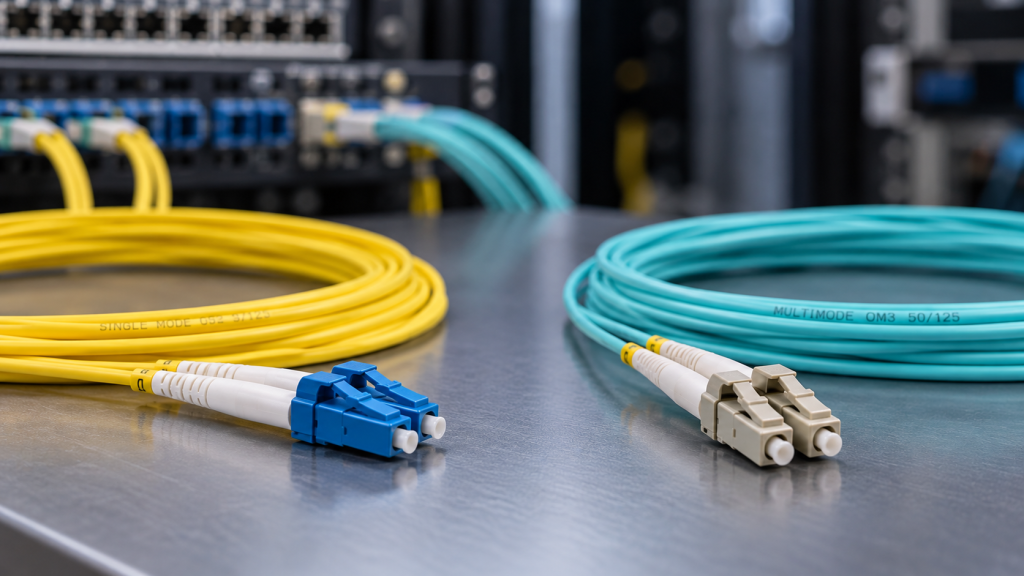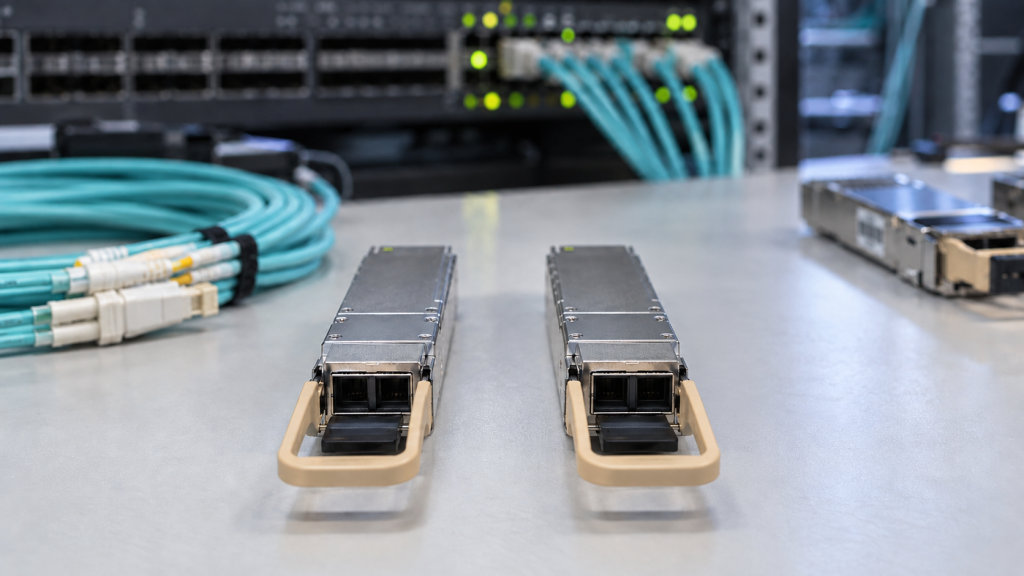
You have two sites, one pair of fibres between them, and a lot more traffic than that fibre currently carries. Wavelength division multiplexing is how you get more out of the strands you already have — and the first decision is CWDM or DWDM.
They solve the same problem in very different ways. CWDM is cheap, simple and passive. DWDM is dense, long-reach and more involved. Choosing the wrong one means either paying for capacity you will never use, or rebuilding the link in eighteen months when you run out of channels.
The short answer
- Choose CWDM when you need up to about 8 or 16 channels over metro distances, want passive kit with no amplification, and care most about cost per channel.
- Choose DWDM when you need tens of channels, distances beyond roughly 80 km, or a path to 100G and above on a single fibre pair.
Everything below is the detail behind that, and the five checks that stop you ordering the wrong optics.
What the two grids actually are
Both technologies put several signals of different wavelengths onto one fibre and separate them again at the far end. The difference is how tightly those wavelengths are packed, and that is set by two ITU-T recommendations rather than by any vendor.
CWDM — coarse spacing, wide tolerances
The CWDM grid is defined in ITU-T G.694.2: 18 channels spaced 20 nm apart, running from 1271 nm to 1611 nm. That 20 nm gap is enormous in optical terms, and it is the whole point. A laser can drift several nanometres with temperature and still sit comfortably inside its channel, which means CWDM transceivers need no thermo-electric cooling. No cooler means less power, less cost and less complexity.
The trade-off is that the grid spreads across a huge slice of spectrum, including the water peak region around 1383 nm where older fibre attenuates badly. In practice most deployments use the 8 or 16 channels that behave best on the fibre in the ground.
DWDM — dense spacing, tight control
The DWDM grid is defined in ITU-T G.694.1, and it is specified in frequency rather than wavelength — anchored on 193.1 THz with spacings of 100 GHz, 50 GHz and finer. In wavelength terms 100 GHz is roughly 0.8 nm. Channels sit in the C-band, around 1530 to 1565 nm, where fibre loss is lowest and optical amplification is available.
Holding a laser to 0.8 nm — or 0.4 nm on a 50 GHz plan — takes active temperature control inside every module. That is why a DWDM optic costs more, draws more power and takes longer to stabilise. It is also why you can fit 40, 80 or more channels on one fibre pair and amplify the whole band in one go.
Side by side
| CWDM | DWDM | |
|---|---|---|
| Standard | ITU-T G.694.2 | ITU-T G.694.1 |
| Channel spacing | 20 nm | 100 GHz / 50 GHz (approx. 0.8 / 0.4 nm) |
| Channels available | Up to 18 (commonly 8 or 16 used) | 40, 80, 96 and beyond |
| Wavelength range | 1271–1611 nm | Mainly C-band, 1530–1565 nm |
| Laser cooling | Uncooled | Temperature controlled |
| Amplification | Not practical across the grid | EDFA amplifies the whole C-band |
| Typical reach | Up to around 80 km | 80 km unamplified, far more with amplification |
| Relative cost per channel | Low | Higher, but lower per bit at scale |
| Best fit | Metro access, campus, business fibre | Core transport, DCI, long-haul |
Where each one wins in practice
CWDM: getting more out of leased fibre
If you lease a fibre pair between two buildings and need to carry eight services over it, CWDM is hard to beat. A passive multiplexer at each end, a CWDM optic per service, and the fibre is doing eight times the work with no powered equipment in the path. There is nothing to configure and nothing to fail in the mux.
It is the standard answer for campus backbones, metro access rings, mobile fronthaul and any situation where the fibre is expensive and the channel count is modest. Our 1.25G CWDM SFP et 10G CWDM SFP+ ranges cover the full grid, with 10G CWDM XFP for older platforms.
DWDM: when channel count or distance decides it
The moment you need more than 16 channels, CWDM stops being an option — there is no more grid to allocate. The same is true past about 80 km, where you need amplification, and CWDM’s spread across 340 nm of spectrum makes that impractical. DWDM keeps everything inside the C-band precisely so one amplifier can lift every channel at once.
This is the territory of core transport and data centre interconnect, which we cover in more depth in our article on data centre interconnect. Our 1.25G DWDM SFP et 10G DWDM SFP+ ranges cover the standard channel plans, with 10G DWDM XFP alongside them.
The stock problem nobody mentions until it bites
Here is the operational sting in fixed-wavelength DWDM. Every channel is a different part number. A 40-channel system is 40 SKUs, and if you hold one spare of each you have tied up a lot of capital in modules that will mostly sit on a shelf. Hold fewer, and the night a channel fails is the night you discover you have spares for channels 21 and 34 but not 17.
Tunable optics solve this directly. One module covers the whole C-band and is set to the channel you need at the point of deployment, so a single spare covers every wavelength in the system. We look at the economics of that in why tunable transceivers reduce complexity in DWDM networks, and there is product detail in our deep dives on the 10G tunable DWDM SFP+ and the 10G tunable DWDM XFP.
Carritech stocks both: tunable DWDM SFP+ et tunable DWDM XFP modules.
Five checks before you order
- Count the services you will need in three years, not today. If that number passes 16, specify DWDM now and save yourself a forklift later.
- Work the optical budget properly. Mux insertion loss, splices, connectors and fibre attenuation all subtract from the transmitter’s output before the receiver sees anything. Our guide to optical link budget sets out the arithmetic.
- Match the mux to the grid. A CWDM mux built for the 8-channel plan will not pass the 1611 nm channel. Check the exact wavelengths the passive kit supports.
- Confirm the fibre type. Both technologies need single-mode fibre to ITU-T G.652. Older cable with a high water peak will not carry the mid-grid CWDM channels usefully.
- Get the coding right. The module has to identify itself correctly to the host or the port may refuse to come up — see transceiver coding explained.
Keeping the link healthy once it is live
WDM links degrade quietly. A connector picks up contamination, a splice ages, a laser loses a little output, and the margin you budgeted disappears months before anything actually drops. Digital diagnostic monitoring reports transmit power, receive power, bias current and temperature per module, so you can trend the decline instead of being surprised by it — our guide on spotting a failing fibre link before it drops covers the thresholds worth alarming on.
Getting the right optics
Carritech Optics supplies compatible CWDM and DWDM modules across the full transceiver range, coded and tested for the platform they are going into and backed by a garantie à vie with UK and EU stock behind it. Every module is tested before it ships — the 22 checks a module passes explains what that involves.
If you have OEM part numbers in hand, our compatibility checker returns the tested Carritech equivalent in seconds. Or send us the sites, distances and service count and we will build the channel plan with you — request a quote.