If you are specifying 400G, 800G or planning a route to 1.6T, one decision shapes everything that follows: QSFP-DD or OSFP. The two form factors carry the same headline speeds, sit in similar-looking cages, and are frequently treated as interchangeable in budget spreadsheets. They are not. They differ in backwards compatibility, thermal headroom and where the industry is heading beyond 800G.
Here is the practical comparison, without the marketing.
The short answer
- Choose QSFP-DD when you are upgrading an existing estate and need the new ports to keep accepting your current QSFP28 and QSFP56 optics.
- Choose OSFP when you are building new high-density fabric — particularly AI and hyperscale east-west traffic — and want thermal and power headroom for what comes after 800G.
In most real networks the choice is made for you by the switch you have already bought. The value in understanding the difference is in specifying the optics correctly, and in planning the next refresh.
What they have in common
Both are eight-lane pluggable form factors. At 400G that is 8 x 50G electrical lanes; at 800G it is 8 x 100G. Both are defined by open multi-source agreements — the QSFP-DD MSA and the OSFP MSA — and both carry optical interfaces standardised by the IEEE 802.3 Ethernet Working Group. Both are managed through the Common Management Interface Specification, so monitoring and diagnostics behave consistently across either.
That shared standards base is why compatible optics work reliably in both: the interfaces are public, and conformance is testable.
Backwards compatibility: QSFP-DD’s biggest advantage
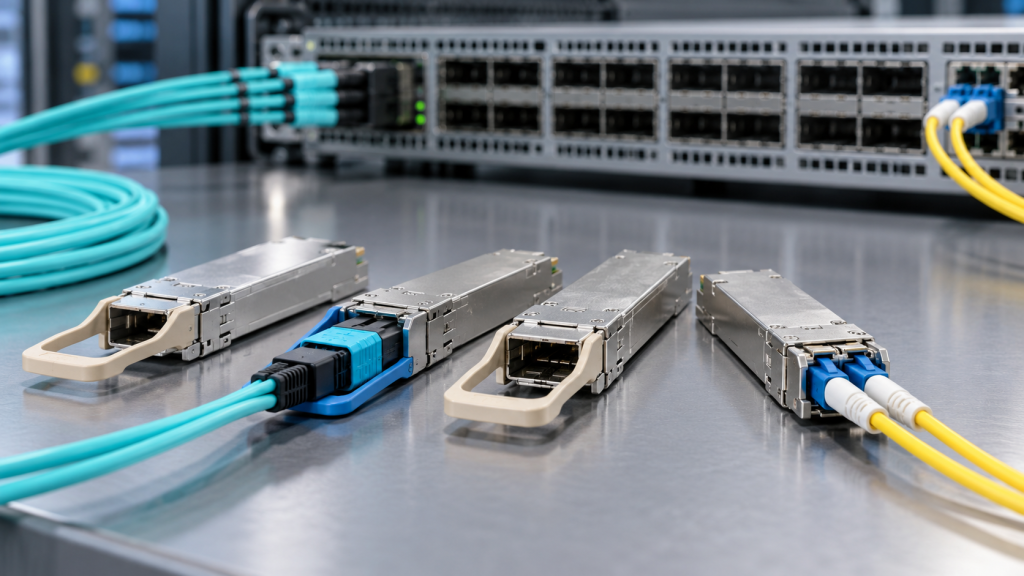
QSFP-DD is a double-density evolution of the QSFP cage — a second row of electrical contacts added behind the first. The mechanical opening is unchanged, so a QSFP28 or QSFP56 module drops straight into a QSFP-DD port and works at its native speed.
For a brownfield estate that is enormously useful. You can populate a new 400G leaf with existing 100G optics on day one, then migrate ports to 400G as demand arrives, without stranding inventory. OSFP ports can accept QSFP-family modules too, but only via an OSFP-to-QSFP adapter — an extra part, an extra failure point and an extra line on the bill of materials.
Thermals and power: OSFP’s biggest advantage
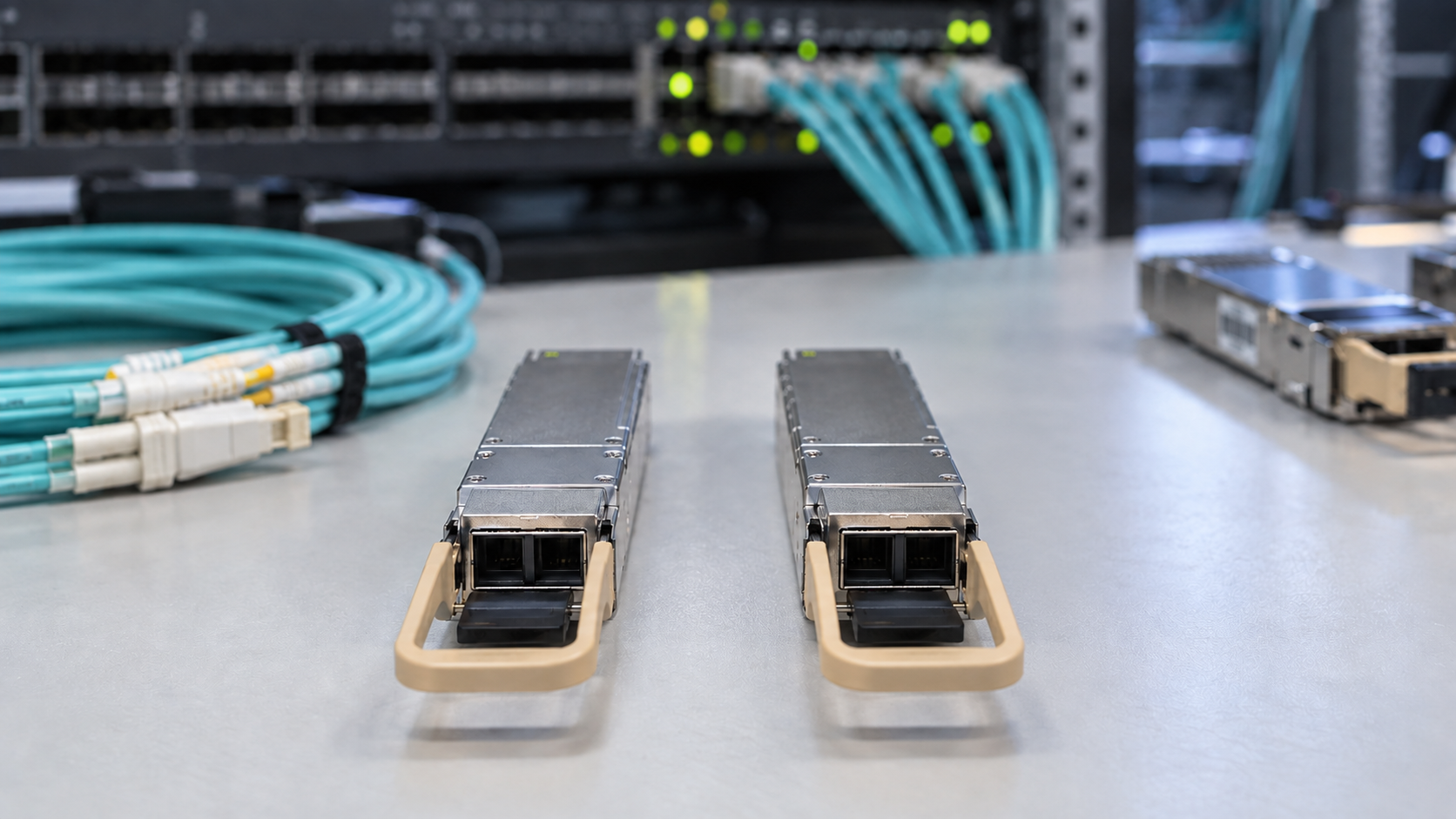
OSFP is physically slightly larger, and that space buys thermal performance. OSFP modules are commonly available with an integrated heatsink on the module body, rather than relying entirely on a riding heatsink in the host cage. As per-module power rises with higher-order modulation and longer reaches, that headroom stops being a nicety.
QSFP-DD is not thermally incapable — well-designed hosts run 400G and 800G QSFP-DD reliably in dense configurations — but it works harder to do it, and switch vendors are more likely to publish population rules or airflow constraints for fully loaded QSFP-DD line cards. If you are filling every port in a hot aisle, ask for those figures before you commit.
Looking past 800G
Both MSAs have published routes to 1.6T. OSFP has been favoured in early AI-cluster deployments, where power budgets per port are high and vendors have leaned on its thermal envelope; OSFP-XD extends the lane count for higher aggregate rates. QSFP-DD’s roadmap continues through higher-rate variants that preserve the cage’s compatibility story.
The honest position for most operators: neither form factor is going away, and the market has settled into a split where enterprise and telecom refreshes lean QSFP-DD while AI fabric leans OSFP. Plan for both existing in your estate rather than betting on one winning. Our 1.6T transceivers et 800G range cover both paths.
Side by side
| QSFP-DD | OSFP | |
|---|---|---|
| Electrical lanes | 8 | 8 (16 on OSFP-XD) |
| Accepts QSFP28/QSFP56 directly | Yes | Adapter required |
| Module size | QSFP footprint | Slightly larger |
| Integrated heatsink option | Host cage / riding heatsink | Commonly on module |
| Typical strength | Brownfield upgrades, mixed-speed ports | AI and hyperscale fabric, high power budgets |
| Speeds in the Carritech range | 200G, 400G | 800G, 1.6T |
What to check before you order
- The host port type, not the speed. A “400G port” tells you nothing about the cage.
- The optical interface — DR4, FR4, LR4, SR8 and so on determine reach and fibre type, and are chosen independently of the form factor.
- Breakout intentions. If you plan to break 400G out to 4 x 100G, confirm the host supports it on that port and specify the right cable or module set.
- Coding. The module must identify itself correctly to the host platform.
- Fibre and polarity. Multi-lane parallel optics use MPO; if polarity is not something you have pinned down, read our guide to MPO polarity types A, B and C.
For short in-rack connections at these speeds, a passive DAC or an AOC is often the better answer than a pair of modules — our comparison of DAC vs AOC covers where each one wins.
Getting the right module first time
Carritech Optics supplies compatible 400G QSFP-DD, 800G OSFP et 1.6T optics, tested against the platforms they are going into and backed by a lifetime warranty. If you have an OEM part number in hand, our compatibility checker returns the tested equivalent in seconds.
Not sure which way your next refresh should go? Send us the switch models and port counts and we will spec it — request a quote.