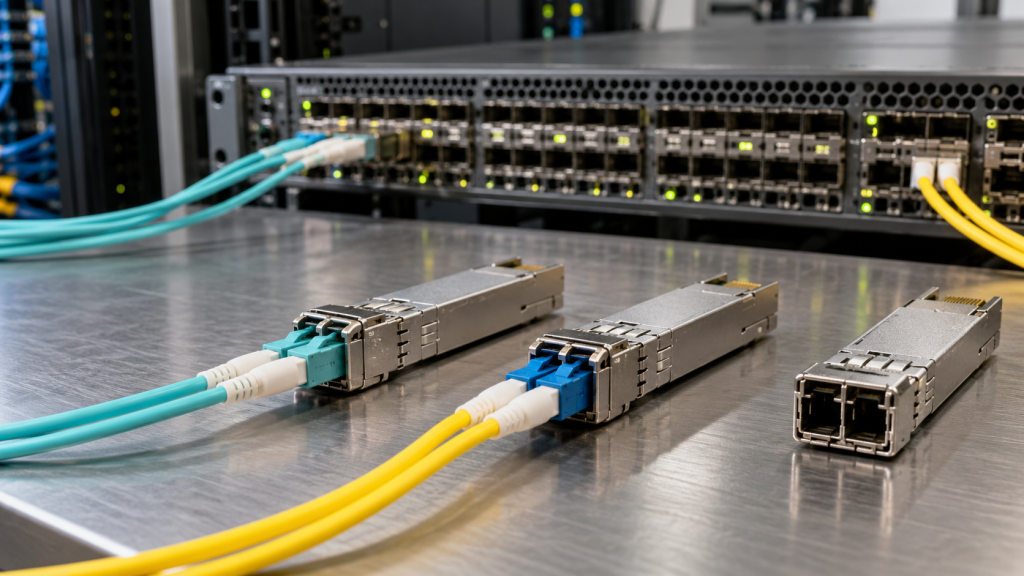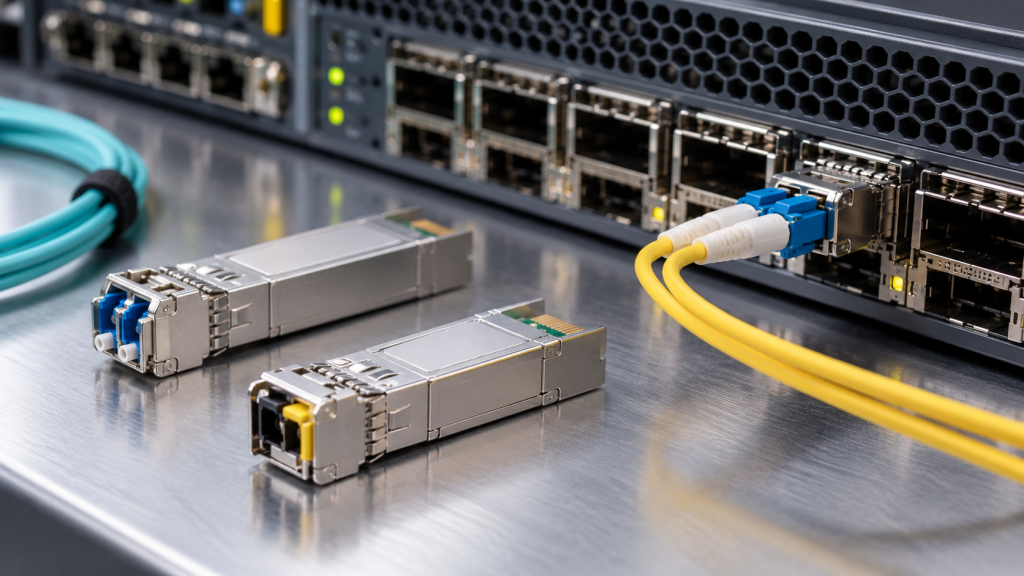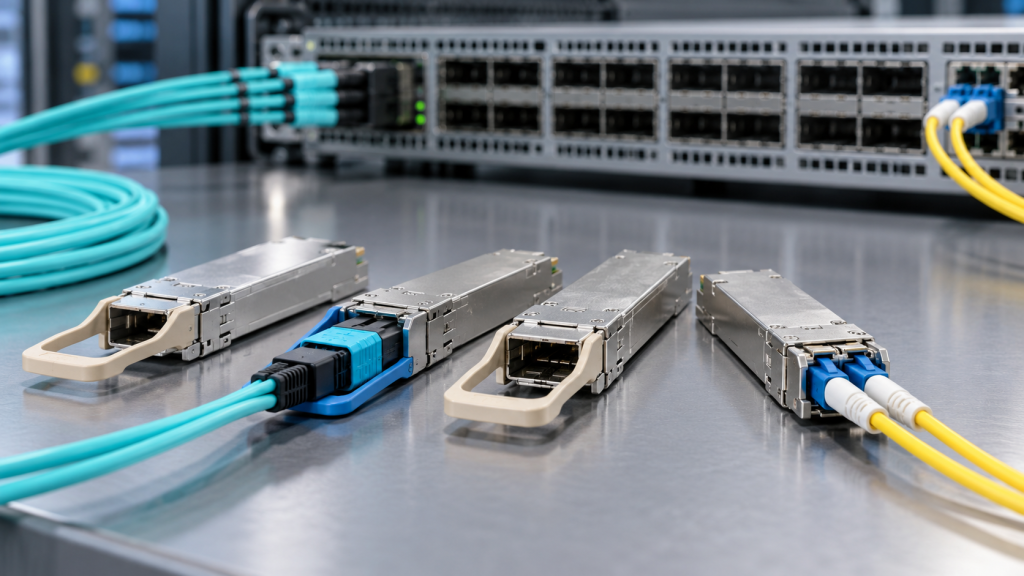
You plug a perfectly good 10G optic into a switch. The light comes on, the fibre is fine, the optics are within spec — and the port stays down, or the log fills with warnings about an unsupported transceiver. Nothing is broken. The switch simply did not recognise the name on the module.
That is transceiver coding, and understanding it turns a frustrating compatibility problem into a stock-control advantage.
What “coding” actually means
Every pluggable optic carries a small EEPROM. When the module is inserted, the host reads it over a two-wire management interface and gets a structured block of information: vendor name, vendor part number, serial number, date code, supported wavelengths, reach, and the digital diagnostic values for temperature, bias current and optical power.
The layout of that block is public. It is defined by the SFF specifications maintained through SNIA — SFF-8472 for SFP-family diagnostics — and, for higher-speed modules, by the Common Management Interface Specification published via the QSFP-DD MSA. The optical behaviour underneath is standardised by IEEE 802.3.
“Coding” is simply what has been written into those vendor identification fields. A module coded for one platform announces itself with that vendor’s strings; the switch checks them against its internal list and decides how to behave.
Why switches care at all
Vendors give different reasons — supportability, qualification, quality control — and the enforcement varies a lot in practice:
- Some platforms refuse to bring the interface up at all unless the identification matches.
- Some bring the link up but log a warning on every insertion, and flag the port in show commands.
- Some require an explicit configuration command to permit unrecognised modules.
- Some accept anything that conforms electrically and say nothing.
Crucially, none of this is an optical incompatibility. The laser, the wavelength, the modulation and the electrical interface are all standards-defined. It is an identification check, and it is why a correctly coded compatible module behaves exactly like the OEM part it replaces — including reporting full diagnostics in the interface table.
The inventory problem coding creates
Here is where it costs real money. Consider a mixed estate — some Cisco, some Juniper, some Arista, a few Nokia and Huawei platforms in the transport layer. If you hold spares for 10G LR across all of them, you are not holding one line of stock. You are holding five, each with its own part number, its own reorder point and its own shelf.
The optics are electrically and optically identical. The only difference is a string in an EEPROM. Yet you carry five times the working capital, and you still get the call at 2am where the only spare in the cabinet is coded for the wrong platform.
Recoding: one module, every platform
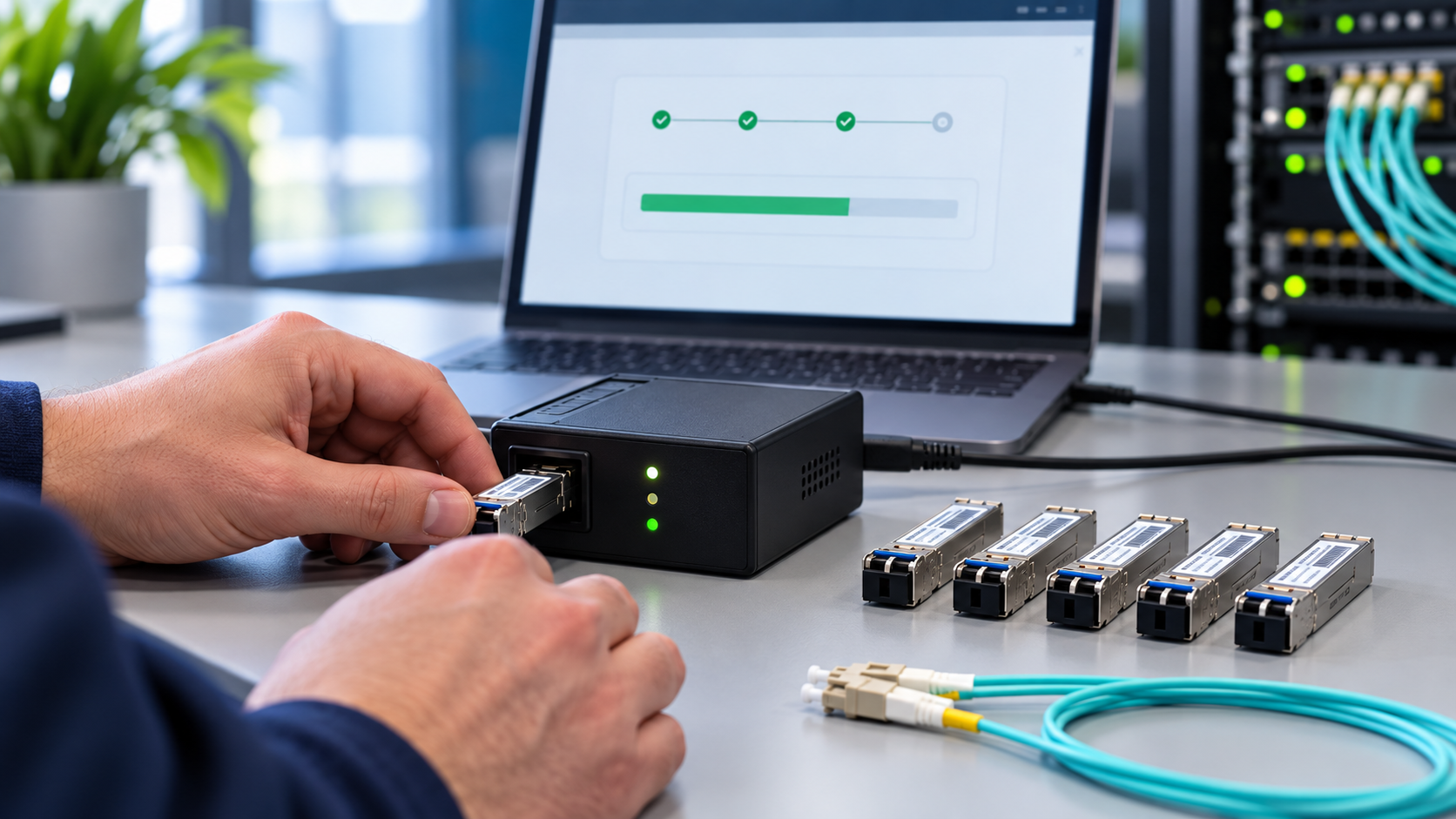
Because the identification fields are writable, a module can be reprogrammed for a different host. That is what a coding box does: it applies a validated vendor profile to a transceiver, on demand, in seconds.
Les Carritech Opticode coding box handles this in-house. Drop a module in, select the target platform profile, apply, and validate. It also lets you read a module’s existing profile and diagnostics before deployment — so you can confirm what you are about to install rather than discovering it in a maintenance window.
What that changes operationally
- One SKU per optical type, not one per platform. Stock 10G LR once and code it when it is deployed.
- Faster incident response. The spare in the cabinet is always the right spare.
- Less stranded inventory. Decommission a platform and the optics move to whatever replaces it.
- Cleaner change windows. Pre-code and pre-validate modules before they leave the workshop.
- Fewer emergency orders at emergency pricing.
Coding is not a substitute for testing
An important caveat: writing the right vendor string onto a poor-quality module does not make it a good module. It only makes the switch accept it. The identification is the last step, not the whole story — the module still has to meet its optical budget, hold power and wavelength across temperature, and survive real duty cycles.
That is why every Carritech Optics module is tested on the platform it is coded for before it ships. Our article on the 22 checks a module passes before it reaches you sets out the process, and there is more detail on our transceiver testing page. Once deployed, digital diagnostic monitoring uses the same EEPROM interface to give you live optical power and temperature data per link.
Getting the coding right first time
If you would rather not code modules yourself, you do not have to. Tell us the platform and we will ship them coded, tested and ready to insert. Our compatibility checker maps any OEM part number to its tested Carritech equivalent, and the Cisco optics reference guide is a useful starting point if that is the bulk of your estate.
Everything in our optical transceiver range — from 155M through 10G et 25G up to 1.6T — carries a lifetime warranty, with UK and EU stock and support behind it.
Send us your part list and platform mix and we will tell you exactly how many SKUs you actually need — request a quote.