How AI is changing the way networks are built
Artificial intelligence is changing far more than software. Behind every AI model, chatbot, automation platform and machine learning application is a physical network that has to move enormous volumes of data quickly, reliably and efficiently.
As AI adoption grows, the pressure on data centres, cloud platforms, telecom networks and enterprise infrastructure is increasing. Training and running AI workloads requires huge amounts of information to move between servers, storage systems, switches and accelerator hardware. That makes the optical layer more important than ever.
In simple terms, AI needs speed. It needs low latency. It needs scalable bandwidth. And that means optical transceivers are becoming a critical part of the AI infrastructure conversation.
Industry analysts have already linked AI cluster growth with a major rise in optical transceiver demand, particularly around 400G, 800G and future 1.6T connectivity. LightCounting has forecast that the market for optics used in AI scale-out and scale-up networks could grow from around $5 billion in 2024 to more than $10 billion in 2026.
Why AI workloads need better optical connectivity
Traditional enterprise networks were often built around predictable traffic patterns. Users accessed applications, data moved between known systems, and bandwidth demand could be planned around fairly stable usage.
AI changes that.
AI infrastructure generates intense “east-west” traffic inside data centres. Instead of data simply moving in and out of a facility, huge volumes of information move between GPUs, servers, switches and storage systems. The faster and more efficiently these systems communicate, the better the performance of the AI environment.
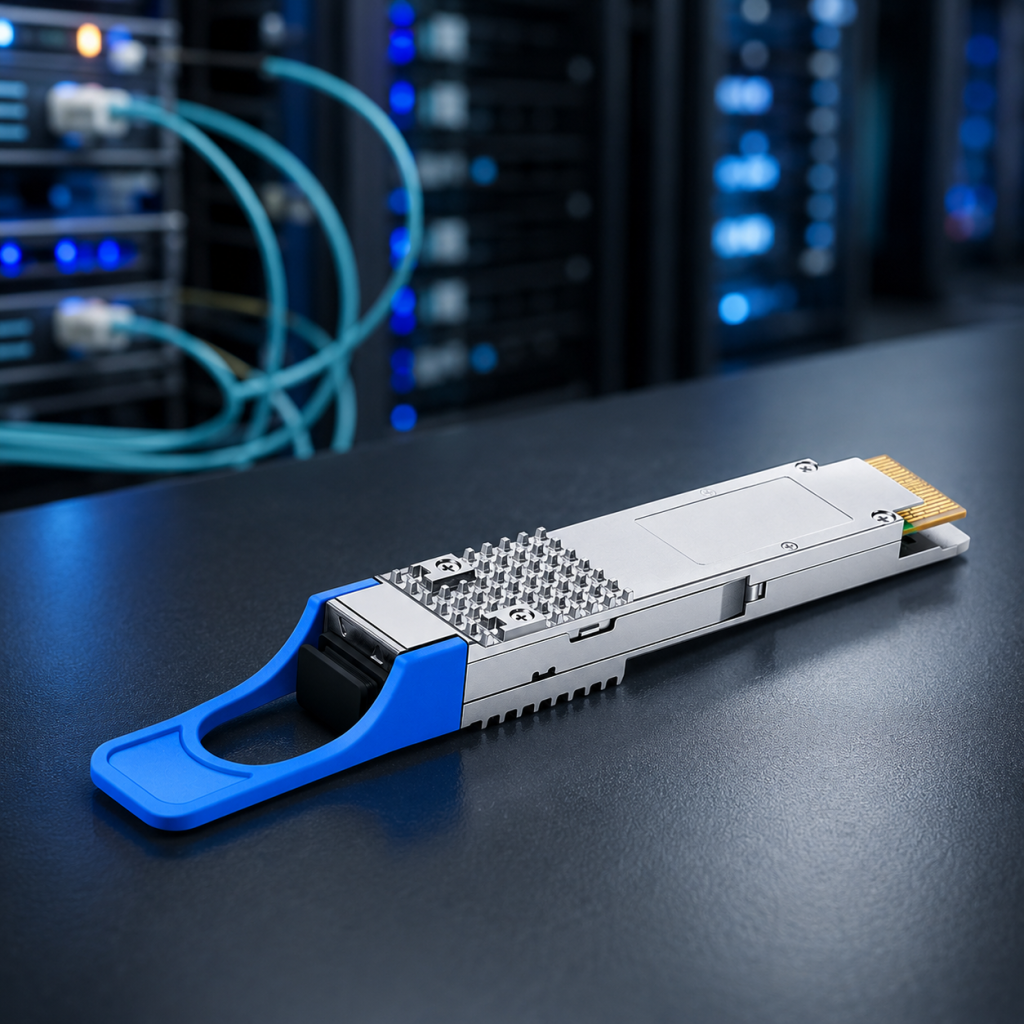
This is where optical transceivers play a central role. They convert electrical signals into optical signals and allow data to move over fibre at high speed and over the required distance. For AI-ready infrastructure, the right transceiver choice can directly affect bandwidth, latency, power efficiency, scalability and long-term network cost.
Carritech Optics supplies a wide range of OEM-compatible optical transceivers for telecom operators, data centres and enterprise networks, covering applications from lower-speed legacy connectivity through to high-capacity 400G and 800G environments.
400G: the practical foundation for AI-ready networks
For many organisations, 400G is one of the most important stepping stones towards AI-ready infrastructure. It offers a strong balance between performance, availability and deployment practicality, especially for data centres and network operators upgrading from 100G environments.
400G optical transceivers are commonly used to support high-density switching, data centre interconnects, aggregation layers and cloud infrastructure. In AI-related environments, 400G can help provide the capacity needed to move large datasets and support more demanding compute workloads.
Carritech Optics offers a range of 400G QSFP-DD Optical Transceivers, including options such as SR4.2 for short-reach multimode fibre applications, DR4 for 500m single-mode links, FR4 for 2km links and LR4/LR8 options for longer 10km single-mode connections.
These products are particularly relevant for organisations building or upgrading high-capacity data centre environments where switch-to-switch and server-to-network connectivity need to scale without unnecessary complexity.
800G: supporting the next wave of AI data centre growth
As AI clusters grow larger, 800G is becoming increasingly important. The move from 400G to 800G allows networks to support greater throughput, higher port density and more efficient scaling across demanding data centre environments.
The industry is already preparing for this shift. Optical vendors are investing in 800G production capacity, and some are also preparing for 1.6T transceiver demand as AI infrastructure continues to evolve.
For organisations looking ahead, Ricetrasmettitori ottici OSFP 800G are part of the wider move towards ultra-high-speed networking. These modules are designed for environments where capacity, density and future scalability are all essential.
While not every organisation needs 800G today, the growth of AI means many network teams are already planning for it. Understanding the migration path from 100G to 400G, and then from 400G to 800G, is becoming an important part of future network planning.
100G still matters in AI-connected infrastructure
Although much of the AI conversation focuses on 400G, 800G and beyond, 100G remains highly relevant.
Many organisations are not replacing their entire network overnight. Instead, they are building hybrid environments where 100G remains in use across access, aggregation, edge, enterprise, metro and interconnect layers.
That makes 100G QSFP28 transceivers an important part of AI-supporting infrastructure, particularly where organisations need cost-effective upgrades, reliable interconnects or extended-reach links between sites.
Carritech Optics supplies a range of 100G QSFP28 transceivers, including LR4, ER4, ZR4, CWDM4, PSM4 and BiDi options. For example, LR4 is commonly used for 10km single-mode links, while ER4 and ZR4 are used for extended and very-long-reach 100G transport over single-mode fibre.
For AI-related network expansion, this matters because not every requirement is inside a hyperscale data centre. AI services also rely on cloud access, metro connectivity, enterprise backbones, content delivery, edge locations and inter-data-centre transport. 100G optics can still be the right choice in many of these areas.
Choosing the right transceiver for AI-driven demand
The right optical transceiver is not just the fastest one available. It depends on the network environment, fibre type, distance, compatibility requirements, budget and upgrade strategy.
For AI-connected environments, the key questions usually include:
- What speed is needed now, and what will be needed in the next phase of growth?
- Is the link inside a rack, across a data hall, between buildings or between sites?
- Is the network using single-mode or multimode fibre?
- Does the application require short-reach, medium-reach or long-reach optics?
- Which OEM platform does the module need to be compatible with?
- Is power consumption, density or cost per bit the main priority?
Carritech Optics provides fully compatible transceivers for many leading OEM platforms, giving network teams more flexibility when expanding or upgrading infrastructure. This is especially valuable in AI-related projects where speed of deployment, availability and cost control can all influence the success of the upgrade.
AI is making the optical layer more strategic
AI has made compute hardware famous. GPUs, servers and accelerators often get the attention. But without the right optical connectivity, that hardware cannot perform at its full potential.
A slow or poorly planned network can restrict AI performance, increase bottlenecks and limit scalability. As AI workloads become more demanding, optical transceivers are no longer just small components in the background. They are strategic building blocks for high-performance infrastructure.
Whether the requirement is 100G, 400G, 800G or a longer-term migration path, the organisations that plan their optical connectivity carefully will be better positioned to support the next generation of AI-driven services.
Explore AI-ready optical transceiver options
Carritech Optics supplies a wide range of OEM-compatible optical transceivers for telecom operators, data centres and enterprise networks.
Explore relevant product ranges:
100G QSFP28 Optical Transceivers
400G QSFP-DD Optical Transceivers
Ricetrasmettitori ottici OSFP 800G
All Optical Transceivers
As AI continues to reshape digital infrastructure, the need for reliable, scalable and cost-effective optical connectivity will only grow. Carritech Optics helps organisations find the right transceiver solutions to support today’s network demands and tomorrow’s AI-driven growth.