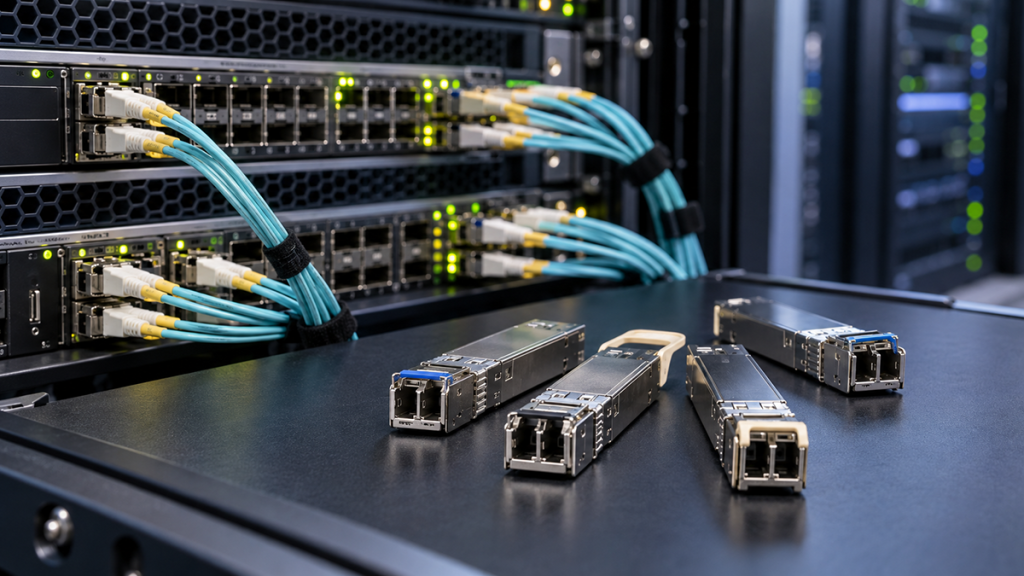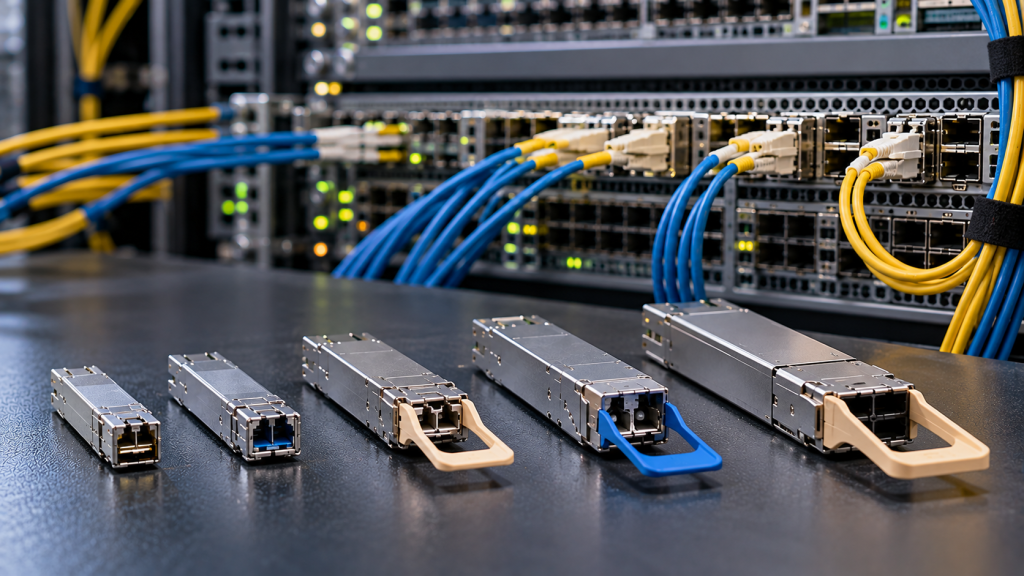
As network traffic continues to grow, many organisations are looking beyond traditional 10G connectivity and considering whether 25G is the right next step. That often leads to one of the most common questions in optical networking: what is the difference between SFP+ and SFP28?
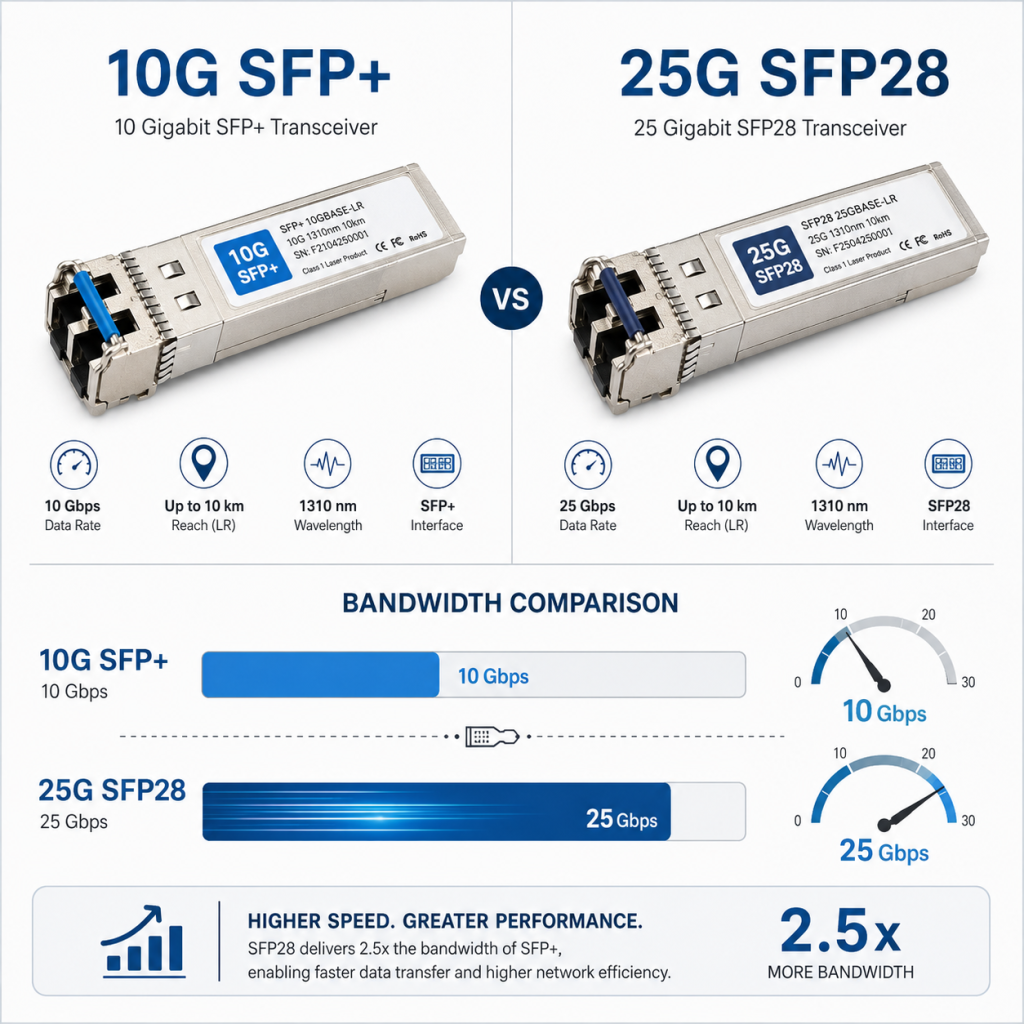
At a glance, the two module types look very similar. Both are compact, hot-pluggable optical transceivers designed for single-lane connections, and both are widely used in modern Ethernet networks. The key difference is speed: SFP+ is most commonly used for 10 Gigabit Ethernet, while SFP28 is designed for 25 Gigabit Ethernet. The SFP28 form factor is defined for 28 Gb/s electrical interfaces and is used to support 25G Ethernet applications in the same compact style of module familiar from SFP+ deployments.
For network teams, the decision is not simply about choosing the faster option. The right choice depends on current bandwidth needs, switching infrastructure, fibre type, upgrade plans and cost expectations. This guide explains how 10G SFP+ and 25G SFP28 transceivers compare, where each is commonly used, and when moving to 25G may make sense.
What is an SFP+ transceiver?
SFP+, short for Small Form-factor Pluggable Plus, is a compact optical transceiver format most commonly associated with 10 Gigabit Ethernet. It became a widely adopted choice for enterprise, data centre and telecom networks because it delivers high-speed connectivity in a small, flexible form factor. Carritech Optics supplies a broad range of 10G transceivers, including 10G SFP+, BiDi SFP+, CWDM SFP+, DWDM SFP+ and tunable DWDM SFP+ options for different distances and applications.
10G SFP+ remains highly relevant because many networks still operate comfortably within 10G requirements, particularly for access, aggregation, enterprise uplinks and established fibre links where there is no immediate need for higher capacity.
Common uses for 10G SFP+ optics
10G SFP+ modules are commonly used for:
- Enterprise network uplinks
- Data centre server and switch connectivity
- Metro Ethernet and carrier networks
- Fibre links requiring short, medium or long reach
- CWDM and DWDM deployments where wavelength-specific transmission is required
Because 10G is mature, widely supported and available across many optical variants, it remains a practical and cost-effective option for a large number of network environments.

What is an SFP28 transceiver?
SFP28 is the next step up in the same compact single-lane family, most commonly used for 25 Gigabit Ethernet. While it is physically similar to SFP+, SFP28 is built to handle a higher signalling rate, allowing more bandwidth through a comparable footprint. The underlying SFP28 specification supports a 28 Gb/s electrical interface, which is why it is suited to 25G Ethernet applications.
Carritech Optics supplies 25G transceivers for higher-capacity networks, including 25G duplex SFP28, BiDi SFP28 and other specialist options designed for modern data centre, telecom and service provider requirements.
Common uses for 25G SFP28 optics
25G SFP28 modules are often chosen for:
- High-density data centre server connections
- Leaf-spine network architectures
- Cloud infrastructure
- 5G transport, fronthaul and backhaul applications
- Higher-bandwidth enterprise or service provider networks
- Upgrade paths where 10G is becoming restrictive but 100G is not yet required
Carritech Optics already positions 25G as a useful option for cloud and 5G edge networks because it can help increase per-port capacity without immediately jumping to much higher-speed optics.
SFP+ vs SFP28: the main differences
Although the two module types appear alike, there are several important differences between SFP+ and SFP28.
| Feature | SFP+ | SFP28 |
|---|---|---|
| Typical Ethernet speed | 10G | 25G |
| Common use case | Established enterprise, telecom and data centre networks | Higher-capacity data centre, cloud and 5G networks |
| Electrical interface | Designed around 10G operation | Designed for 28 Gb/s signalling to support 25G Ethernet |
| Bandwidth per lane | 10 Gbps | 25 Gbps |
| Upgrade position | Mature, cost-effective baseline | Higher-capacity next step from 10G |
| Form factor | Compact SFP-style module | Compact SFP-style module |
The most important practical difference is simple: SFP28 provides 2.5 times the bandwidth of SFP+ on a single lane. This can make 25G especially attractive in environments where traffic is increasing but rack space, switch port density or cabling simplicity still matter.
Are SFP+ and SFP28 physically compatible?
SFP+ and SFP28 use a very similar physical form factor, but that does not mean every SFP28 module will operate in every SFP+ port or vice versa. Whether a link can run at 10G or 25G depends on the capabilities of the host equipment, the port design, the module and the network configuration.
In practice, some SFP28 ports support operation at both 10G and 25G, which can make staged upgrades easier. However, compatibility should always be checked against the switch, router or network platform being used before deployment. For buyers, this is one of the reasons technical support from a knowledgeable optics supplier is valuable when selecting modules for a specific environment.
Why choose 25G instead of staying with 10G?
For networks that are reaching the limits of 10G, 25G can be a very sensible upgrade path. It offers substantially more bandwidth without requiring a move straight to 40G or 100G, and it is particularly useful where server, storage or east-west traffic is increasing inside modern data centres.
A move from 10G to 25G may be worth considering when:
- Existing 10G uplinks are becoming congested
- Server bandwidth requirements are increasing
- The network is being refreshed around newer switching platforms
- You want more headroom for cloud, virtualisation, storage or edge workloads
- You need a denser, more efficient step before moving to 100G
Because 25G delivers more bandwidth per lane than 10G, it can improve performance while preserving a familiar compact module format. This makes it a practical bridge between established 10G deployments and larger-scale higher-speed networks.
When does 10G SFP+ still make more sense?
While 25G offers greater capacity, 10G SFP+ is far from obsolete. For many organisations, it remains the right choice where the network is stable, traffic demand is predictable and there is no operational need to upgrade.
10G SFP+ may still be the better fit when:
- Current applications do not require more than 10G
- Existing switching infrastructure is built around 10G ports
- The goal is to extend or maintain a mature network cost-effectively
- Long-reach, CWDM or DWDM variants are required within an existing 10G design
- Budget efficiency is more important than additional bandwidth headroom
Carritech Optics supports both scenarios by supplying a wide range of OEM-compatible 10G and 25G optical transceivers, allowing buyers to choose modules based on the actual requirement rather than being pushed toward unnecessary upgrades. The company’s product range includes options across multiple speeds, distances and use cases, with support for major network environments and technical advice where needed.
SFP+ vs SFP28: which should you choose?
The right answer depends on the network you are building or maintaining.
If you need a proven, widely deployed and cost-effective optical solution for established network infrastructure, 10G SFP+ remains a strong choice. If your network is growing and you need more capacity per port without moving directly to 100G, 25G SFP28 is often the more future-ready option.
A simple way to think about the decision is:
- Choose 10G SFP+ for dependable, mature 10G connectivity where current capacity is sufficient.
- Choose 25G SFP28 where bandwidth demand is increasing and you want a logical upgrade path for newer data centre, cloud, telecom or edge networks.
How Carritech Optics can help
Carritech Optics supplies high-quality OEM-compatible optical transceivers for a wide range of networking requirements, including both 10G SFP+ and 25G SFP28 modules. Whether you are extending an existing 10G deployment, planning a staged network upgrade or sourcing a specific optic for a particular platform, the team can help identify a suitable option for your technical and commercial requirements. Carritech Optics highlights OEM compatibility, short lead times, UK and EU shipping and lifetime warranty support across its 10G and 25G product ranges.
Conclusion
The difference between SFP+ and SFP28 is primarily one of speed and network intent. SFP+ is the established standard for 10G connectivity, while SFP28 enables 25G Ethernet in a similarly compact form factor. For organisations with growing bandwidth needs, 25G can offer a practical next step. For networks that are already performing well at 10G, SFP+ may continue to provide the most economical and appropriate solution.
By understanding the strengths of both module types, buyers can choose optics that match their real network needs today while keeping future upgrades in mind.