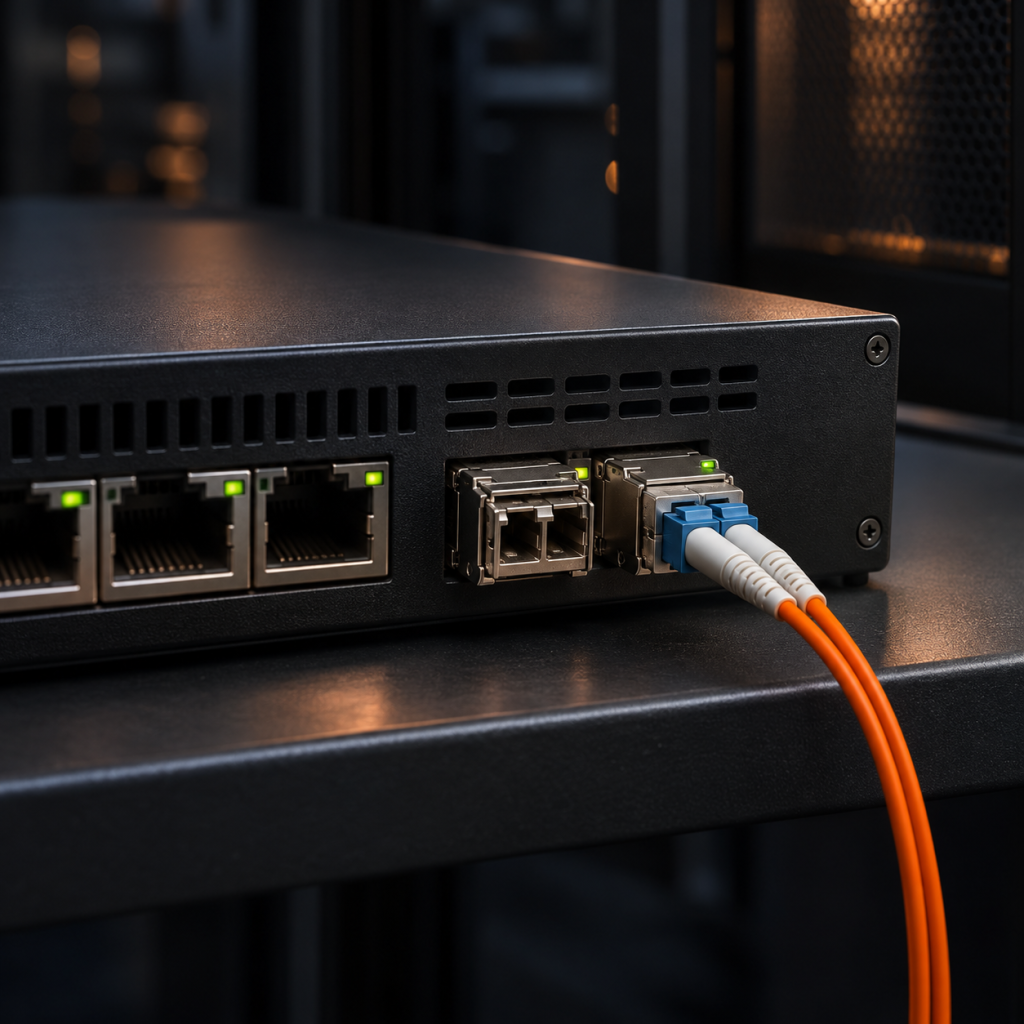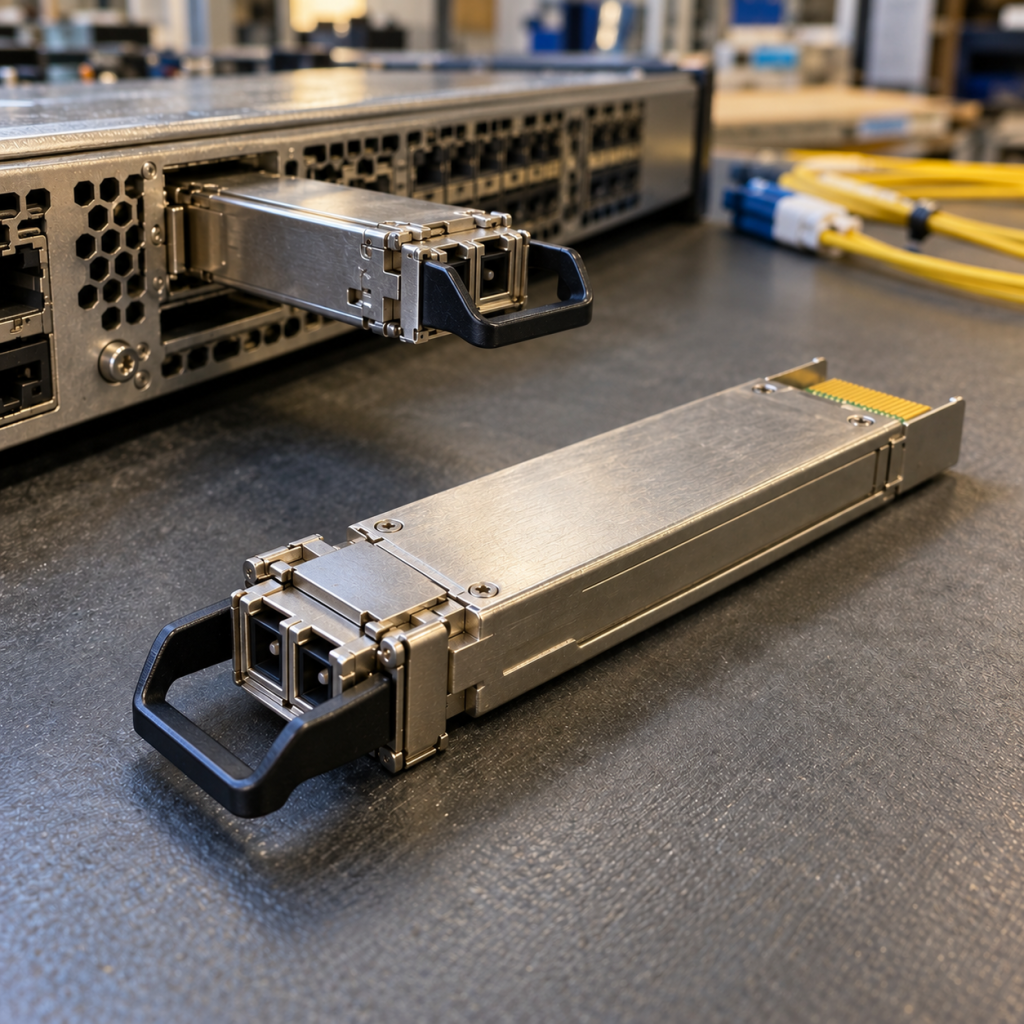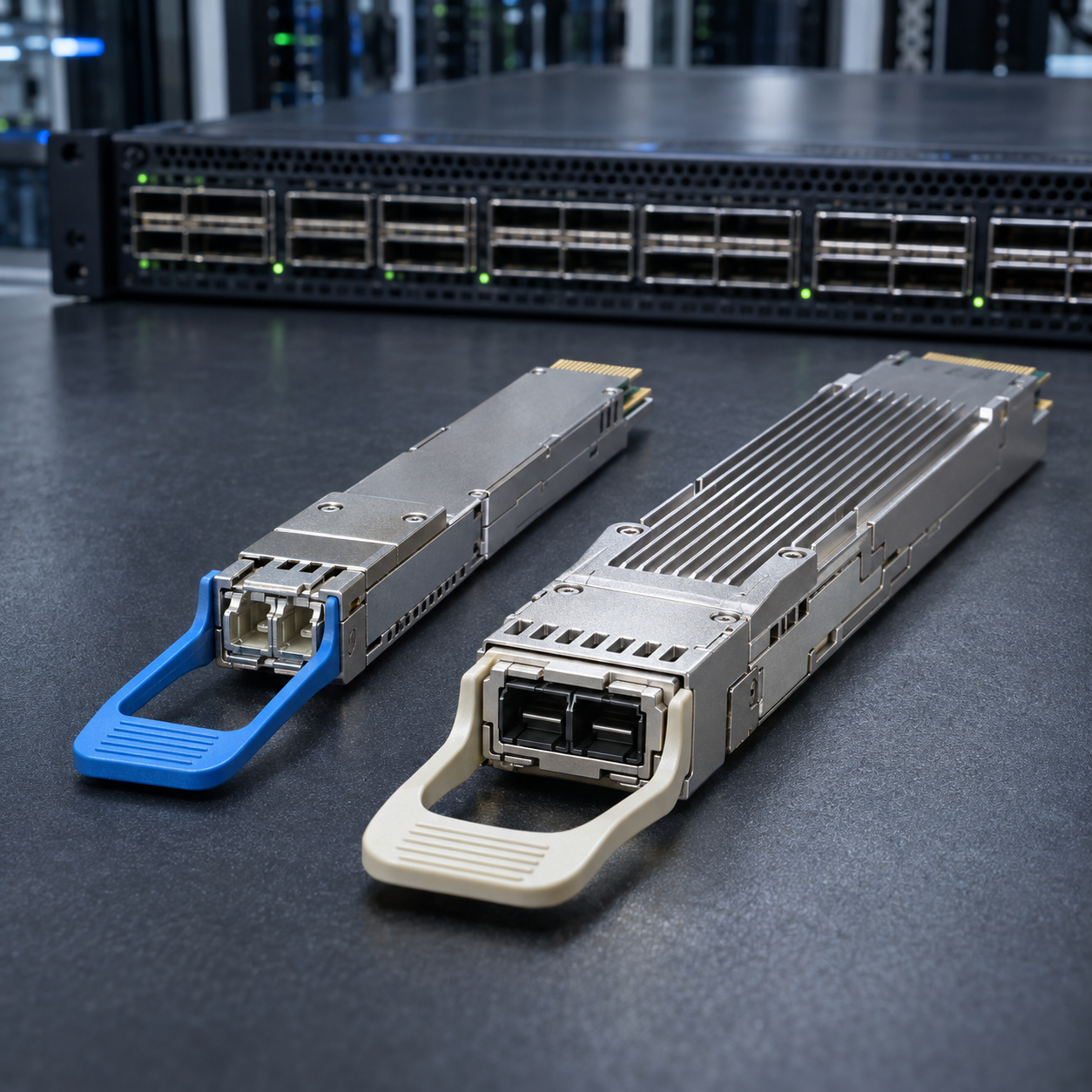
There is no other range in this catalogue where the part number tells you so little and the stakes are so high. MMS4X00-NM and MMS4X00-NM-T differ by two characters. MMA4Z00-NS-T and MMA4Z00-NS-FLT differ by two more. In each pair the optics are the same and something that decides whether the module physically fits, or which fabric it belongs to, is different. Nothing in the string says which.
That is the problem this guide solves. It covers what the NVIDIA and Mellanox part-number families mean, the lid geometry that catches people at 800G, why one optic can serve both Ethernet and InfiniBand without saying so, where the standards actually are at 800G and 1.6T, and the 49 NVIDIA compatible optics Carritech holds, from 10 Gigabit to 1.6 Terabit.
One number frames the whole range: 27 of the 49 parts are 800G or 1.6T OSFP modules. Every other vendor range in this catalogue is shaped like an enterprise network, with the bulk of the parts at 1G and 10G and a thin tail at the top. This one is the other way up. It is an AI and high-performance computing range with a small legacy tail, and it is the only range on this site that includes 1.6T OSFP parts at all.
The part-number families
| Family | Example | What it is | How to read it |
|---|---|---|---|
| MMA | MMA1B00-C100D | Mellanox engineering part number | The optical part identifier. Appears on the module label. |
| MMS | MMS1V00-WM | Mellanox engineering part number | As MMA. In our range, almost all MMS records are single-mode designs. |
| 980-9Ixxx-xxxxxx | 980-9I301-00NM00 | NVIDIA order code | An ordering SKU, not a description. Nothing readable in the string at all. |
| MC / MFM | MC2210411-SR4E | Older Mellanox codings | The 10G and 40G legacy parts. Pre-NVIDIA. |
| QDD-, T-DQ | QDD-400G-SR4 | Descriptive 400G codings | Readable: form factor, speed, port type. |
| Suffixes | -NM, -NS, -XM, -T, -FLT, -HGX | Variant markers | This is where the information lives, and where the traps are. |
Mellanox was acquired by NVIDIA in April 2020, and the catalogue has carried two naming systems ever since. The MMA and MMS strings are the engineering part numbers that appear on the module itself; the 980- strings are NVIDIA order codes. The same optic has both, and the two never appear together. 980-9I301-00NM00, 980-9I302-00NM00, 980-9I30G-00NM00 and 980-9I30G-F4NM00 all describe the same 800G 2×DR4 design in our catalogue, as do MMS4X00-NM-FLT, MMS4X00-NM-HGX and MMS4X00-NM-T. Seven order codes, one optical design, and a quote that names one of them will not match an inventory export that names another.
The suffixes are where the useful information is, and three of them decide purchases:
- -T and -FLT mark different lid geometries on the same optical module. This is the 800G trap and it has its own section below.
- -HGX marks a part scoped to a particular platform family. MMS4X00-NM-HGX is optically the same design as its siblings; the suffix exists because the platform’s support list names that string.
- -XM and -NM / -NS separate generations and media in our records: the -XM parts in this range are the newest silicon-photonics designs and the 1.6T family, while -NM and -NS sit on the 800G 2×DR4 and 2×VR4 designs respectively.
The 800G trap: open top, closed top, and riding heat sinks
This is the most useful thing in this article, and it is not an optical question at all. It is about the lid.
An 800G OSFP module dissipates enough power that it cannot cool itself from the faceplate alone. The OSFP MSA allows for two arrangements, and the OSFP Module Specification Rev 5.22, dated 9 August 2025, names them closed top and open top. A closed-top module presents a sealed lid; the specification requires that "the top trailing edge of the closed top heatsink shall have a minimum edge break to avoid riding heatsink damage", which tells you what it is designed to slide underneath. An open-top module carries its own heat-sink fins, and is allowed "only when the heat sink fins are designed to meet the dimensional requirements" the specification sets out. There is a third arrangement, OSFP-RHS, where the module "makes contact to a riding heatsink which is part of the host".
Two things follow that are worth more than the terminology. First, the industry mostly calls these "flat top" and "finned top", and the MSA deliberately stopped: the Rev 5.2 revision history records that the relevant figure was retitled from "flat top" to "closed top" specifically to avoid confusion with OSFP-RHS. So if you are reading a cabling plan that says "flat top", it is worth establishing whether the author meant a closed-top module or an RHS one, because those are different parts.
Second, and this is the practical one: the lid has to match the cage the module is going into, and the optics give you no clue. In our own range, MMA4Z00-NS-T and MMA4Z00-NS-FLT are the same 800G 2×VR4 optical design with different trailing suffixes, and our product descriptions for the two are currently identical — they describe the optics, which really are the same, and say nothing about the lid. That is a gap in our data rather than in the modules, and we are closing it. In the meantime: tell us the platform and the port, not just the part number, when you order an 800G OSFP module, and we will confirm the lid geometry before anything ships. A module whose lid is wrong will not seat, and if it does seat it will not cool.
The power numbers explain why any of this exists. The OSFP specification states that an OSFP1600 module "can have a maximum power of up to 42.9W", and its revision history records that this ceiling was raised from 33 W. A faceplate and an airflow design that comfortably cooled a 33 W part is not automatically good for 42.9. That is a data-centre design question before it is a purchasing one, and optical transceiver power consumption works through what each port really costs to run.
One optic, two protocols: Ethernet and InfiniBand
Read the descriptions in the list below and you will notice a phrase that appears nowhere else on this site: "for 800G Ethernet and InfiniBand applications". That is not marketing slack. At these rates the optical interface is frequently the same for both, and the protocol is a property of the switch and the host adapter rather than of the module.
The two bodies name their generations differently, which is where the confusion starts. IEEE names Ethernet port types after the bit rate — 800GBASE-DR8, 400GBASE-DR4. The InfiniBand Trade Association roadmap names InfiniBand generations by letter: NDR, then XDR. The IBTA announced the XDR specifications on 5 October 2023, which included "the final physical specifications for NDR 400Gb/s InfiniBand" and added SerDes support of 200Gb/s per lane, giving "unprecedent 800Gb/s speeds per port". So an 800G OSFP module might be destined for an 800G Ethernet fabric or for an XDR InfiniBand one, and the part number will not tell you which.
Three consequences for anyone buying into an AI or HPC fabric:
- Say which protocol the fabric runs when you order. Even where the optical interface is identical, the coding, the firmware expectations and the supported breakout configurations are not.
- Breakout means different things in the two worlds. An 800G module presenting two independent 400G interfaces is a normal arrangement in both, but what the far ends are and how the fabric manager sees them differs.
- A spares holding that serves both is possible, and that is the whole argument for coding at the point of deployment. One optical design, two identification strings, decided when the module is deployed rather than when it is ordered — which is what the Opticode coding box is for.
Our own guide to AI, optical transceivers and the new demand for high-speed connectivity covers why this range exists at all, and data centre interconnect covers what happens when the fabric leaves the building.
Where the standards are at 800G and 1.6T
Worth being precise about, because it changes what "compatible" can mean at the top of this range.
| Speed | Standards position | What that means when you buy |
|---|---|---|
| 10G, 25G, 40G, 100G | Fully standardised: IEEE Std 802.3ae-2002, IEEE Std 802.3by-2016, IEEE Std 802.3ba-2010, IEEE Std 802.3bm-2015 | An LR4 is an LR4. Interoperability is a specification question with a clear answer. |
| 400G | Standardised in IEEE Std 802.3bs-2017, approved 6 December 2017, with electrical interfaces from IEEE Std 802.3ck-2022, approved 21 September 2022 | Port types are defined. Confirm which one, because DR4, FR4, LR4 and SR8 are not alternatives. |
| 800G | Port types in IEEE Std 802.3df-2024, approved 16 February 2024; form factor from the OSFP MSA | The interface is standardised. The module’s mechanical and management behaviour comes from an MSA. |
| 1.6T | Not yet a published IEEE standard. In progress in the IEEE P802.3dj 200, 400, 800 Gb/s and 1.6 Tb/s task force | Today’s 1.6T parts are built to the OSFP1600 MSA and to pre-standard expectations. Buy them as a matched set, with one supplier behind both ends. |
That last row deserves emphasis rather than alarm. 1.6T Ethernet is being standardised, not speculated about — the task force exists, has adopted objectives and a timeline, and the OSFP1600 mechanical and electrical envelope is settled enough that modules ship. But a pre-standard interface is one where the two ends of a link should come from a known-good pairing rather than from two unconnected purchase orders, and where "compatible" means specification overlap rather than standards compliance. Our guide to 1.6T optical transceivers: what changes at 200G per lane works through what the step to 200G per lane actually changes, and 800G and 1.6T migration covers what to check before you buy.
One management detail that ties the range together. Several of the records below mention a CMIS-compatible two-wire interface. CMIS — the Common Management Interface Specification — is how a host talks to a modern pluggable, and it is now an Optical Internetworking Forum specification: the OIF adopted CMIS from the QSFP-DD MSA on 5 January 2022, and it covers QSFP-DD, OSFP, COBO and QSFP. For the older parts in this range, the equivalent management layout lives in the SFF documents held in the SNIA SFF specifications library. Two different management generations in one catalogue, and a host that expects one will not read the other.
Four things that catch people out
1. 800G DR8 and 800G 2×DR4 are not the same product
Both arrive as an 800G OSFP module with dual MPO-12 connectors on single-mode fibre at 500 metres. A DR8 part is one 800 Gigabit interface. A 2×DR4 part is two independent 400 Gigabit interfaces in one cage, which can feed two downstream devices from one faceplate position. Which you want is a fabric design decision, not a speed upgrade, and the two are not substitutes.
Our catalogue currently shows the hazard rather than hiding it. MMS4X00-NM is recorded as an 800G DR8 design, while MMS4X00-NM-FLT, MMS4X00-NM-HGX and MMS4X00-NM-T — the same stem with variant suffixes — are recorded as 2×DR4. One of those groupings is wrong and they cannot both stand. If you are buying into an existing fabric, tell us whether the port is configured as one 800G interface or two 400G ones and we will confirm the part against that rather than against the part number. Breakout explained covers the mechanics of splitting a high-speed port, and QSFP-DD vs OSFP covers the form-factor choice underneath it.
2. MMA and MMS are not interchangeable as a mental shortcut
In our range almost every MMS record is a single-mode design and the multimode 800G parts are the MMA4Z00 pair, which makes the prefix a tempting shortcut. It does not quite hold: MMS4A00 is recorded as an 800G SR8 multimode part, which is the one exception in the range. Either that record is wrong or the shortcut is, and we would rather tell you that than let you rely on it.
Use the prefix as a hint and the fibre plant as the specification. If the trunk is OM4, you need a multimode part whatever the prefix says; if it is single-mode, you need a single-mode part. Single-mode vs multimode fibre covers how to tell which you have, and why optical link budget matters covers the arithmetic when the answer is borderline.
3. The reaches at the top of the range are short, and that is the point
Everywhere else on this site, going faster costs reach gradually. In this range it is abrupt. The 800G and 1.6T single-mode parts reach 500 metres, and the multimode ones reach 30 metres on OM3 or 50 on OM4. Compare that with the 10 kilometres a 100G LR4 gives you from the same catalogue.
| Speed and type | Reach stocked | Fibre | Connector |
|---|---|---|---|
| 1.6T OSFP DR8 | 500 m | Single-mode | Dual MPO-12/APC |
| 800G OSFP DR4 and 2×DR4 | 500 m | Single-mode | MPO-12/APC, or dual |
| 800G OSFP 2×VR4 and SR8 | 30 m OM3 / 50 m OM4 | Multimode | Dual MPO-12/APC |
| 800G OSFP 2×SR4 | 100 m OM4 or OM5 | Multimode | Dual MPO-12/APC |
| 400G QSFP-DD | 100 m to 10 km depending on type | Both | MPO or duplex LC |
| 100G QSFP28 | 100 m to 40 km depending on type | Both | MPO or duplex LC |
This is not a limitation, it is a design assumption. An AI fabric is a dense arrangement of racks in one hall, and 500 metres of single-mode is a generous allowance for a link that never leaves the building. But it means two things when you plan. A 1.6T or 800G part will not serve a campus link, and the step from an in-hall fabric to a site-to-site one is a different product class entirely — which is what 400ZR vs OpenZR+ and data centre interconnect are about. And the multimode parts at 30 to 50 metres constrain the physical layout, not just the cabling budget: a spine that is more than 50 metres of fibre away from its leaves needs single-mode, and that decision is cheaper to make before the trays go in.
4. A silicon-photonics transmitter is a different supply chain
The 1.6T and the single-wavelength-per-lane 800G parts in this range use silicon-photonics transmitters with 1310 nm-class DFB lasers, where the 100G and 400G parts below them use discrete EML or VCSEL arrays. That is an engineering detail with a commercial consequence: it is a newer, narrower manufacturing base, which is why lead times at the top of this range behave differently from lead times at the bottom of it.
The practical advice is unglamorous. Order 800G and 1.6T spares at the same time as the production modules, not after the first failure, and hold them as one optical design per reach rather than one line item per OEM string. The argument is in building a smarter transceiver stock strategy, and it lands harder in an AI fabric than anywhere else on this site, because this is the range where a single order code can have seven aliases.
Five checks before you order
- Give us the platform and the port, not just the part number. At 800G the lid geometry decides whether the module seats, and the part number does not reliably carry it.
- Say whether the fabric is Ethernet or InfiniBand. The optics may be identical; the coding and the supported configurations are not.
- Establish whether the port is one 800G interface or two 400G ones before choosing between a DR8 and a 2×DR4 part.
- Confirm the fibre plant rather than trusting the prefix. MMS and MMA are a hint, not a specification.
- Check the reach against the physical layout. 500 metres on single-mode and 30 to 50 metres on multimode are in-hall numbers, not campus ones.
The NVIDIA and Mellanox coded optics Carritech stocks
Forty-nine tested part numbers, every one coded for the platform it is going into and measured against its specification before despatch. This is the complete range of NVIDIA compatible optics we hold, listed by speed from the top down, because that is the shape of this range.
1.6T OSFP — 8 parts, the newest optics on this site
980-9IAH1-00XM00, 980-9IAU0-00XM01, 980-9IAU1-00XM01, MMS4A00-XM, MMS4C10, MMS4C10-XM, MMS4C11, MMS4C11-XM
All eight are the same DR8 design: eight 212 Gb/s PAM4 electrical lanes and eight 106.25 GBd PAM4 optical lanes for an aggregate 1.6 Tb/s, on a silicon-photonics transmitter with 1310 nm-class DFB lasers and a PIN receiver, reaching 500 metres over single-mode through dual MPO-12/APC connectors. Eight order codes and engineering part numbers for one optical design is the clearest illustration in this catalogue of why coding and part numbering are separate problems. Per the OSFP MSA, the OSFP1600 variant is the 200 Gb/s-per-lane one, and its power ceiling is the 42.9 W figure discussed above. See 1.6T optical transceivers and the 1.6T transceivers page, and browse the 1.6T OSFP range.
800G OSFP — 19 parts, the largest group in the range
800G-O112-2SR4, 980-9I301-00NM00, 980-9I302-00NM00, 980-9I30G-00NM00, 980-9I30G-F4NM00, 980-9I510-00NS00, 980-9I510-F4NS00, 980-9I51A-00NS00, 980-9IAI0-00XM00, 980-9IAT0-00XM00, 980-9IAY0-00XM00, MMA4Z00-NS-FLT, MMA4Z00-NS-T, MMS4A00, MMS4A20-XM800, MMS4X00-NM, MMS4X00-NM-FLT, MMS4X00-NM-HGX, MMS4X00-NM-T
Four distinct optical designs under nineteen part numbers, and the design matters more than the number:
- DR4 at 500 m single-mode — four 212 Gb/s electrical lanes and four 106.25 GBd optical lanes, silicon photonics at 1310 nm-class wavelengths, single MPO-12/APC. A full 800G flow on four lanes.
- 2×DR4 at 500 m single-mode — eight 53.125 GBd PAM4 lanes presented as two independent 400G interfaces, dual MPO-12/APC, up to 16 W. Two downstream devices from one cage.
- 2×VR4 at 30 m OM3 / 50 m OM4 — 850 nm VCSELs, dual MPO-12/APC, flexible 800G, 400G and 200G breakout.
- 2×SR4 at 100 m OM4 or OM5 — the longest-reach multimode option here, with 800G, 400G, 200G and 100G Ethernet and InfiniBand breakout.
800 Gigabit Ethernet port types come from IEEE Std 802.3df-2024, approved on 16 February 2024. Read the lid-geometry section above before ordering any of these, and tell us the platform and the port. See 800G optical transceivers: what they are and when you need them, 800G OSFP optical transceivers and 800G and 1.6T migration, and browse the 800G OSFP range and the 800G transceivers page.
400G QSFP-DD — 6 parts
MMS1V00-WM, MMS1V50-WM, MMS1V90-WR, QDD-400G-SR4, QDD-LR8-400G, T-DQ8FNS-N00-M
Five optical interfaces: DR4 at 500 m, FR4 at 2 km and LR4 at 10 km on single-mode; SR4 at 100 m and SR8 at 100 m on multimode; and LR8 at 10 km on an eight-lane LAN-WDM design. Note that the SR8 part, T-DQ8FNS-N00-M, uses an MPO-16 connector rather than MPO-12 — sixteen fibres, not twelve, which is a cabling decision rather than a module one. 400 Gigabit Ethernet was standardised in IEEE Std 802.3bs-2017, approved on 6 December 2017. A QSFP-DD cage will also take your existing QSFP28 optics, which makes a staged migration possible. See choosing 400G optics, 400G optical transceivers and the real TCO of 400G, check MPO polarity before the install rather than during it, and browse the 400G QSFP-DD range and the 400G transceivers page.
100G QSFP28 and CFP — 5 parts
100G QSFP28, 4 parts. MMA1B00-C100D, MMA1L10-CR, MMA1L30-CM, SPQ-CE-ER-CDFL-M. SR4 on multimode at 70 m OM3 or 100 m OM4, from IEEE Std 802.3bm-2015, approved on 16 February 2015; LR4 at 10 km on the 1295/1300/1304/1309 nm LAN-WDM plan; CWDM4 at 2 km on four wavelengths from 1271 to 1331 nm with host FEC required for the full reach; and SPQ-CE-ER-CDFL-M as an ER4 at 40 km on cooled LAN-WDM EML transmitters and APD receivers under 4.5 W. This is where the reach is, and it is worth knowing that the slowest parts in the range go four hundred times further than the fastest. See 100G QSFP28 transceivers and 100G ZR4 vs LR4 vs ER4, and browse the 100G QSFP28 range.
100G CFP, 1 part. MEL-CFP-100G-SR10-P. A word of caution: this is an SR10 coding. 100GBASE-SR10 came in with IEEE Std 802.3ba-2010, approved in June 2010, and carries 100 Gigabit as ten 10G lanes over a 24-fibre MPO, where 100GBASE-SR4 carries it as four 25G lanes over twelve fibres. They are different interfaces and they will not link to each other or share cabling. Our record for this coding is currently mapped onto an SR4 profile and we are correcting it, so if your far end or your trunk is SR10, say so when you order and we will confirm the lane count and MPO size before anything ships. If you own CFP line cards, CFP, CFP2 and CFP4 sets out the honest options, one of which is adapting the cage to QSFP28. Browse 100G CFP, CFP2 and CFP4.
40G QSFP+ — 4 parts
MC2210411-SR4E, MC2210411-SR4L, MC2210511-LR4, MMA1B00-B150D. Three SR4 codings at 100 m on multimode and one LR4 at 10 km. These descriptions say "40GBASE-SR4 Ethernet, Infiniband, and data center applications", which is the dual-protocol point above appearing a decade earlier than you might expect: Mellanox was shipping optics that served both fabrics long before AI made it interesting. 40 Gigabit Ethernet arrived with IEEE Std 802.3ba-2010, approved in June 2010. These ports also break out to four 10G links where the platform supports it. See 40G QSFP+ transceivers and browse the 40G QSFP+ range.
25G SFP28 and 10G SFP+ — 5 parts
25G SFP28, 3 parts. MMA2L20-AR, MMA2P00-AS, MMA2P00-ASHT. SR at 100 m on multimode and LR at 10 km on single-mode, from IEEE Std 802.3by-2016, approved on 30 June 2016. Note that MMA2P00-ASHT carries an HT suffix on the same SR optical design — a second coding where the rating rather than the optics differs, and another reason to tell us the ambient rather than only the part number. FEC configuration is the usual reason a 25G link stays down, and it is a host setting, so both ends must agree. See 25G SFP28 transceivers, forward error correction explained and SFP+ vs SFP28, and browse the 25G SFP28 range.
10G SFP+, 2 parts. MFM1T02A-LR, MFM1T02A-SR — SR at 300 m on multimode and LR at 10 km on single-mode, from IEEE Std 802.3ae-2002, approved at the June 2002 Standards Board meeting. The oldest codings in the range, and a reminder that an AI-era vendor still has a long tail. There is no forward error correction at 10G over fibre, so an error counter on a 10G port means exactly what it appears to mean — which is a useful property when you are diagnosing a fabric where everything faster has FEC masking the problem. See SFP-10G-SR: the full specification and browse the 10G duplex SFP+ range.
Gigabit SFP and copper — two parts, with a caveat
MC3208011-SX and MC3208411-T. MC3208011-SX is a 1000BASE-SX gigabit module currently filed in our 155M category — a classification error on our side rather than a claim about the module, and one it shares with forty-eight other records across the catalogue. It is a gigabit part. MC3208411-T is a 1000BASE-T copper SFP: a complete IEEE Std 802.3an-2006-family physical layer in an optical cage, which draws more power and runs hotter than an optical module. See copper SFP modules, 155M and 1.25G SFP modules and copper SFPs and adapters.
Inside the rack, do not buy optics at all
This matters more in an AI fabric than anywhere else, because the fabric is mostly short links. For a connection between a server and the switch above it, a cable assembly is cheaper, draws no power, has no connectors to clean and no optical budget to manage. The direct attach copper and active optical cable ranges cover 10G to 800G, including 800G OSFP DAC and 800G OSFP AOC — see DAC and AOC cables and DAC vs AOC.
Two points specific to this range. A cable assembly has an EEPROM at each end and each end faces a different device, so a host adapter at one end and a switch at the other needs correct identification twice. And the lid-geometry question applies to cable assemblies as well as to transceivers at 800G: a cable whose connector body is the wrong variant for the cage is the same problem as a module that will not seat. The Opticode coding box handles the identification at the point of deployment; tell us the cages at both ends and we will get the mechanics right as well.
Keeping an AI fabric supplied
Carritech Optics holds the NVIDIA compatible optics range in UK and EU stock across the whole span: 10G, 25G, 40G, 100G, 400G, 800G and 1.6T, with patch cords and the cable assembly ranges alongside.
Every module is coded for the target platform and measured against its specification before despatch — see the 22 checks a module passes, which verify the wavelength accuracy and receiver sensitivity that a 212 Gb/s-per-lane interface lives or dies by — and carries a lifetime warranty. On the procurement questions, compatible optical transceivers vs OEM, OEM compatible vs OEM branded and do third-party optical transceivers void your warranty? answer them straight. Our accreditations, why choose us and support pages cover how we work, and the knowledge centre holds the rest of the technical library, including optical transceiver power consumption and how the optical transceiver industry is evolving.
Trying to work out which of seven order codes describes the module in your hand, whether an 800G part will seat in a particular cage, or whether a port is one 800G interface or two 400G ones? Tell us the platform, the port and what is at the far end and we will say. Our compatibility checker returns the tested Carritech equivalent of an OEM part number in seconds, upload a whole part-number list and we will price it, or request a quote.