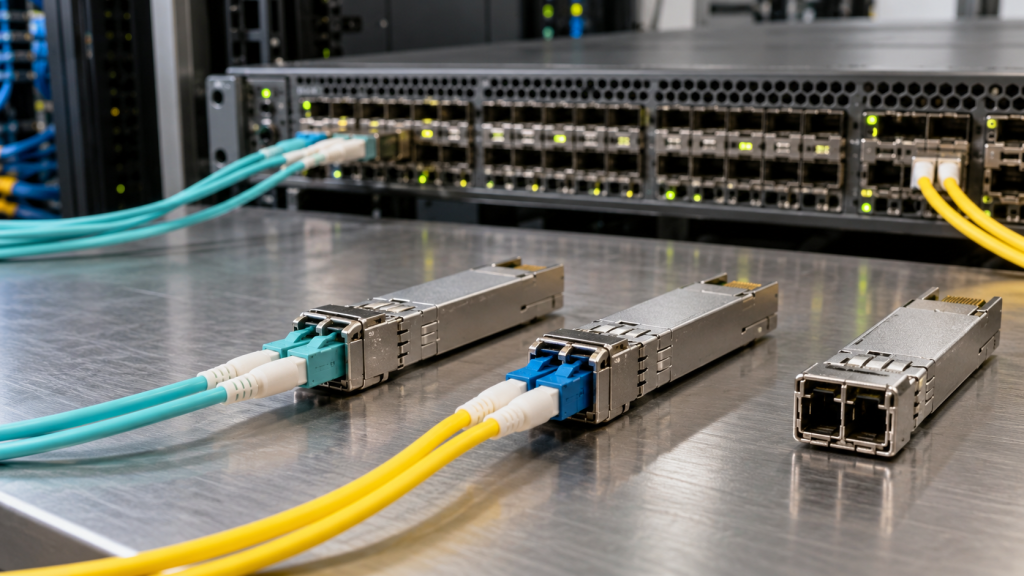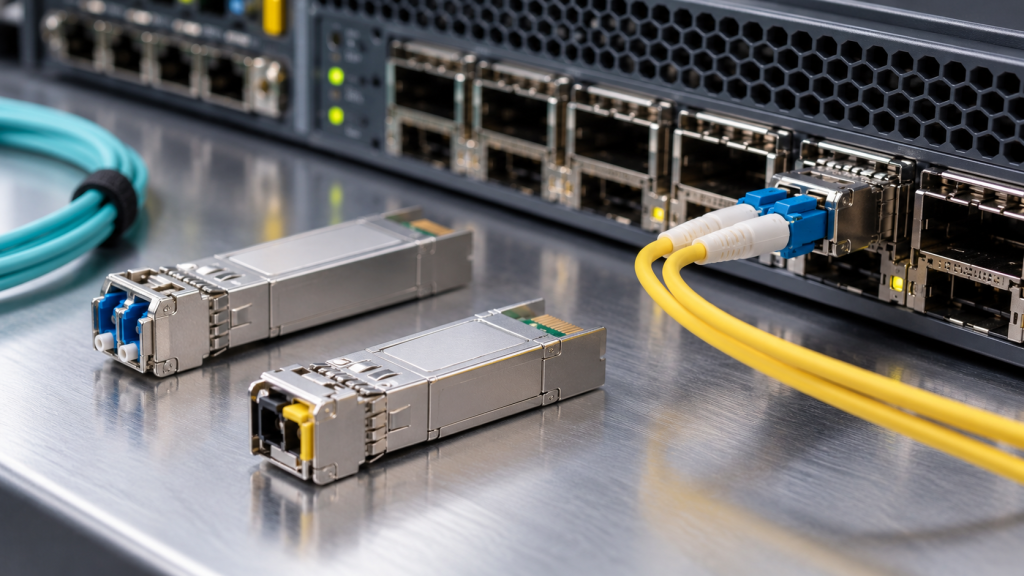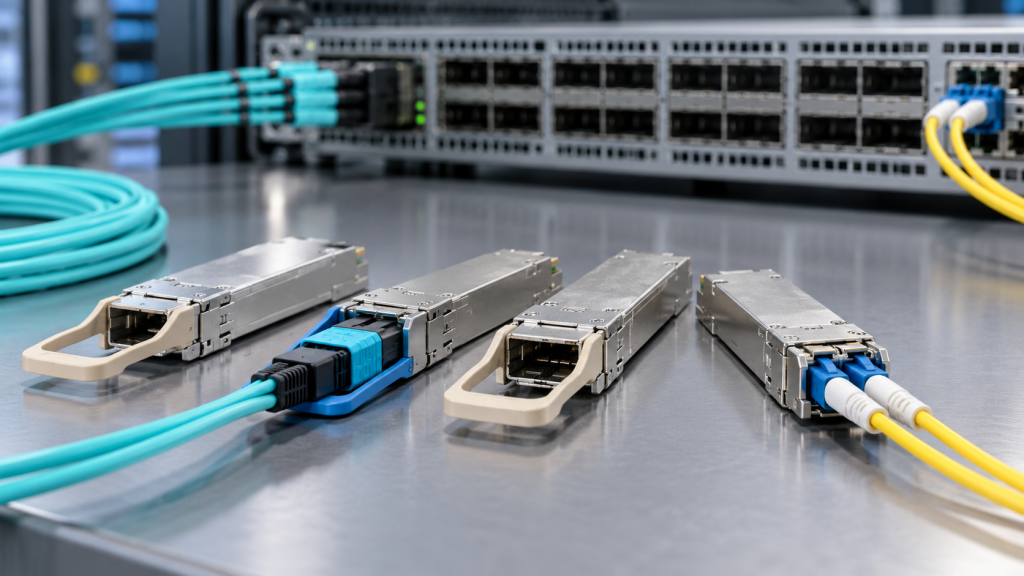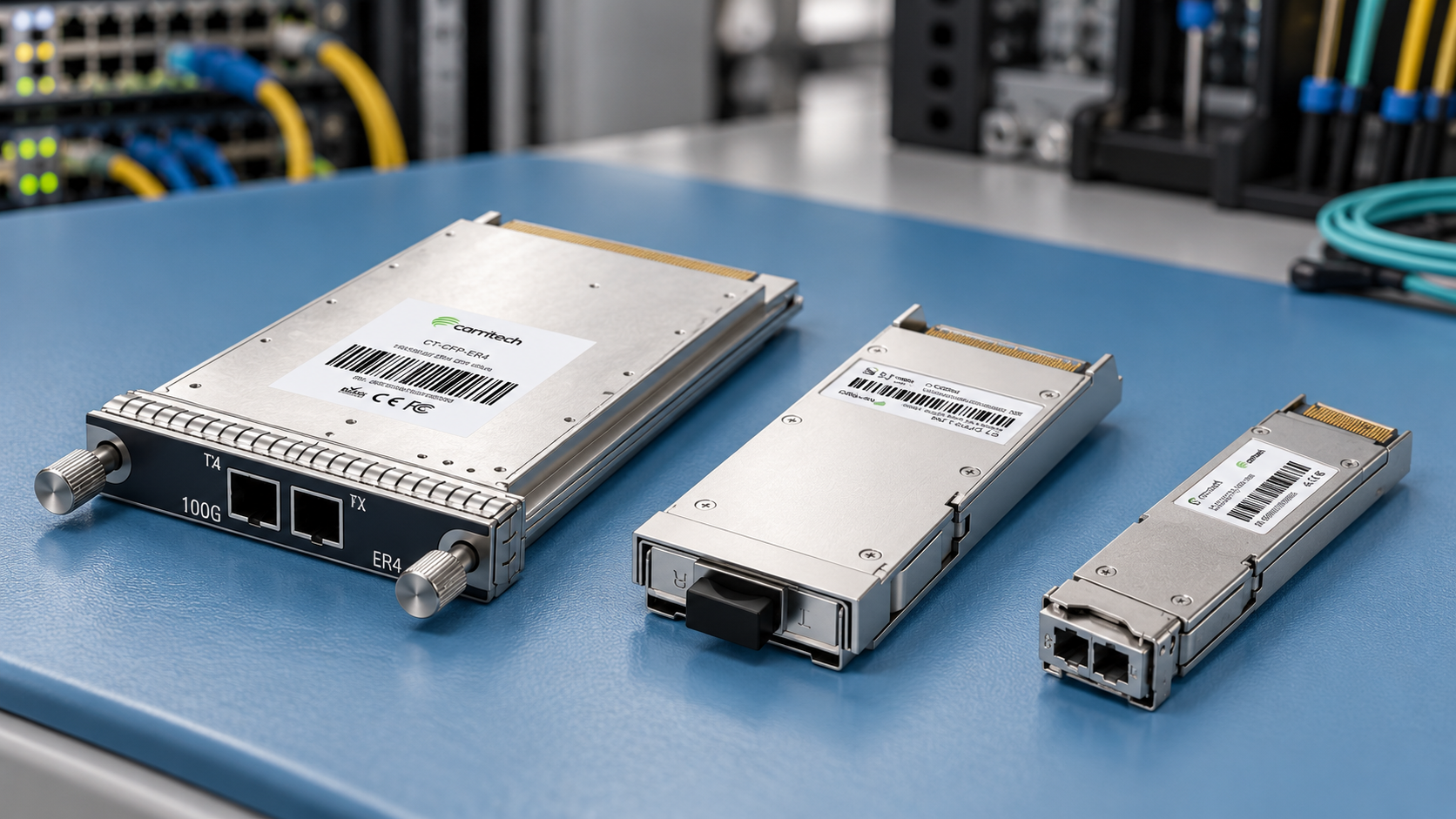
Nobody designs a new network around CFP. Nobody has for a decade. And yet CFP, CFP2 and CFP4 modules are still carrying production traffic in core routers, transport platforms, firewalls and aggregation switches all over Europe, because the line cards they plug into are expensive, they work, and nothing has given anybody a sufficiently good reason to rip them out.
That makes CFP an awkward thing to own. The modules are getting harder to buy from the original vendors, the lead times are getting worse, and the engineers who knew the quirks have mostly moved on to QSFP-DD. This guide covers what the three form factors actually are, how they differ, the one CFP variant that still has a future, what your options are if you own CFP line cards, and which modules fit what.
Where CFP came from
100 Gigabit Ethernet was standardised in IEEE 802.3ba, approved in June 2010. At that point nobody could build a 25G serial lane economically, so 100G was constructed as ten lanes of 10G — ten lanes on the electrical side, and on multimode, ten lanes of fibre each way.
Ten electrical lanes plus the optics and the thermal mass to run them needs a large package, and CFP — "C form-factor pluggable", the C from the Roman hundred — is what the industry produced. It is a big module by any standard: roughly 145 mm deep, 82 mm wide, 13.6 mm tall. You can hold one and feel the generation it came from.
Then 25G serial lanes arrived, 100G was rebuilt as four lanes of 25G, and each shrink of the electrical interface produced a smaller package: CFP2, then CFP4, then QSFP28 — which is where the market stopped, because QSFP28 was small enough to put 32 of them on a 1U switch. CFP8 exists for 400G and is a historical footnote; the 400G market went to QSFP-DD and OSFP instead.
The family, compared
| CFP | CFP2 | CFP4 | QSFP28 | |
|---|---|---|---|---|
| Approx. size (D × W × H) | 145 × 82 × 13.6 mm | 107.5 × 41.5 × 12.4 mm | 92 × 21.5 × 9.5 mm | 72 × 18.35 × 8.5 mm |
| Electrical interface | 10 × 10G (CAUI-10) | 10 × 10G or 4 × 25G | 4 × 25G (CAUI-4) | 4 × 25G |
| Management | MDIO | MDIO | MDIO | I²C |
| Typical max power | up to ~24 W | up to ~12 W | up to ~6 W | ~3.5 W |
| Ports per 1U, realistically | 4–8 | 8–16 | ~24 | 32–36 |
| Status | Legacy, support only | Legacy — except coherent | Legacy, never widely adopted | Current |
Carritech’s own CFP-family modules bear that progression out: the CT-CFP2-LR4 is specified under 9 W and the CT-CFP4-LR4 under 6 W for the same 100GBASE-LR4 interface over the same fibre to the same 10 km.
MDIO: the difference that actually bites
Every CFP-family module is managed over MDIO — the IEEE 802.3 Clause 45 management interface, a clocked two-wire bus with a 16-bit register model inherited from Ethernet PHY management. Every SFP, QSFP and QSFP-DD module is managed over I²C, with the byte-oriented memory map defined in the SFF specifications maintained through SNIA and, on the newest form factors, the OIF’s Common Management Interface Specification.
Three consequences worth knowing:
- Diagnostics look different. You still get temperature, voltage, bias current and optical power, but they live in a different register space, and tooling written against SFF-8472 or CMIS will not read a CFP without specific support. If a monitoring system reports nothing for your CFP ports, that is usually why.
- Coding is a different exercise. The vendor identification a host checks sits in MDIO registers rather than an I²C EEPROM page. The principle is identical — see transceiver coding explained — but the mechanics are not, and it is one reason CFP programming is a specialist job rather than a generic one.
- Adapters are not just mechanical. Putting a QSFP28 module into a CFP cage means translating MDIO to I²C as well as 10 lanes to 4, which is why a CFP-to-QSFP28 adapter is an active device, not a sleeve.
The optical interfaces, and the fibre trap
Three reaches cover almost all CFP-family deployment, and the names map onto the Ethernet convention you already know.
- Short reach, 850 nm multimode, 100 m. The CFP-era parts are predominantly SR10: ten lanes of 10G over a 24-fibre MPO ribbon. The QSFP28-era equivalent is SR4: four lanes of 25G over a 12-fibre MPO. Both are "100G short reach over multimode"; neither will plug into the other’s cabling. Check the connector and the fibre count on the specific part, not the category name — and if ribbon cabling is involved, read MPO polarity explained first.
- LR4, 1310 nm single-mode, 10 km. Four LAN-WDM wavelengths multiplexed onto a duplex LC pair. This is the workhorse of the CFP family and the reach most CFP ports are actually running. It is identical in optical terms to a 100G QSFP28 LR4 — only the package differs.
- ER4, 1310 nm single-mode, 40 km. Same four wavelengths, higher launch power, APD receivers, and a module that draws noticeably more. The reach comparison is in 100G ZR4 vs LR4 vs ER4.
Because an LR4 CFP and an LR4 QSFP28 are optically the same interface, a CFP port will happily light a link to a QSFP28 port at the far end. That matters more than it sounds: it means you can replace one end of a link at a time, which is the basis of any sane CFP exit strategy. Confirm the fibre type first — our guide to single-mode vs multimode fibre covers how to tell what you have — and work the optical link budget rather than trusting the datasheet kilometre.
CFP2-ACO and CFP2-DCO: the variant with a future
One corner of the CFP family is not legacy at all. CFP2 turned out to be the right size for a coherent transponder, and coherent optics in CFP2 are still being specified into transport networks today.
- CFP2-ACO — analogue coherent optics. The module carries the optics and the modulator; the digital signal processor stays on the host line card. Flexible for the system vendor, and a tight coupling between module and host.
- CFP2-DCO — digital coherent optics. The DSP moves inside the module, so the host sees a standard client interface and the coherent complexity is self-contained. This is the one that won, and the one still shipping.
CFP2-DCO is why CFP2 cages still appear on new transport hardware: the form factor has the volume and the power envelope to run a high-performance coherent DSP at reaches that a QSFP-DD coherent module cannot match. Where QSFP-DD and OSFP coherent pluggables have taken over is the data-centre interconnect end of the market, which is the argument in 400ZR vs OpenZR+ and data centre interconnect. If you are running DWDM on CFP2, our guides to CWDM vs DWDM and tunable transceivers cover the channel-planning side.
Why CFP4 never happened
Worth a short note, because it explains why CFP4 modules are so much harder to find than CFP or CFP2. CFP4 and QSFP28 arrived at roughly the same time, aimed at roughly the same job: a 4 × 25G 100G module small enough for high port density. QSFP28 was smaller, drew less power, used the same I²C management as every other pluggable in the rack, and was mechanically backwards-compatible with the QSFP+ cages switch vendors had already built in. CFP4 had a slightly larger power budget and no other advantage worth the trouble.
So the data centre went to QSFP28 essentially unanimously, and CFP4 ended up in a handful of router and transport platforms. Carritech holds seven CFP4 part numbers against forty in CFP, which is a fair reflection of how the market went. If you own CFP4 ports, you own a genuinely scarce supply line, and that is a sourcing risk worth planning around rather than discovering.
If you own CFP line cards: four options
1. Keep running them and source compatible modules
Usually the right answer. The line card works, the link works, and a tested compatible CFP costs a fraction of the OEM part — and in a growing number of cases is available when the OEM part is not. The relevant question is not whether the technology is current but whether the link does its job for the remaining life of the chassis. Our comparison of compatible optical transceivers and OEM covers the usual objections, and do third-party optical transceivers void your warranty? answers the one that always comes up.
2. Adapt the cage to QSFP28
A CFP-to-QSFP28 adapter or a CFP2-to-QSFP28 adapter lets a CFP or CFP2 port take a current-generation 100G QSFP28 module. That turns a scarce, expensive, high-power part into a commodity one, and it means the optics you buy for the old chassis are the same optics you will buy for the new one. Validate it on one port before you commit a design: the adapter has to satisfy the host’s management expectations as well as the electrical ones, and host support varies. Our adapters range also covers QSFP28-to-SFP28 and QSFP+-to-SFP+ for the same kind of problem a layer down.
3. Move the links, one end at a time
Because LR4 is LR4 regardless of package, a CFP port and a QSFP28 port interoperate. New leaf or spine hardware can be brought up against the existing CFP core without a flag day. This is the quiet advantage of a standards-defined optical interface, and it is why migration planning should start from the PMD type rather than the form factor.
4. Replace the line card
Sometimes correct, rarely cheap, and worth costing honestly: a QSFP28 line card buys density and power savings, but the optics for it are the smaller part of the bill. Run the numbers including the optics you already own.
Whichever you choose, do it before the decision is made for you. CFP is the textbook case of the problem described in your optics will go end-of-sale before your switch does: a chassis with years of service left and a module supply that is quietly drying up. The Ethernet Alliance‘s roadmap is a useful sanity check on where the industry’s attention actually is, and it is not on ten-lane 100G.
The CFP, CFP2 and CFP4 modules Carritech stocks
Seventy-four tested modules across the three ranges, coded for the platform they are going into. Grouped by OEM coding below.
Cisco and Cisco-coded
In CFP, CFP-100G-SR10 for short reach, CFP-100G-LR4 and its variants CFP-100G-LR4 and CFP-100G-LR4 at 10 km, and CFP-100G-ER4, CFP-100G-ER4 and CFP-100G-ER4-40KM at 40 km. In CFP2, CFP2-100G-SR10 and CFP2-100G-SR10-D3, CFP2-100G-LR4 and CFP2-100G-LR4, plus CFP2-100G-ER4 and CFP2-100G-ER4-D. Our guide to compatible optics for Cisco platforms covers the wider picture.
Arista
CFP-100GBASE-LR4, CFP-100GBASE-LR4, CFP-100GBASE-LR4, the second-generation CFP-GEN2-100GBASE-LR4, CFP-100G-LR4-AR, ARISTA-CFP-100GBASE-SR10, CFP-100GBASE-SR10 and CFP-100GBASE-ER4; in CFP2, CFP2-100GBASE-LR4, CFP2-100GBASE-SR10 and CFP2-100GBASE-ER4. See also Arista compatible optics.
Juniper
CFP-100G-LR4-JNPR, XCVR-CFP-100G-LR4 and the SRX-coded SRX-CFP-100G-LR4. For the rest of the Juniper range, see JNP-QSFP-100G-LR4 and Juniper QFX5120 compatible optics.
Nokia and Alcatel-Lucent
In CFP, 3HE04821AB, 3HE05935AA and 3HE06699AA for LR4, 3HE06699BA for ER4, plus NOK-CFP-100G-SR10-P and the 1830-series 3AL82066AA. In CFP2, 3HE08217AA and 3HE09255AA; in CFP4, 3HE09498AA and 3FE71994AA. These part numbers describe nothing on their face — our guide to Nokia compatible optics and 3HE part numbers explains why.
Huawei
In CFP, 02310YTB, 02310YTD, 02310YTE and 02311QNV. In CFP2, 02311AEM and 02311NCL. In CFP4, 02311QDF and 02311SVC.
Ciena, Nortel and transport platforms
160-9113-900 and 160-9115-900 in CFP, with 160-9300-900, 160-9301-900, 160-9310-900 and 160-9320-900 in CFP2, plus the Nortel-heritage NTTA03AA.
HPE, Dell, Extreme, Fortinet and others
HPE JG829B and JH289A; Dell DEL-CFP-100G-SR10-O; Mellanox-coded MEL-CFP-100G-SR10-P; the Brocade and Extreme family 100G-CFP-SR10, 100G-CFP-LR4-10KM, 100G-CFP-ER4-40KM, 100G-CFP2-SR10, 100G-CFP2-LR4-10KM, 10330 and 10331; and Fortinet FG-TRAN-CFP2-LR4 and FG-TRAN-CFP2-SR10.
The Carritech base parts
Behind every coding above sit nine optical designs — three reaches in three form factors. In CFP: CT-CFP-SR4 at 850 nm to 100 m, CT-CFP-LR4 using cooled LAN-WDM EA-DFB transmitters and PIN receivers to 10 km, and CT-CFP-ER4 to 40 km. In CFP2: CT-CFP2-SR4, CT-CFP2-LR4 (under 9 W) and CT-CFP2-ER4. In CFP4: CT-CFP4-SR4, CT-CFP4-LR4 (under 6 W) and CT-CFP4-ER4.
Nine optical designs, seventy-four part numbers. That gap is entirely vendor coding, and it is the stock problem set out in building a smarter transceiver stock strategy.
Five checks before you order
- Confirm the form factor from the cage, not the speed. CFP, CFP2, CFP4 and QSFP28 are all "100G" and none of them fit each other’s ports.
- Check the fibre and the connector. SR10 wants a 24-fibre MPO; SR4 wants 12; LR4 and ER4 want a duplex LC pair on single-mode.
- Match the coding to the platform. MDIO identification still has to satisfy the host, and the qualification is per-platform.
- Budget the power and the airflow. A fully-populated CFP card is a serious thermal load — the numbers are in optical transceiver power consumption.
- Decide your exit now. Compatible modules, an adapter, or a card replacement. All three are cheaper planned than urgent.
Keeping CFP ports supplied
Carritech Optics holds the 100G CFP, CFP2 and CFP4 range in UK and EU stock — browse 100G CFP, 100G CFP2 and 100G CFP4 directly, or the wider 100G transceiver range if a QSFP28 is where you are heading.
Every module is coded for the target platform and tested before despatch — see the 22 checks a module passes and our transceiver testing process — and carries a lifetime warranty. For multi-vendor estates, the Carritech Opticode coding box lets you hold one optical design per reach and code at the point of deployment.
Holding a list of CFP part numbers and a quote that has gone up again? Our compatibility checker returns the tested Carritech equivalent in seconds, or upload the whole list and we will price it. Working out whether an adapter or a module is the better answer for a given chassis? Tell us the platform and the line card and we will say — request a quote.