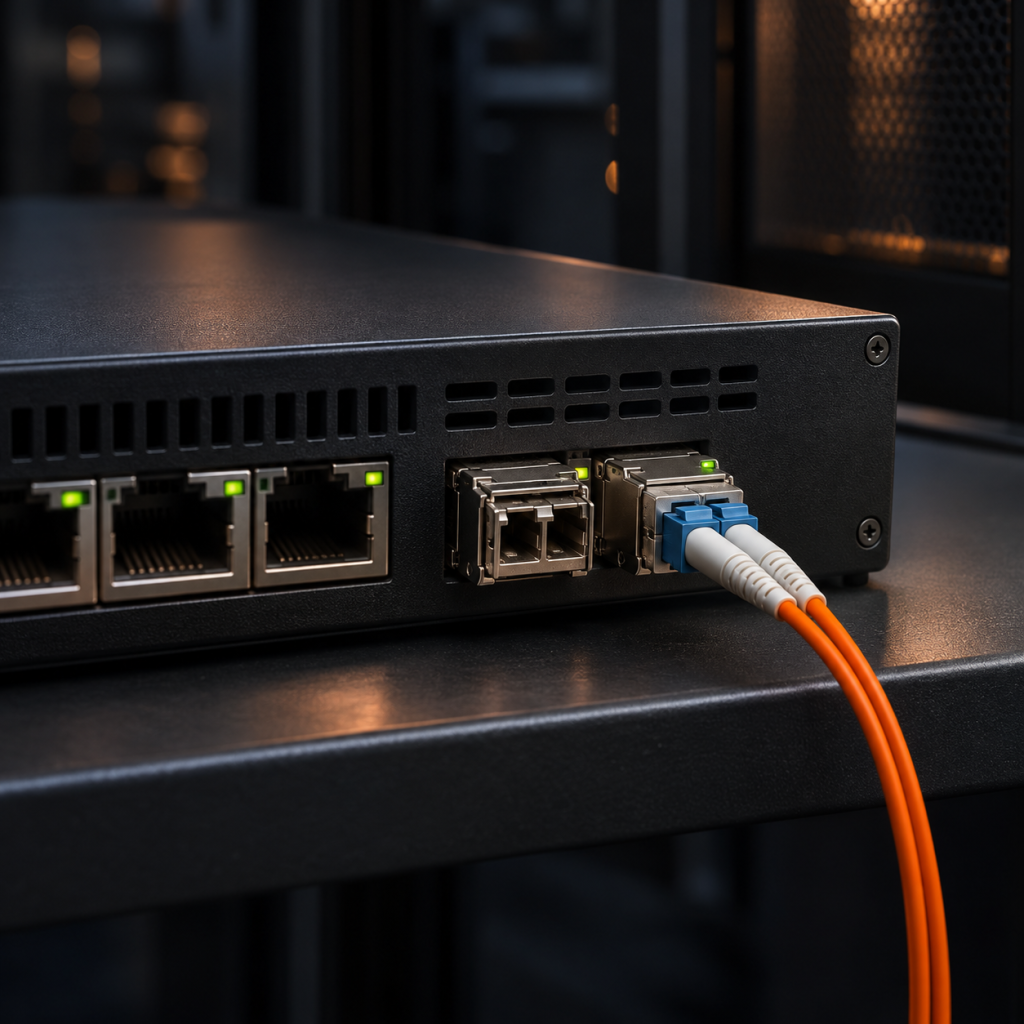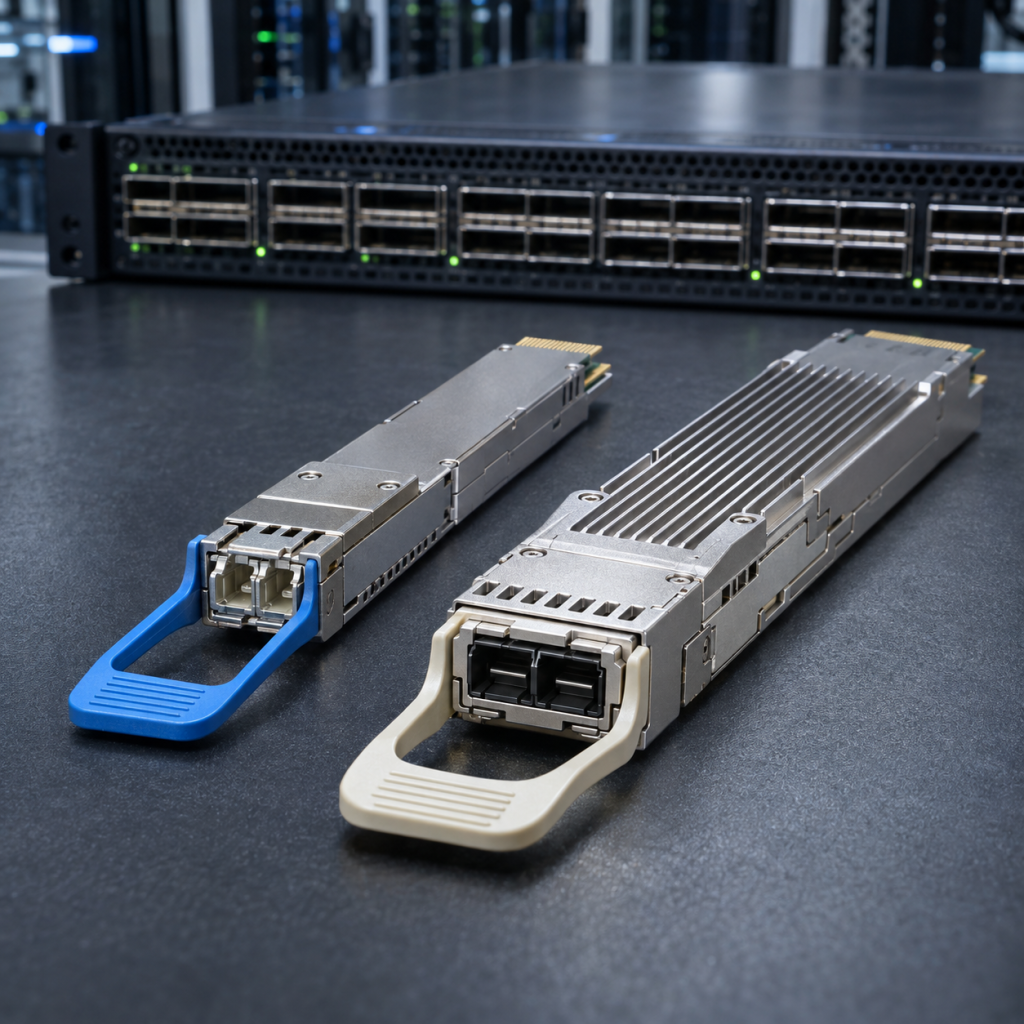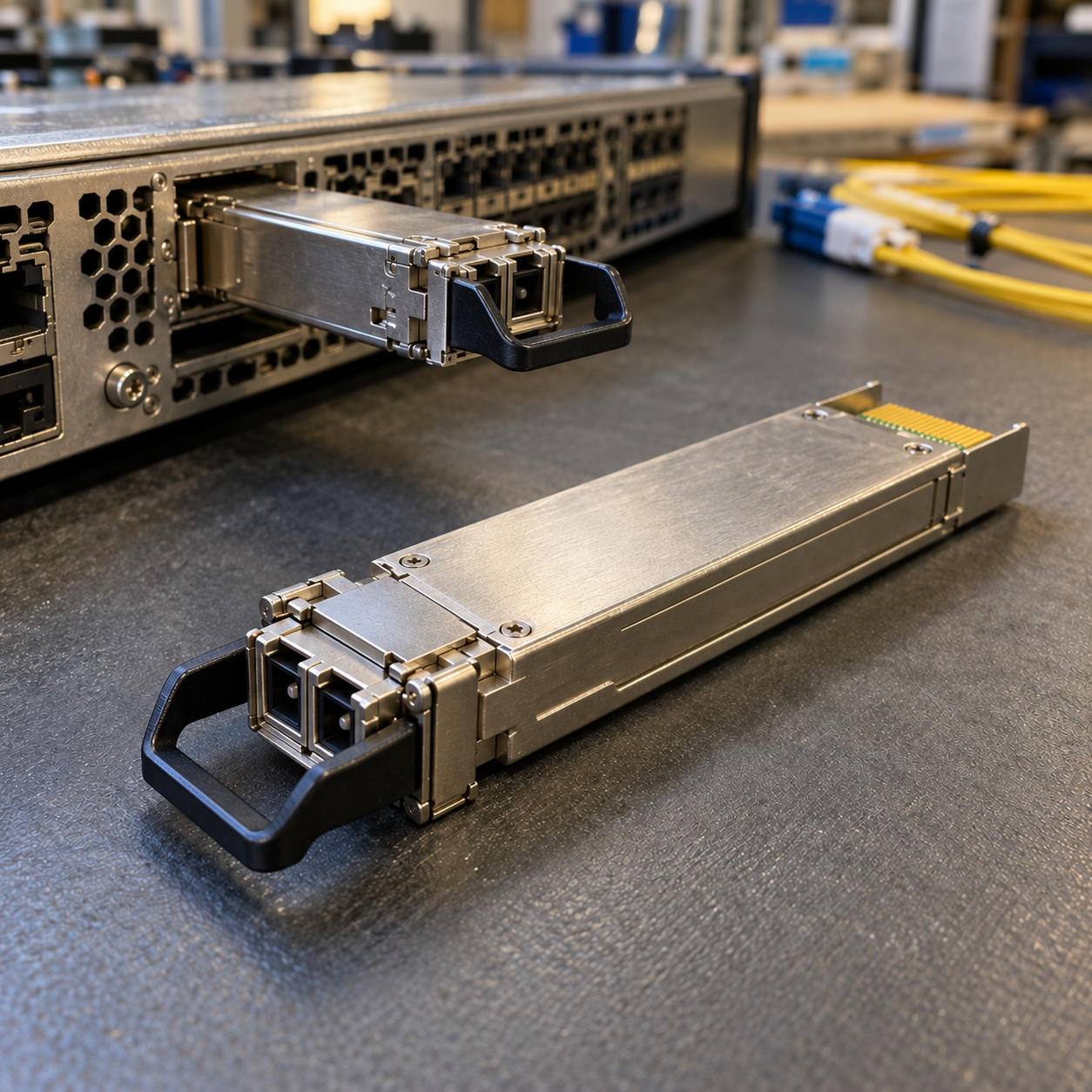
XFP is the form factor that did everything right and lost anyway. It arrived first, it was multi-protocol from the outset, it worked across a wider range of host platforms than its successor, and it is still carrying 10 gigabits in core routers, SDH and OTN transport shelves and firewall clusters across Europe. It also lost the volume market so completely that most engineers under forty have never held one.
What beat it was not performance. It was a decision about where to put one chip — and understanding that decision is the whole of what you need to know to buy XFP sensibly in 2026, because it explains the price, the power draw, the port density, why there is no adapter, and why the monitoring system shows you nothing.
This guide covers what XFP actually is, how it differs from SFP+ and why that matters commercially, the variants and their reach, the SONET, SDH and OTN support that is XFP’s surviving advantage, the CWDM and DWDM parts, the supply position — which is the real reason to read this — and which of the 77 part numbers in Carritech’s XFP ranges fits what.
What XFP is, and the one chip that decided everything
XFP is specified by the XFP MSA in document INF-8077i, published as a third-party specification by the SFF Committee and now held in the SNIA SFF specifications library. The specification covers the module, the cage, the electrical interface and a management memory map of its own.
The important part is the electrical interface. An XFP module takes a single 10 Gb/s serial electrical lane — the XFI interface — and contains its own clock and data recovery circuit. The module retimes the signal. Everything needed to clean up the electrical path lives inside the pluggable.
SFP+ made the opposite choice. It moved the retimer out of the module and into the host, leaving the module as a far simpler, largely analogue device driven across the SFI interface. Three consequences follow, and all three are commercial rather than technical:
- SFP+ is smaller, so you get more ports. An SFP+ cage is roughly the footprint of a 1G SFP. XFP is appreciably larger. On a 1U face that is the difference between 48 ports and about half as many, and port density is what switch vendors sell.
- SFP+ is cheaper and cooler, because the expensive part is amortised. One retimer in the host serves every port. XFP pays for a retimer per module, every time. Carritech’s long-reach XFP parts are specified at under 3.5 W; the equivalent SFP+ parts sit under 2 W.
- XFP is more host-agnostic, and that is why it survives. A module that cleans up its own signal asks less of the board it plugs into. For transport platforms, ruggedised hardware and anything with a long design life, that was — and is — worth paying for.
One practical side effect is worth knowing before you go looking for diagnostics. XFP is managed against the memory map in its own specification, not against the SFF-8472 map that SFP and SFP+ modules use. Monitoring systems that were written for SFP+ frequently report nothing at all for an XFP port — no temperature, no optical power, no laser bias. The module is almost certainly reporting; the collector does not know how to ask. If you are troubleshooting an XFP link and the diagnostics are blank, suspect the monitoring system before the optic. Our guide to spotting a failing fibre link before it drops covers what you should be able to see.
XFP and SFP+ are not interchangeable, and there is no adapter
This needs saying plainly because people lose time to it. The cages are different sizes with different pinouts and different electrical expectations. An XFP module does not fit an SFP+ port, an SFP+ module does not work in an XFP port, and no mechanical adapter resolves it — the host would still have to supply the wrong electrical interface. The cage on the line card decides which family you are buying, and nothing else does.
What is interchangeable is the optical interface, and this is the single most useful thing in this guide. An XFP 10GBASE-LR and an SFP+ 10GBASE-LR are the same 1310 nm interface from the same standard. They link to each other. So do the two SR parts, and the two 1550 nm ER parts. That means you can replace one end of a link at a time: a new SFP+ switch at the aggregation end will talk happily to the XFP line card you have not replaced yet, provided the optical interface matches on both sides. It is the same argument we make for CFP, CFP2 and CFP4, and it is what makes a staged migration possible rather than a big-bang one.
The XFP variants, compared
Read the standard column as carefully as the reach column. The first three rows are IEEE 802.3 port types. Everything below them is an industry design, and three of those have names that look exactly like IEEE ones.
| Variant | Optics | Fibre and connector | Reach | Standard |
|---|---|---|---|---|
| SR | 850 nm VCSEL, PIN | Multimode, duplex LC | 300 m on OM3 | IEEE 802.3ae |
| LR | 1310 nm uncooled EML, PIN | Single-mode, duplex LC | 10 km | IEEE 802.3ae |
| ER | 1550 nm cooled EML, PIN | Single-mode, duplex LC | 40 km | IEEE 802.3ae |
| ER-1310 | 1310 nm cooled EML, PIN | Single-mode, duplex LC | 40 km | Vendor design |
| ZR | 1550 nm EML | Single-mode, duplex LC | 80 km | Vendor design |
| EZR | 1550 nm cooled | Single-mode, duplex LC | 100 km | Vendor design |
| XZR | 1550 nm cooled CML, APD | Single-mode, duplex LC | 120 km | Vendor design |
| BiDi | Paired wavelengths, one strand | Single-mode, simplex LC | 10–100 km | Industry design |
| CWDM | 1470–1610 nm, 20 nm grid | Single-mode, duplex LC | 40 or 80 km | ITU-T G.694.2 grid |
| DWDM | C-band, 100 GHz grid | Single-mode, duplex LC | 40 or 80 km | ITU-T G.694.1 grid |
| Tunable DWDM | C-band, 50 GHz grid | Single-mode, duplex LC | 80 km | ITU-T G.694.1 grid |
The three IEEE rows come from IEEE Std 802.3ae-2002, approved in June 2002 — the amendment that created 10 Gigabit Ethernet in the first place. IEEE 802.3aq-2006, approved on 15 September 2006, added 10GBASE-LRM for legacy multimode plant; there is no LRM part in the XFP range, and if you need one it is an SFP+ purchase.
Four things worth knowing before you order
1. ER is 1550 nm, and there is a 1310 nm part that is not it
10GBASE-ER under 802.3ae is a 1550 nm interface reaching 40 km, and CT-XFP-ER is built that way with a cooled EML transmitter. Alongside it sits CT-XFP-ER-1310, which is also 40 km but at 1310 nm — a vendor design that exists because some systems want the whole estate on one wavelength plan.
Both are legitimate parts. They are not interchangeable, and a 1550 nm module will not link to a 1310 nm one however good the fibre is. Check the wavelength at both ends of every 40 km order, not the suffix. The same trap exists one speed up in the opposite direction: 25GBASE-ER is a 1310 nm interface, as our guide to 25G SFP28 transceivers sets out.
2. ZR, EZR and XZR are not IEEE interfaces
802.3ae stops at ER’s 40 km. There is no 10GBASE-ZR, and no 100 km or 120 km 10G port type either. The 80, 100 and 120 km modules that everybody sells — and the demand for them is real — are industry designs built by driving a 1550 nm transmitter harder and improving the receiver. Carritech’s CT-XFP-XZR is the clearest example: a cooled CML laser and an avalanche photodiode receiver, 120 km, under 3.5 W.
Two things follow. Cross-vendor interoperability is a matter of specification overlap rather than standards compliance, so compare launch power and receiver sensitivity instead of assuming two parts labelled "ZR" will work together. And a sensitive receiver overloads as easily as it reaches: a 120 km module on a 10 km span can be saturated by its own far end, and the symptom looks exactly like a dirty connector. Work the optical link budget for the real route on ITU-T G.652 fibre, and read fibre optic connector cleaning before you reach for an attenuator, because it is the cheaper decibel.
3. There is no FEC at 10G, and that works in your favour
10GBASE-R over fibre runs no forward error correction. At 25G it is a configuration choice and the two ends can be set to disagree. At 100G and above it is mandatory and permanently on, so a healthy port shows a steadily climbing corrected-codeword counter. At 10G neither applies: an error counter means what it appears to mean. A rising count is a real fault in the optical path that you can go and find, and a clean counter is a genuinely clean link rather than one whose errors are being quietly repaired. Our guide to forward error correction explains why that stops being true one generation up.
4. The SR reach figure depends on a fibre grade nobody recorded
CT-XFP-SR is specified at 300 m, which is the OM3 figure. On OM4 the same optic reaches further; on OM2 it is roughly 80 m, and on the OM1 that fills older buildings about 33 m. That is a twelve-fold spread across cable that looks identical behind a patch panel. If you are extending an existing multimode run rather than installing new fibre, establish the grade first — single-mode vs multimode fibre covers how to tell.
The real reason XFP is still specified: SONET, SDH and OTN
This is the part of the story that gets left out of form-factor comparisons, and it is why XFP remains a current product rather than a legacy one.
XFP was designed as a multi-protocol 10G module, not an Ethernet module. The same part carries 10 Gigabit Ethernet, 10G Fibre Channel, OC-192 and STM-64 under ITU-T G.707, and OTU-2 under ITU-T G.709. Carritech’s base designs are specified for all of it: CT-XFP-LR, CT-XFP-ER and CT-XFP-ZR are each documented for 10G Ethernet, SONET/SDH and Fibre Channel transport from the same module.
You can read that straight off the part numbers. A large share of the Cisco-coded XFP range in the list below carries an OC-192 or 192IR designation rather than an Ethernet one — XFP-10GLR-OC192SR, XFP-10GZR-OC192LR, XFP-10GER-192IR+ — and several more carry an RGD suffix marking a ruggedised design for environments a data-centre module would not survive. Those parts are not in service because somebody failed to upgrade. They are in service because the transport shelf they sit in is a twenty-year asset doing a job Ethernet does not do.
The practical consequence for buying is that protocol support is a specification you have to check, not an assumption. An Ethernet-only 10G module in an SDH shelf will not work, and the part numbers do not always make the distinction obvious. Tell us the platform and the framing and we will confirm it.
BiDi XFP: a wavelength pairing, not a form factor
A duplex module assumes two fibres, one for each direction. Where only a single strand is available — which in access and municipal networks is most of the time — a BiDi part puts one wavelength each way down one fibre, with a simplex LC on the front.
The rule that catches everybody: BiDi modules are sold in matched upstream and downstream halves, and two of the same half will never link. A 1270/1330 nm pair means one end transmits at 1270 and receives at 1330 while the other does the reverse. Order two upstream parts and you have two modules that cannot hear each other.
The second thing worth knowing is that the pairing is an optical property, not a mechanical one. What has to match is the wavelength plan and the reach budget. The form factor at each end does not: an XFP upstream half will link to an SFP+ downstream half on the same wavelength pair, which is exactly the arrangement you want when one end of the link is an older transport shelf and the other is a modern access switch. Carritech’s range reflects that pattern — the XFP halves are upstream parts, and the downstream halves they pair with are SFP+. Our guides to BiDi transceivers and 10G BiDi XFP cover the mechanics, and the 10G BiDi XFP and 10G BiDi SFP+ ranges hold both sides.
Six XFP upstream designs cover 10 to 100 km: CT-XFP-BX-10U, CT-XFP-BX-20U, CT-XFP-BX-40U, CT-XFP-BX-60U, CT-XFP-BX-80U, CT-XFP-BX-100U. The SFP+ downstream halves they pair with are CT-SFP+BX-10U, CT-SFP+BX-20U, CT-SFP+BX-40U, CT-SFP+BX-60U, CT-SFP+BX-80U, CT-SFP+BX-100U and their D counterparts — tell us the reach and the wavelength plan and we will supply a matched pair rather than leaving you to work out which half is which.
CWDM, DWDM and tunable XFP
Where the fibre is in the ground and there is not enough of it, coloured optics multiply what you already own instead of trenching more. At 10G in an XFP package that is a transport-network purchase rather than a data-centre one, and the grids are ITU’s rather than IEEE’s.
- CWDM follows the 20 nm wavelength grid in ITU-T G.694.2, the current edition of which dates from December 2003. CT-XFP-CWXX-40 and CT-XFP-CWXX-80 cover the 1470–1610 nm channels at 40 and 80 km. Wide channel spacing means a cheaper, cooler laser with no wavelength locking to maintain.
- DWDM follows the frequency grid in ITU-T G.694.1, current edition October 2020. CT-XFP-DWXX-40 and CT-XFP-DWXX-80 cover C-band channels 16 to 61 on the 100 GHz grid, with a cooled EML transmitter and — at 80 km — an APD receiver.
- Tunable DWDM is the inventory answer. CT-XFP-TDWXX-80 covers the full 50 GHz C-band plan from one part number at 80 km, which turns a forty-line-item spares holding into one. The case is made properly in why tunable optics reduce complexity in DWDM networks and tunable DWDM XFP.
If the module is going into somebody else’s transmission system — which is the normal case for a third-party coloured optic — the governing document is ITU-T G.698.2, "Amplified multichannel dense wavelength division multiplexing applications with single channel optical interfaces", current edition November 2018. It specifies the single-channel interface at each end of a line system whose internals are treated as a black box, which is what turns "will your optic work in our DWDM network" from a gamble into a design exercise with numbers in it. CWDM vs DWDM covers the choice between grids, 10G CWDM XFP the CWDM parts, and 10G DWDM and CWDM SFP+ the same decision one form factor along.
Supply is the thing that will actually bite you
Everything above is engineering. This is the part that costs money.
XFP is the most supply-exposed range on this site. It was displaced from volume manufacturing more than a decade ago, the vendors still building it are fewer every year, and the parts that go first are precisely the ones hardest to design around: the long-reach optics, the ruggedised variants, the coloured channels and anything with an OC-192 coding. Meanwhile the line card it plugs into has another decade of service in it, and replacing that line card usually means replacing the shelf.
That asymmetry — a twenty-year chassis and a ten-year module — is the subject of your optics will go end-of-sale before your switch does, and XFP is further into it than anything else we stock. Two things help. The first is buying a tested compatible design instead of chasing a withdrawn OEM part number, which is the ground covered in compatible optical transceivers vs OEM and OEM compatible vs OEM branded. The second is reducing how many distinct part numbers you have to hold at all: seven optical designs cover every duplex XFP part number below, and the difference between them is the identification string in the EEPROM. That is the argument in building a smarter transceiver stock strategy, and the reason the Carritech Opticode coding box exists.
Six checks before you order
- Confirm the cage is XFP, not SFP+. They are not interchangeable and no adapter exists. If the far end is SFP+, match the optical interface instead and replace one end at a time.
- Confirm the protocol, not just the speed. 10G Ethernet, 10G Fibre Channel, OC-192/STM-64 and OTU-2 are different jobs, and the part number does not always say which.
- Check the wavelength on 40 km parts. IEEE ER is 1550 nm; there is also a 1310 nm 40 km design, and the two will not link to each other.
- Check the short spans on long-reach parts. An 80, 100 or 120 km receiver can be overloaded by a link that is too short.
- For BiDi, order a matched pair. Two upstream halves will never link, and the pairing is set by wavelength rather than form factor.
- Match the coding to the platform — see transceiver coding explained. A correct optic with the wrong identification string is a module the host will refuse.
The XFP modules Carritech stocks
Seventy-seven tested part numbers across the five XFP ranges. Fifty-nine of those are XFP modules; the other eighteen are the SFP+ halves of BiDi pairs, held alongside them because that is how the pairs are bought. Every part is coded for the platform it is going into and measured against its specification before despatch. Grouped by OEM coding below.
Cisco and Cisco-coded
XFP-10G-MM-SR, XFP-10G-S, XFP-10GE-ER, XFP-10GE-LR, XFP-10GE-SR, XFP-10GER-192IR+, XFP-10GLR-OC192SR, XFP-10GZR-OC192LR, XFP10GER-192IR-L, XFP10GER192IR-RGD, XFP10GLR-192SR-L, XFP10GLR192SR-RGD, XFP10GZR192LR-RGD, XFP-10G-CBANDT50-ZR. Note the shape of this group: more than half of it is transport coding rather than Ethernet coding, and three parts carry the RGD ruggedised designation. XFP-10G-CBANDT50-ZR is the tunable C-band part on the 50 GHz grid. Platform guidance is in compatible optics for Cisco platforms and the Cisco optics reference guide.
Juniper
EX-XFP-10GE-ER, EX-XFP-10GE-LR, EX-XFP-10GE-SR, EX-XFP-10GE-ZR. The EX- prefix marks the switching-platform coding; Juniper QFX5120 compatible optics covers how Juniper’s schemes line up.
HPE, Aruba and H3C
Duplex: JD088A, JD107A, JD108B, JD117B, JD121A. DWDM: JG226A, JG227A, JG228A, JG229A, JG230A, JG231A, JG232A, JG233A — eight fixed C-band channels, which is a complete small DWDM plan in one coding. BiDi: JL738A, JL740A, R9X54A, S6H20A, S6H22A, which are the SFP+ halves noted above. The J, JD, JG, JL, R9X and S6H series span three decades of HPE, ProCurve, Aruba and H3C acquisitions, which is why one optical design turns up under so many unrelated strings.
Nokia
Duplex: 3HE00564AA, 3HE00566AA, 3HE00566CA. BiDi: 3FE48235AB, 3FE55744AA, 3HE05037AB. The 3HE and 3FE schemes describe nothing on their face — Nokia compatible optics and 3HE part numbers explains how they are constructed.
Palo Alto Networks
PAN-XFP-LR, PAN-XFP-SR. Appliances are all-fibre and the things either side of them often are not, which is why firewall codings come up as often as switch ones.
Extreme, Brocade and Ruckus
10G-SFPP-BXD-ER, 10G-SFPP-BXD-S, 10GB-BX10-D, 10GB-BX40-D — all four the downstream SFP+ halves of BiDi pairs.
Vendor-neutral and component codings
10G-XFP-ER, 10G-XFP-LR, 10G-XFP-SR, 10G-XFP-ZR, and the tunable DWDM part 10200.
The Carritech base parts
Seven duplex optical designs sit behind every duplex part number above. In order of reach: CT-XFP-SR, 850 nm VCSEL and PIN receiver over multimode, quoted at 300 m on OM3; CT-XFP-LR, a 1310 nm uncooled EML to 10 km and the most-ordered single-mode design in the range; CT-XFP-ER, 1550 nm cooled EML to 40 km, the IEEE extended-reach interface; CT-XFP-ER-1310, the same 40 km on 1310 nm for estates that want one wavelength plan throughout; CT-XFP-ZR to 80 km; CT-XFP-EZR to 100 km; and CT-XFP-XZR to 120 km on a cooled CML laser with an APD receiver, under 3.5 W. All are specified for 10G Ethernet, SONET/SDH and Fibre Channel, and all report full digital diagnostics.
Alongside them: six BiDi upstream designs from 10 to 100 km, two CWDM designs at CT-XFP-CWXX-40, CT-XFP-CWXX-80, two fixed DWDM designs at CT-XFP-DWXX-40, CT-XFP-DWXX-80 covering channels 16 to 61, and the tunable CT-XFP-TDWXX-80 covering the whole 50 GHz plan from one part number.
Seventeen designs, seventy-seven part numbers. In a range this exposed to supply, that ratio is the point: holding one design per reach and coding at the point of deployment with the Opticode coding box turns a cupboard full of dead OEM stock into a handful of live line items.
Keeping XFP ports supplied
Carritech Optics holds the 10G range in UK and EU stock. Browse 10G duplex XFP, 10G BiDi XFP, 10G CWDM XFP, 10G DWDM XFP and 10G tunable DWDM XFP directly, or the whole XFP family. If the far end is SFP+, the 10G duplex SFP+ range and our guide to 10G duplex SFP+ transceivers are the other half of the picture, and the 16G Fibre Channel range covers storage fabrics. Inside the rack, the 10G SFP+ DAC and 10G SFP+ AOC ranges are cheaper than two modules and a patch lead — see DAC and AOC cables. Patch cords, copper SFPs and adapters and media converters are alongside.
Every module is coded for the target platform and measured against its specification before despatch — see the 22 checks a module passes and our transceiver testing process, which verifies the launch power and receiver sensitivity a 120 km link lives or dies by — and carries a lifetime warranty, with UK and EU stock and support behind it. On the procurement questions, compatible optical transceivers vs OEM, OEM vs compatible: cost, risk and performance compared and do third-party optical transceivers void your warranty? answer them straight, and our accreditations, why choose us and support pages cover how we work. The knowledge centre holds the rest of the technical library.
Chasing a withdrawn XFP part number, or working out whether a new SFP+ switch will talk to the XFP line card at the other end? Tell us the platform, the framing and the distance and we will say. Our compatibility checker returns the tested Carritech equivalent of an OEM part number in seconds, upload a whole part-number list and we will price it, or request a quote.